
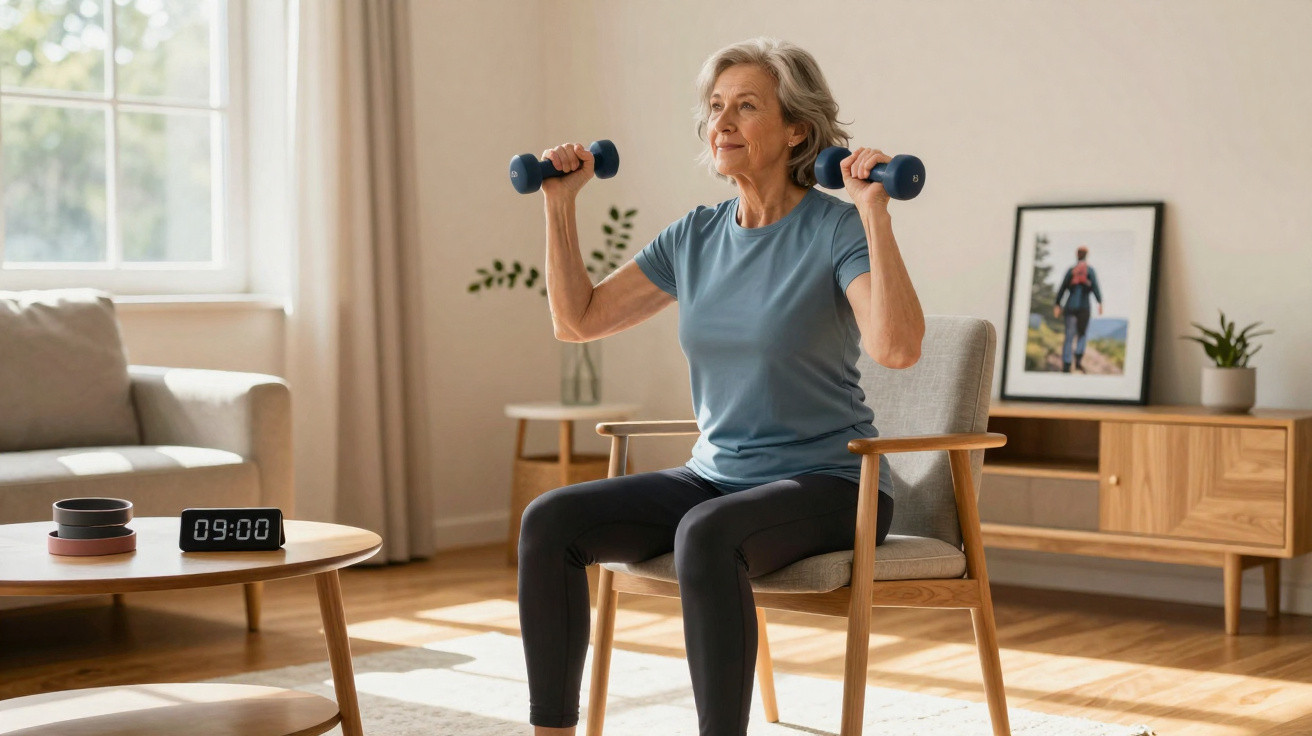
There’s a moment that plenty of us recognise, but rarely say out loud.
It could be the first time you can’t quite heave a suitcase into the overhead locker. Or the day you realise getting up from the sofa now seems to require a little push from your hands. Nothing dramatic, no injury - just a low-level realisation: “Oh. I’m not as strong as I used to be.” It shows up on the stairs when your legs feel oddly weighted, or when a jar lid wins and gets put back in the cupboard untouched.
Most of us stick these moments in the folder marked “getting older” and carry on. We might make a joke, we might shrug, but underneath there’s often a small shiver of worry: Is this the beginning of the slide? That’s why research involving 62-year-olds, a stopwatch and a nine‑minute exercise routine has been attracting attention in scientific circles. It hints that what we assume about age-related muscle loss may need a proper rethink.
The quiet thief: when muscle starts slipping away
Clinicians call it sarcopenia, but to most people it’s simply the gradual draining away of strength that tends to arrive in our 50s and 60s. It doesn’t happen overnight - you don’t wake up and find you’ve lost half the muscle you had at 30. It’s more like a quiet thief that takes a little each year, until one day you notice what’s missing. Your clothes may fit the same and the scales might barely change, yet your body feels different when you lift, push or carry.
This isn’t about vanity; it’s about usefulness. It’s the practical stuff: getting out of a chair, picking up a grandchild, keeping your independence.
Doctors see where it can lead in the numbers: more falls, longer recoveries after surgery, and people who stop trusting their own bodies and begin avoiding activity. Once that loop starts, it accelerates. You move less because you feel weak, then you become weaker because you move less. Most of us have had the thought, “If I fall now, will I be able to get back up?” and then brushed it off with a laugh, hoping the answer is yes.
For years, the unofficial story has sounded like this: decline is inevitable. Muscles shrink, nerves don’t fire as efficiently, hormones shift, and that’s that. Exercise might “delay” it, but the tone is still one of mild resignation. But what if that’s only part of the truth? What if a meaningful share of the loss is down to neglect rather than fate?
The study that challenged the script
A research team - the kind of quietly meticulous scientists who thrive on clipboards and stopwatches - set out to test what might happen if older adults followed a strength plan that was both specific and very short.
They weren’t studying seasoned gym-goers. The participants were ordinary people in their 60s and early 70s - the sort you’d pass in the supermarket, not the sort you’d expect on a fitness magazine cover. The average age was 62. Some had aches, some carried blood pressure tablets, and all shared the same reality: they were getting weaker.
Rather than prescribing a grand, one‑hour‑a‑day routine that few people could sustain, the researchers went the other way. Nine minutes. A small set of movements. Repeated a few times a week. Something you could slot in while the kettle boils and the news chatters on in the background. Let’s be honest: daily 45‑minute home workouts don’t fit most lives.
They tested leg strength, grip and everyday function - including repeated chair stands. Then they gave participants the routine, asked them to follow it and keep track, and brought them back for re-testing. What followed wasn’t a miracle, but it was quietly striking.
What a 9-minute protocol actually looks like
Short, sharp, and very focused
The plan didn’t rely on fancy equipment or complicated sequences. It centred on straightforward strength exercises that almost anyone can learn, adapted to suit each person’s ability. Picture sit‑to‑stand from a chair, wall push‑ups, slow and controlled calf raises, plus a few carefully selected leg movements.
Most of the work was interval-based: around 30–40 seconds of effort, a short pause, then repeat. Long enough that the muscles truly have to work, but not so long that it becomes daunting.
In total, it took about nine minutes - not “nine minutes if you’re a triathlete with perfect technique”, but nine minutes for real people who stop to breathe, reset their stance, and shake out their hands. Some began at the most basic level: hands on the chair for stability, shallow knee bends, gradually building capacity. The key wasn’t how impressive it looked, but the repeated message to the body: you’re still needed.
The uncomfortable but crucial bit
One requirement mattered: the exercises had to feel “challenging”. Not painful, but genuinely hard in the final seconds of each effort. You know the moment when your thighs start arguing and your brain offers several excellent reasons to stop? That moment. That’s where the useful stimulus for muscle fibres happens - even at 62 or 72.
For many participants, part of the process was relearning what “challenging” actually feels like, because ageing often nudges us to hold back. The researchers stayed cautious: they checked blood pressure, watched for pain, and adjusted repetition targets as needed. This wasn’t a macho trial of toughness; it was carefully dosed stress, applied in small, precise amounts. Over time, those small doses began to accumulate.
What changed in those 62-year-old bodies
Within a few weeks, the results on paper had shifted. Strength measures moved in the right direction: increased leg power, improved grip, quicker times for getting up from a chair and walking a short distance. Some people who had struggled to stand repeatedly without using their hands could do so with far more ease.
These aren’t achievements you’d necessarily brag about in the pub, but in day-to-day life they’re enormous. They can be the difference between dreading the stairs and simply… taking them.
There were changes that didn’t fit neatly into a spreadsheet as well. A few volunteers said they felt “more solid” underfoot when stepping off a bus or walking over uneven pavements. Others noticed the small, ordinary wins: carrying the shopping without stopping, feeling less drained by the end of the day. One woman described the oddly satisfying moment of opening a stiff window latch without needing to call her partner over. That quiet click felt like a private triumph.
Biologically, the rationale is more encouraging than many people assume. Even in our 60s and 70s, muscle can still respond by developing thicker, stronger fibres when it’s challenged in the right way. The nervous system can also improve how effectively it recruits those muscles. The changes aren’t as dramatic as they might be at 25, but they are real. The old narrative said, “It’s all downhill.” The data’s reply is: “Not if you train.”
The emotional side of getting stronger again
More than just biceps
What stood out to the researchers wasn’t only the improved scores, but how participants seemed to inhabit their bodies differently. Regaining strength has a way of showing up in posture, confidence and how you move through a room. One person said she felt less “fragile”, as though a thin glass layer around everyday life had thickened.
Ordinary actions began to feel less loaded with risk: reaching up to a high shelf, stepping into the bath, crossing a wet floor.
We often talk about muscle as though it’s mainly for appearance or sport. For older adults it’s tied to identity and freedom - being able to say yes when a friend suggests a walk, or getting down on the floor with a toddler and knowing you’ll stand back up again without a minor production. That isn’t vanity; it’s dignity. When you trust your body more, your world expands.
The “I thought that ship had sailed” moment
Several participants admitted they’d assumed any physical improvement was behind them. Maintenance, perhaps. Slowing decline, maybe. But actual progress? That felt like something reserved for the young.
Discovering that their legs could become stronger at 62 - not merely weaken more slowly - was a quiet jolt.
That’s what lingers. It isn’t only the 9‑minute protocol; it’s what it symbolises. A move from passive decline to active agency. A sense that the next decade isn’t just something your body does while you look on, but something you can influence, even with small, time-efficient habits. Not everyone will choose that path, but having the option matters.
So what does this look like in real life?
It’s easy to picture a completely ordinary morning. The kettle is humming, grey light sits softly at the kitchen window. Instead of scrolling aimlessly or waiting for the water to boil, someone pulls out a sturdy chair and does 30 seconds of sit‑to‑stand. Then 30 seconds of rest. Repeat. Next comes a set of gentle wall push‑ups, a round of supported calf raises, and a timed practice of getting up from the floor safely. Nine minutes, then the day carries on.
No gym subscription, no Lycra, no motivational playlist.
Some days will be missed because the grandchildren are round, or because a knee feels off. Other days will feel strong and the effort will creep up a notch. The quietly radical part is consistency, not perfection. It’s a small, ongoing conversation with your muscles three or four times a week, instead of the occasional, guilt-fuelled monthly gym visit that never quite sticks.
This is where many of us go wrong. We picture change as a big, cinematic overhaul: the new membership, the perfect diet, the dramatic plan. But ageing bodies often respond best to smaller, honest, repeatable rituals. The nine‑minute protocol works with the messy reality of real life. It doesn’t require you to become “a gym person”; it asks only that you can tolerate a few minutes of effort, regularly.
The hard truths and the hopeful one
A few awkward truths apply. No routine - however smart - can erase every effect of ageing. Joints still wear, recovery still slows, and some health conditions create real boundaries around what’s safe. There will be mornings when even nine minutes feels like a stretch, and days when your body demands rest - and you should listen.
It’s also true that starting from genuine weakness can feel emotionally raw. Doing sit‑to‑stands and finding yourself short of breath after ten seconds isn’t enjoyable. It stings pride. It can make you want to shut the door and pretend the whole idea never happened.
And yet, that discomfort is often the entry point. The people who improved didn’t begin strong; they began honest.
Then there’s the hopeful truth: muscle is more adaptable than we’ve been taught to believe. It will respond to effort, even later in life, if it receives the right signal often enough. That doesn’t mean turning your living room into a boot camp. It may be as simple as nine focused minutes, three times a week, reminding your legs, your core and your grip that they are still needed - still part of the plan. Age doesn’t cancel your right to get stronger; it just changes the terms of the deal.
A different story about getting older
No one is returning to their 25‑year‑old body, and there’s a kind of grace in accepting that. But accepting reality isn’t the same thing as surrendering to it.
The story many of us absorbed - that ageing is an unstoppable slide into weakness - is not only lazy, it’s a little cruel. The findings from that 9‑minute protocol point towards a different version: one where decline can be negotiated with, rather than accepted as guaranteed.
Picture yourself at 70, 75, 80 - not as a number, but as a person stepping off a bus, carrying a bag, climbing a few stairs, maybe laughing with a friend as the wind catches your face. Strength is the quiet scaffolding holding those moments up. You barely notice it when it’s there; you notice its absence with sharp clarity.
So when scientists report 62-year-olds rebuilding strength with nine minutes of purposeful work, it isn’t just a quirky detail. It’s an invitation - not to chase youth, but to build something sturdier and kinder in the body you have today. You are not too old to get stronger. And that plain, stubborn fact may be the most radical thing we’ve heard about ageing in a very long time.




Comments
No comments yet. Be the first to comment!
Leave a Comment