
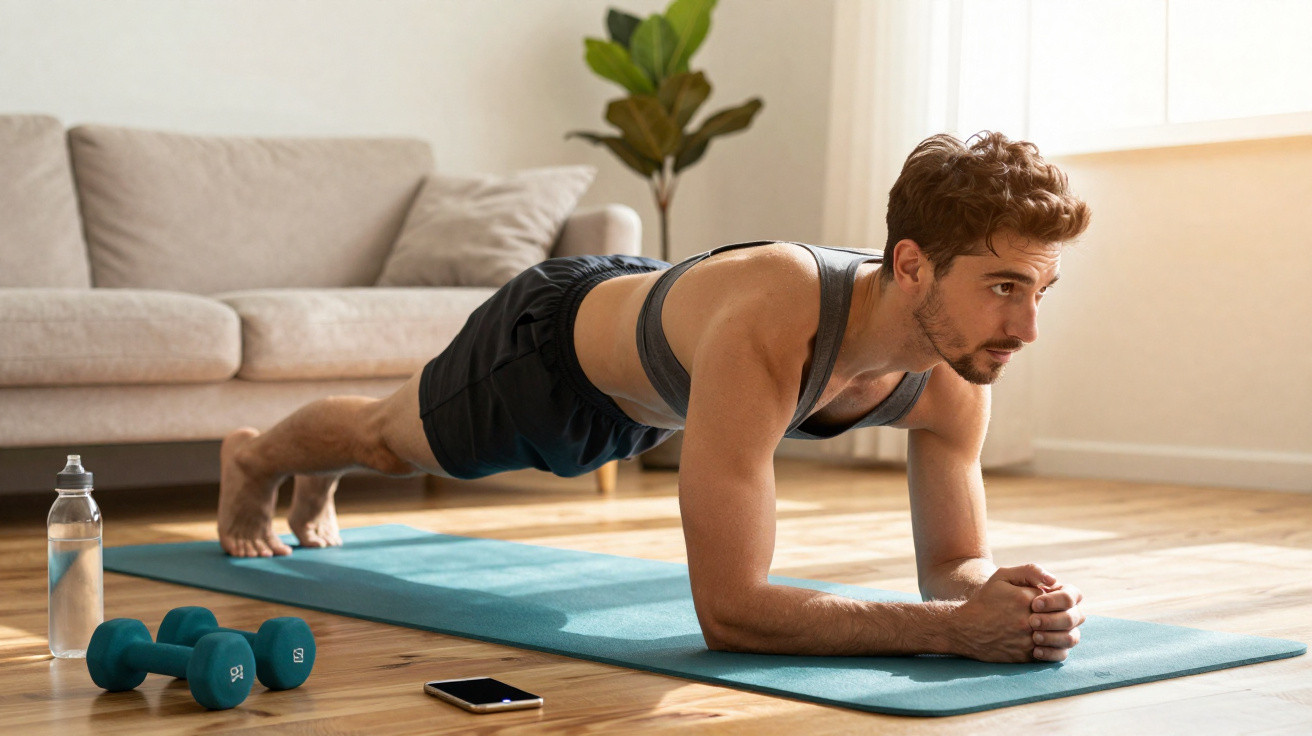
Home exercise almost always brings to mind the plank, crunches and squats, yet there’s a dynamic move that often gets left out - and it delivers a broader training stimulus. The mountain climber, done on the floor with no equipment, demands trunk stabilisation, pushes the heart rate up and spreads the workload across several muscles. That combination is valuable for anyone chasing better fitness and fat burning at home.
Why isn’t the abdominal plank the only benchmark for the core?
The abdominal plank remains a solid choice for building stability, particularly through the rectus abdominis, the obliques and the lower back. The issue is that it’s performed in a fixed support position, with minimal movement. That reduces how strongly the shoulders, hip flexors and legs have to contribute compared with cyclical, travelling patterns.
Once a home exercise includes alternating knee drive, the demands shift. You have to control the pelvis, keep the shoulder girdle supported, transfer force between arms and legs, and manage your breathing rhythm. The result is that more muscles are working at the same time - without losing the core emphasis.
Which simple movement works the trunk, legs and arms at the same time?
The mountain climber is the action of bringing one knee at a time towards the chest while supporting yourself with your hands on the floor. It looks straightforward, but it blends stability with quick, repeated motion. In practice, it recruits the abdominal muscles, shoulders, chest, quadriceps, hip flexors and glutes, while keeping the spine under control.
This home exercise also wins on practicality: it fits neatly into short workouts. Instead of splitting your session into a core block, a cardio block and a lower-body block, this single movement can cover those roles in one sequence - handy if you’re training in the living room, the bedroom or between daily tasks.
What about this pattern increases fat burning?
The explanation has less to do with any “miracle” effect and more to do with the type of demand it creates. Because the mountain climber is dynamic, heart rate typically rises faster than with a static abdominal plank. That increases the session’s calorie expenditure and makes it easier to keep intensity high, especially when it’s used in circuits with short rests.
A few technical details can noticeably change the outcome:
- a controlled pace keeps the abdominals engaged without dumping load into the lower back
- driving the knee up to hip height increases the contribution from the hip flexors and the core
- firm hands on the floor improve shoulder and scapular stability
- 20 to 40-second sets promote a cardiovascular challenge without the technique falling apart
Is there scientific evidence to say it activates more muscles?
There’s an important nuance here. Direct comparisons between exercises depend on speed, technique and which muscles are measured via electromyography. Even so, research consistently distinguishes between static tasks and movements that combine stabilisation with hip and limb action.
According to the systematic review Core Muscle Activity During Physical Fitness Exercises, published in the International Journal of Environmental Research and Public Health, core exercises that include dynamic variations and changes of support tend to produce meaningful muscular responses across different regions of the trunk. This helps explain why more complex movements can outperform the logic of simply “holding still” when the goal is to recruit more groups at once. The study can be found via its PubMed record, which references the original article.
How do you do it without losing posture or overloading the lower back?
Technique is what determines whether this home exercise becomes a useful tool or just rushed movement. The ideal set-up starts with hands under the shoulders, a neutral neck, and the abdominals braced before the very first step. The most common mistake is letting the hips rise too high or sag too low, which reduces trunk muscle activation.
To lock in the pattern, follow this sequence:
- start slowly for 15 to 20 seconds to organise your posture
- brace your abdominals before moving each leg
- avoid rocking the torso side to side
- exhale as you bring the knee forwards
- stop the set as soon as the lower back begins to arch
When does it fit best into an at-home training routine?
The mountain climber works well as an active warm-up, in the middle of circuits, and at the end of short sessions to raise metabolic demand. For beginners, two to three sets of 20 seconds are enough. If you’re more conditioned, you can vary the speed, drive the knee across towards the opposite elbow, or pair the pattern with a press-up.
The abdominal plank still has its place, particularly in blocks focused on stability and isometric endurance. But if you want a home workout with greater overall muscle involvement, faster breathing and a higher energy cost per minute, the dynamic option provides a more complete stimulus. On your own floor, with good technique and progressive overload, it aligns better with functional strength, coordination and conditioning than long sets of holding a static support.



Comments
No comments yet. Be the first to comment!
Leave a Comment