
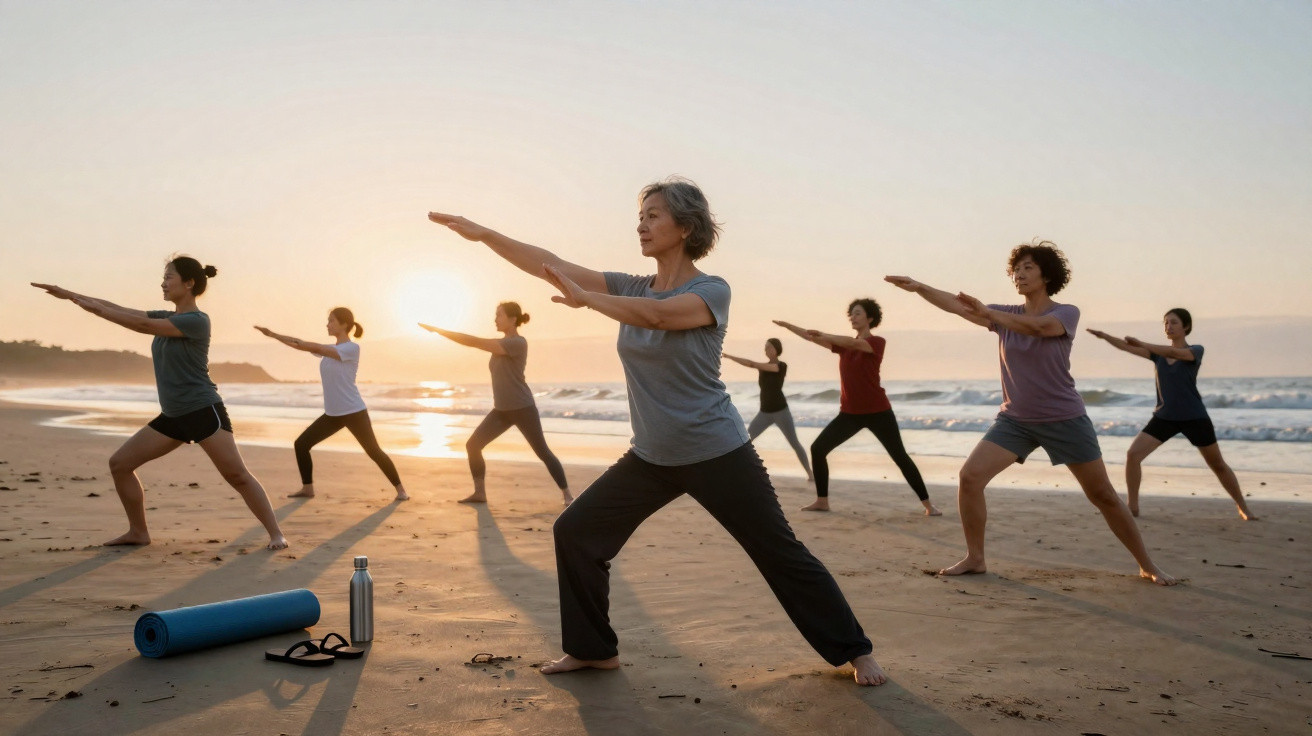
Exercise on the beach is often linked to a stroll along the shoreline or a dip in the sea, yet the morning routine of many over 60s has been making room for something else. Practised on firm sand at a controlled pace, tai chi develops balance, posture, mobility and breathing without putting early-day strain on knees, hips and the spine.
Why tai chi works so well for the over-60s
For people over 60, the main goal is not simply burning calories. What tends to matter more is building steadiness, leg strength, coordination and the confidence to change direction, climb steps and recover from small losses of balance. In that context, tai chi provides a full-body session that includes weight transfer, single-leg support and controlled trunk stability.
On the beach, a gentle breeze, cooler temperatures and morning light can make it easier to keep the habit going. Rather than speeding up, the practice asks for rhythm, focus on foot alignment and a safe arm range of motion. That makes exercise on the beach more approachable for anyone wanting to start consistently, without the repetitive impact that can show up with fast walking or swimming in rougher conditions.
Do walking or swimming stop being good options?
Walking remains helpful for fitness, and swimming supports cardiorespiratory capacity. The issue is that neither option, on its own, fully addresses a common ageing need: precise balance control during changes in stance and posture. On uneven sand, walking may demand too much from ankles and knees. In the sea, waves and currents can alter the workload from one day to the next.
For over 60s, the best choice usually depends on the main objective. When the priority is lowering fall risk, improving stability and waking the body up gently, tai chi tends to come out ahead. Walking and swimming can still fit in as weekly complements, on different days and at different intensities.
What should you check before starting a morning practice?
A few straightforward precautions can make an early session safer and more comfortable, particularly if you are still getting your joints and muscles used to moving on sand.
- Choose firm sand closer to the waterline, but avoid any slippery strip.
- Start with 15 to 20 minutes, with no rush to extend the duration.
- Wear light trainers, or go barefoot only if you already have good foot stability.
- Avoid sudden knee rotations during weight shifts.
- Bring water and wear clothing that allows full shoulder and hip movement.
What does the science say about balance and fall prevention?
Tai chi’s prominence is not based only on what instructors and physiotherapists observe. The link between slow movement, centre of gravity and postural response has been examined for years, particularly in people over 60-an age group in which instability and falls directly affect independence.
According to the systematic review and meta-analysis Systematic review and meta-analysis: Tai Chi for preventing falls in older adults, published in BMJ Open, tai chi reduced the rate of falls and showed a stronger preventive effect when practised more frequently. The paper brought together randomised clinical trials involving older adults and reinforces that balance training, weight transfer and whole-body control go beyond a simple sense of wellbeing. It is worth reading the study abstract via an indexed page on tai chi and fall prevention in older adults.
How to build a simple, no-excess routine on the sand
If you want tai chi to become a habit, the most effective approach is to repeat a small number of movements with care. Especially for over 60s, the body typically responds better to regularity than to long, tiring sessions.
- Do 3 to 5 minutes of breathing and shoulder mobility.
- Practise short steps with slow weight transfer.
- Add stances with knees slightly bent, without squatting too low.
- Train small trunk turns, with your gaze following your hands.
- Finish with a light walk back to loosen the legs.
This format suits the start of the day because it warms the body without sharp spikes in effort. If you already enjoy walking, a practical option is to use tai chi as the opening block and leave a short walk for the end, when ankles, hips and the spine feel freer.
Which habit makes the most sense for ageing with independence?
On the beach, the smartest choice is not always the most obvious. Tai chi stands out because it matches real ageing needs-balance, mobility, posture and the ability to respond on unstable surfaces. As a result, exercise on the beach becomes more than an aerobic moment and starts to function as motor-control training.
For over 60s, walking and swimming still have their place, but as parts of a broader routine. When the aim is to protect stability, joints and movement confidence first thing in the morning, few options fit as well as a short, regular and technical tai chi sequence on firm sand.





Comments
No comments yet. Be the first to comment!
Leave a Comment