
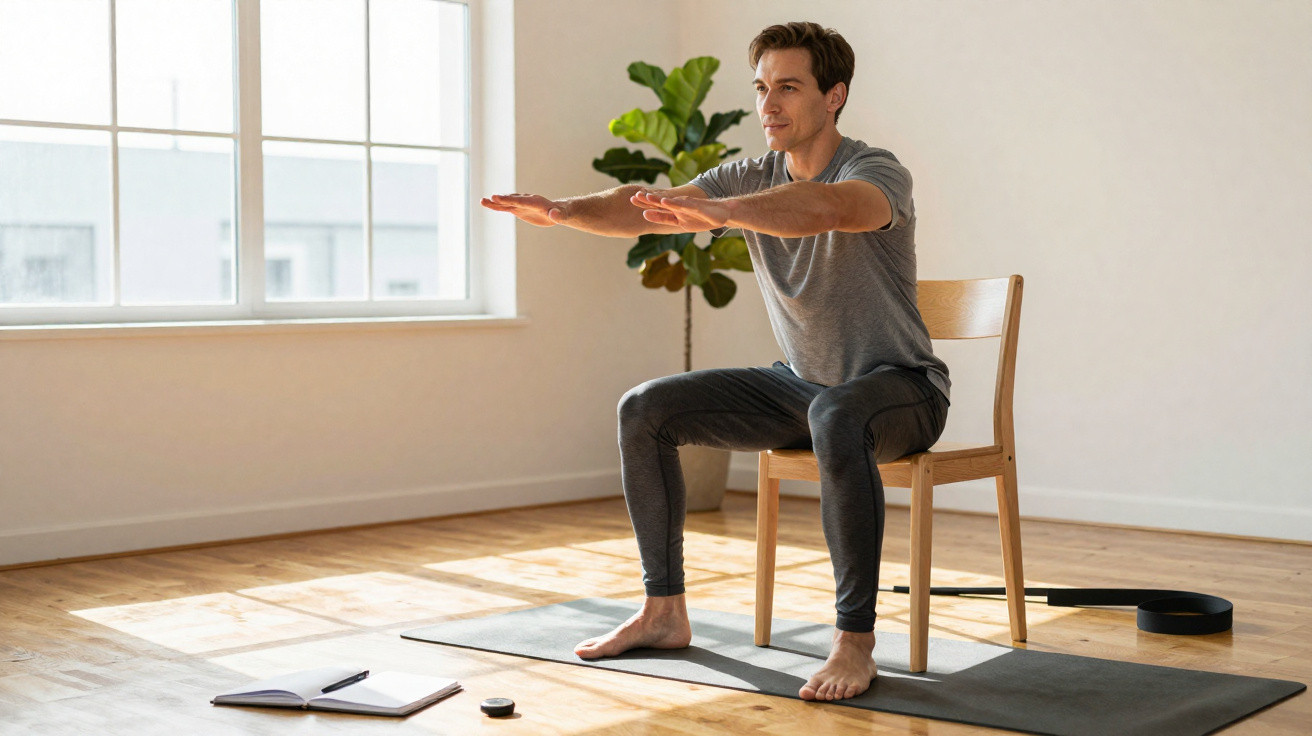
Home exercise is often linked with basic movements, yet some options place a greater mechanical demand on your legs than a squat performed with both feet on the floor. When the plan involves single-leg support, a controlled lowering phase and a solid range of motion, the work done by the quadriceps, glutes and stabilising muscles increases-without needing jumping, running or joint impact.
Why can a unilateral movement demand more from the legs?
When only one leg handles both the rise and the descent, you lose the help that comes from splitting force across two sides. That ramps up the requirement at the knee, hip and ankle, and it also calls on balance, co-ordination and trunk control. In practical terms, the effort is concentrated more locally-something that does not always happen in a traditional squat.
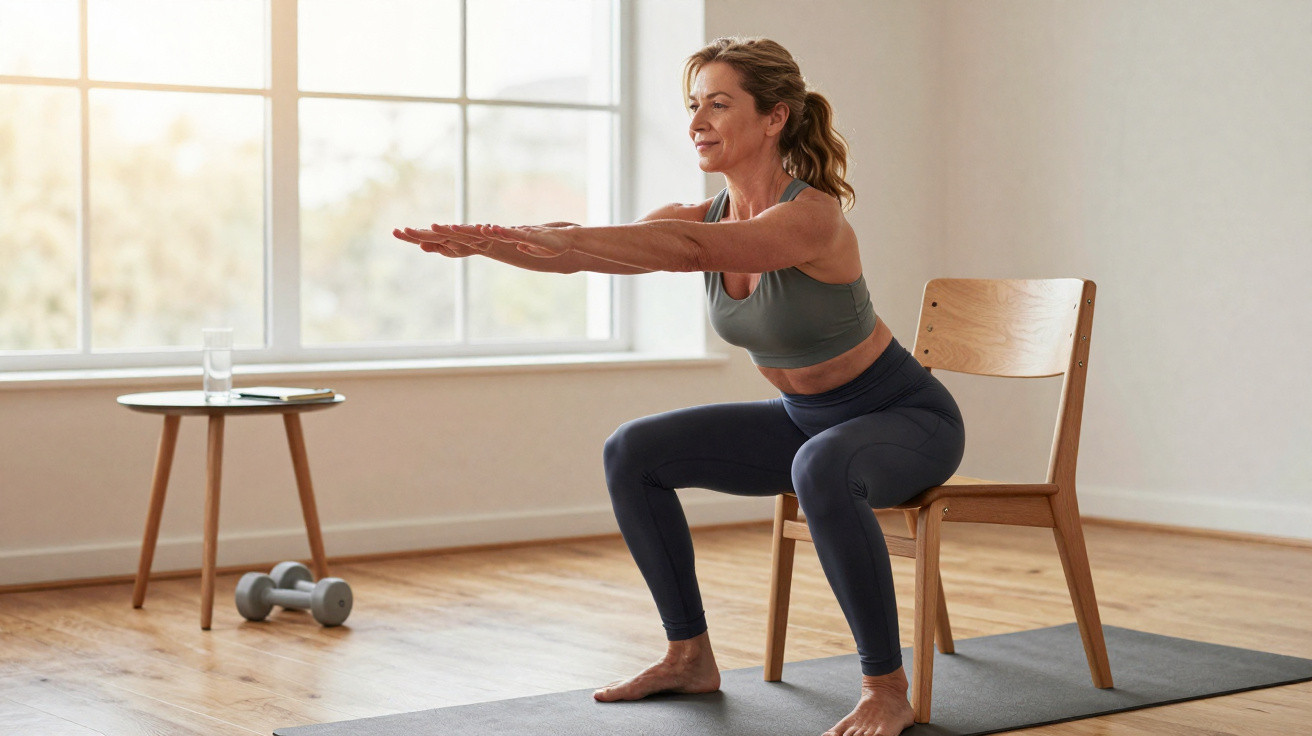
One of the most overlooked at-home choices is the one-leg sit-to-stand using a sturdy chair. It stands out because it brings together strength, range and stability. The movement looks simple, but it can heavily tax the quadriceps and the entire extensor chain-especially when you stand up without using momentum.
Which home exercise does almost nobody use?
The most accurate name is the unilateral sit-to-stand, also known as the single-leg sit-to-stand. You start from a chair with one foot planted on the floor while the other leg stays slightly lifted. The goal is to sit down under control and return to standing using the same working leg-without throwing your torso forwards or pushing off with the free foot.
This set-up typically creates more work per leg because each repetition funnels the load into the active limb. For anyone chasing muscle strengthening without noise and without impact, it can provide a highly effective stimulus at home-provided the seat height matches your current strength level.
How do you do it without overloading the knees and lower back?
Technique is the make-or-break factor with this type of training. Before you chase more repetitions, it is worth organising the movement so the load stays in the thigh and hip muscles rather than being “stolen” by trunk compensations.
- Choose a solid chair and place it against a wall.
- Keep the whole foot down; do not let the heel lift.
- Lean forwards only as much as you need to stand, and avoid rounding the lower back.
- Lower yourself slowly over two to three seconds.
- If it is too hard, begin with a higher seat.
A few warning signs mean you should adjust immediately. A sharp knee pain, the knee collapsing inwards, or using an exaggerated body swing to get up are common mistakes. In those situations, reducing the range of motion or using light support from a wall can quickly improve your mechanics.
What does research show about this strength pattern?
This movement has gained attention precisely because it both measures and demands real lower-limb strength. According to the study Differences in hip and knee muscle strength between successful and unsuccessful performances of the single leg sit to stand test from a 20-cm-high box in healthy young adults, published in the Journal of Physical Therapy Science, performance in the unilateral sit-to-stand is associated with differences in hip and knee strength among healthy young adults. The paper can be found via the study page indexed on PubMed.
In practical terms, that finding supports treating the movement as more than a functional test. It can also be used as a leg-training tool, particularly because it isolates strength deficits and forces control both on the way up and on the way down. That helps explain why many people feel their thighs working harder with this pattern than during long sets of bilateral squats.
When does it deliver more than the traditional squat?
The biggest payoff tends to show up when a regular bodyweight squat has become too easy. Because the load in the unilateral sit-to-stand is concentrated, the perceived effort rises even without dumbbells, a rucksack or resistance bands.
It is usually especially helpful in a few specific scenarios:
- when there is no equipment available to progress load at home
- when someone wants to train thighs and glutes without impact
- when there is a visible strength difference between legs
- when the bilateral squat has lost intensity
- when the goal is to combine strength and stability in one exercise
How can you add this movement to your routine without losing consistency?
The safest approach is to begin with a small number of high-quality repetitions-around 3 to 6 per side for 2 or 3 sets. If it still feels too heavy, an assisted version (a light fingertip touch on a wall) or a higher chair can still provide plenty of stimulus for legs, quadriceps and glutes.
Over time, you can progress by lowering the seat height, pausing briefly at the bottom, or increasing the control of the descent. For anyone building a home routine focused on legs, strength and joint-friendly training, this home exercise delivers dense, quiet work and a more technical challenge than many rushed squat sets.




Comments
No comments yet. Be the first to comment!
Leave a Comment