
Your phone keeps lighting up. By about 4 pm, your energy slumps, and the playlist that feels brilliant indoors suddenly sounds oddly thin. Meanwhile, parks sit around like oversized batteries nobody ever bothers to plug in. People drift past with dogs and takeaway coffees, half smiling, half elsewhere. What if the answer isn’t another routine, but a different backdrop? What if the best dance floor comes with grassy edges and a breeze that quietly rewrites your thoughts?
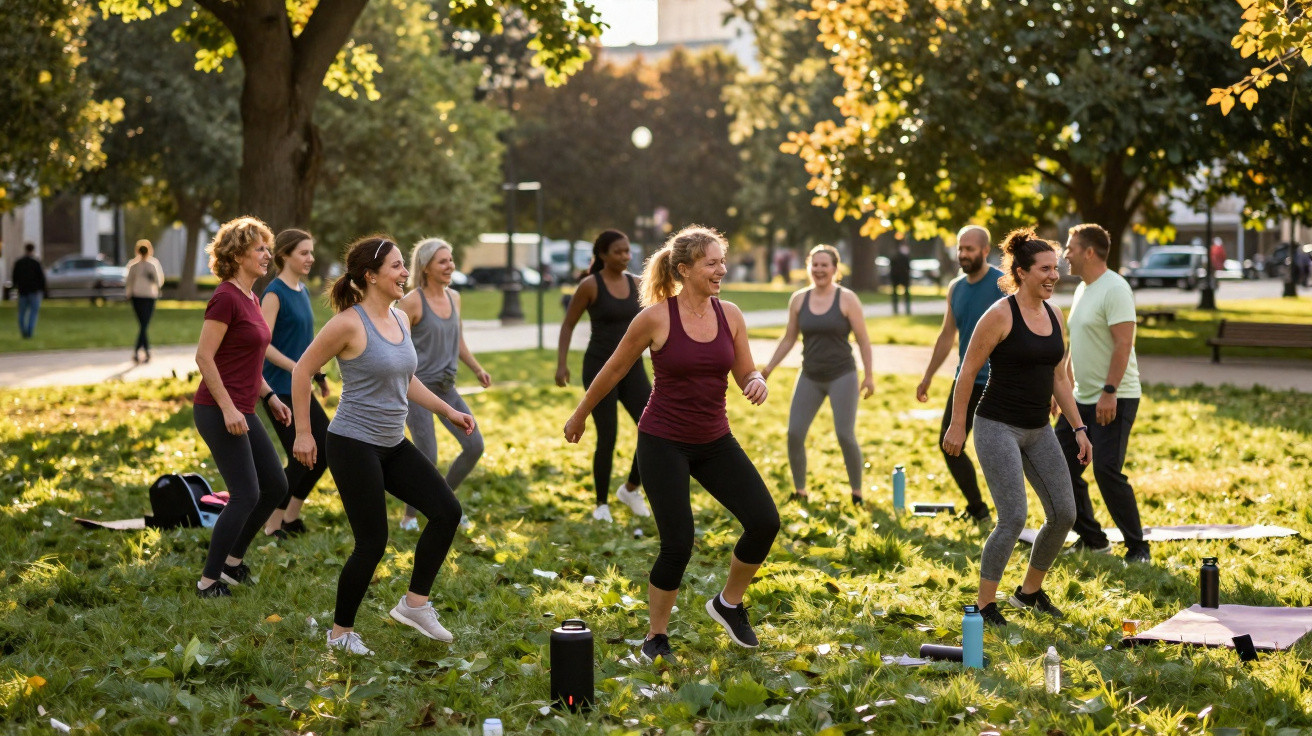
It starts with a crackle from the speaker, like a fizzy drink being opened. A few beats spill across the grass. Two joggers look over as a woman in a red hoodie begins with a shoulder roll, then lets her hips follow. A child copies her without hesitation-because that’s what children do-and within moments the rhythm spreads, like sunlight slipping through branches. People slow down. The loose circle turns into seven, then ten, then twelve, as if the whole park has been let in on something. No mirrors. No glowing clock. No instructor barking “left foot, right foot”. Just open air, expressions, and a low bass line that turns awkwardness into energy. And then the atmosphere changes.
Why outdoor dance workouts flip your mood so fast
Picture sunlight as a dimmer switch for your brain that you can push higher. Moving to music in a green space layers together things that naturally boost your chemistry: light encourages serotonin, rhythm nudges dopamine, and exercise releases endorphins. Sunlight, music, and shared movement are a mood cocktail. Add in trees-shown to calm the body’s stress response-and your nervous system reads the scene as safe enough to loosen up. That small sense of permission to play is often where your mood begins to lift.
In a Saturday group I joined once, the only guideline was: three songs, no perfection, shoes optional. People arrived carrying a hard week and walked away looking visibly lighter. Research backs up the feeling-around 20 minutes in a park can reduce cortisol, and moving in sync has been associated with higher pain tolerance and stronger social bonding. Most of us have felt it: music can cut through heaviness faster than any motivational speech. This is your permission slip.
There’s a practical reason it works. Outside, the usual performance signals disappear-no mirrors and no instructor elevated like a judge-so your focus settles into a healthier balance between yourself and the people around you. Wind, birdsong, and distant conversation create “soft fascination”: a gentle kind of attention that doesn’t drain your mind, helping your mood recover. The beat gives your body one clear task, which quietens rumination. And when you match someone else’s step for even a moment, your brain registers it as connection. Small, yes. Powerful, yes.
How to set one up, step by step
Begin with a simple triangle: place, time, and sound. Find a spot with some shade, firm footing, and enough room for a circle that can expand. Choose a consistent slot-Saturdays at 10 a.m., for example-before the wind picks up and before midday glare. Put together a 45-minute playlist that rises gradually, hits a peak, then finishes gently; 100–130 BPM tends to work well for mixed abilities. Your blueprint: one spot, one time, one playlist, one vibe. A small Bluetooth speaker will do; you’re not running a festival, you’re anchoring a feeling.
Build it in layers rather than laying down rules. Leave a warm message on the park noticeboard or in a local group: “Open-air dance, all levels, bring water.” Keep the moves easy and repeatable-two steps, a sway, a turn-so new people can join without feeling exposed. If attention makes you anxious, start with earbuds and two friends, then switch to the speaker when it feels comfortable. And be realistic: hardly anyone keeps this up daily. Choose a rhythm your life can actually sustain, and be kind to yourself when weather or work takes over.
Bring people in with curiosity, not obligation. Even five people is a success; energy builds socially, and it gathers momentum without much noise.
“I thought people would stare,” said Maya, who showed up in a hoodie and sunglasses, “but they mostly smiled. Two joined. That was enough to change my week.”
- Choose a spot that’s sheltered from wind, and point the speaker away from nearby homes.
- Rotate “lead” songs so anyone can suggest a move.
- Bring water, sunscreen, and a backup playlist saved offline.
- Have a rain plan: use a pavilion or come back next week, same time.
- Keep it neighbourly: finish on time and leave the area cleaner than you found it.
Let it become a ritual, not a performance
The biggest benefit tends to arrive without fuss. The park turns into a fixed point in your week-a place where your shoulders drop as soon as the first chord lands. Some sessions you’ll feel effortless; other days you’ll clatter through two songs and stop. It still counts as a mood win, because you met sunlight and rhythm, and your nervous system stored that as safety. Joy is a habit before it is a feeling. Swap favourite tracks, notice the small wins, and keep the circle open at the edges so passers-by can step in. You may begin for fitness and stay for the quiet, human moments that make the week feel a little gentler.
| Key point | Detail | Why it helps you |
|---|---|---|
| Choose the right triangle | Place, time, sound set the tone | Fewer decisions, smoother start |
| Keep moves simple | Two-step, sway, turn, repeat | Inclusive, low-pressure flow |
| Make it a ritual | Same place and hour each week | Mood lift that compounds |
FAQ:
- How loud should the speaker be? Loud enough for your circle to hear clearly, quiet enough that nearby benches can still chat. Aim for respect over reach.
- What if I’m shy and don’t know how to dance? Think “move,” not “perform.” Start with walking to the beat, add a sway, then one extra step. Momentum follows motion.
- Do I need permission from the city? Small, non-commercial gatherings are often fine in public parks. Check local guidelines and pick times that don’t clash with events.
- What if nobody shows up? Dance anyway for two songs, record a short clip, and post next week’s time. Consistency invites company.
- How do I handle weather changes? Keep a backup plan: pavilion, sheltered corner, or reschedule. Post updates early, and treat cancellations as part of the rhythm.




Comments
No comments yet. Be the first to comment!
Leave a Comment