
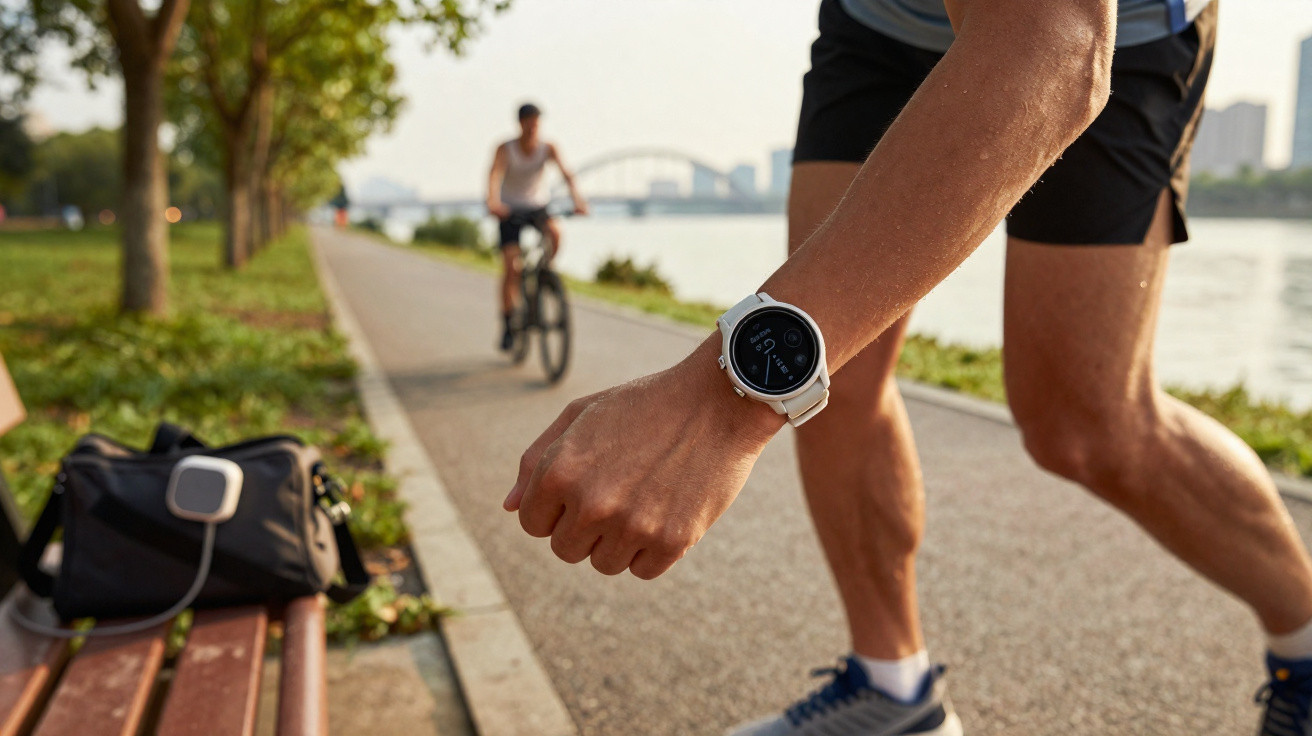
Coros continues to keep Garmin at arm’s length in the under-€300 sports watch category-so long as what you want is a device that’s focused almost entirely on training. With the new Coros Pace 4, the brand pushes further than the Pace 3, introduces AMOLED properly on this line, and pairs it with truly huge battery life. What it still won’t do, however, is meaningfully expand its day-to-day smart features. Here’s our real‑world test and our opinion on the watch.
First spotted on Eliud Kipchoge’s wrist at the New York Marathon, the new Coros Pace 4 quickly made its way into many runners’ kit bags after its late‑2025 launch. Replacing the Pace 3 released in 2022, this latest sports watch inherits the AMOLED screen first introduced on the Pace Pro. It keeps the entry‑level dimensions Coros is known for, while staying true to the brand’s obsession with ultra‑light weight. The formula works so well that the Pace Pro may end up being removed from the range.
The Coros Pace 4 is not just here to compete with sibling models either, because it arrives in a line-up that has already been reshuffled. Since August 2025, Coros has launched two other watches: the brand‑new Nomad, built for outdoor adventures (hiking, but also hunting and fishing), and the Apex 4, the fourth generation of its mountain‑oriented sports watch. Those two releases also help explain why the Pace Pro no longer fits.
Before strapping on the Pace 4, we wore the Pace 3 for more than a year. It became our go‑to running training companion for a simple reason: we wanted a cheap, light, accurate, long‑lasting and comfortable sports watch-and it delivered on every point. So what could the Pace 4 add? An AMOLED screen, obviously, but without sacrificing battery life, weight, or price. Three years after the Pace 3, we also hoped to see a few everyday features that rivals offer…
Introducing the Coros Pace 4
What’s changed and what’s new
Before getting into the full test, here’s a quick overview of what Coros has changed on the Pace 4 versus the Pace 3. The headline upgrade is the move from MIP (transflective) to AMOLED, bringing higher brightness, deeper contrast, and more vivid (and more numerous) colours. Both displays are 1.2 inches, but resolution jumps to 390 x 390 pixels (up from 240 x 240 pixels), essentially matching Apple Watch‑level sharpness. The case surrounding the screen also looks closer to the Pace Pro-more solid and more grown‑up.
Coros Pace 4 battery life is the other major leap over the Pace 3. Coros has managed to fit a much bigger battery than the already‑excellent Pace 3, directly taking aim at the competition-Garmin included. Coros also states that the Pace 4 includes a new heart‑rate sensor and a new processor, intended to make menus and features feel snappier. Feature-wise, it also gains a microphone. And thanks to the AMOLED panel, it can act as a torch at night. A third physical button is added too, making it easier to move between menus.
On pricing, Coros has edged the Pace 4 up slightly versus the Pace 3, which is understandable given the hardware changes and three years of inflation. The Coros Pace 4 costs 269 euros, compared with 249 euros for the Pace 3 (now reduced to 229 euros until stocks run out). The Pace 4 comes with either a silicone or nylon strap at the same price. Ordering has been possible since December 2025, in black or white.
Comfort and watch design
Coros hasn’t dramatically reinvented the Pace 4’s design, but it’s clear the aim is a more mature look. The case is closer to the Pace Pro’s style and appears more rugged, even though it remains plastic. That choice isn’t surprising-and it isn’t disappointing-because the whole point is to keep the Pace 4 light and affordable. Without changing materials, Coros has subtly reworked the shapes. The screen is protected by mineral glass rather than sapphire or Gorilla Glass (a decision that helps keep both weight and price down).
Alongside the tougher silhouette, the Pace 4 also feels a bit more understated-we particularly like the removal of the bezel accent ring that surrounded the Pace 3’s display. The brand name remains on the left side, and that’s essentially it. It’s still unmistakably a sports watch, but it looks closer to more expensive models. To elevate the feel, the display has slightly curved edges that blend into the plastic case. There’s no noticeable step between materials, which improves both the look and the feel (and the screen remains touch‑enabled).
The buttons are tweaked too: they’re slightly wider for easier use. There are also more of them, because Coros adds a third button to simplify navigation for anyone who doesn’t rely on touch controls. This extra button can also be assigned as an activity shortcut. You can choose a shortcut to change data pages (including switching to route tracking), pin a location, jump to the next lap, or leave it unassigned. The right‑hand button can be configured similarly.
Coros keeps the same strap philosophy: you still have a choice between silicone and nylon. Pace 3 straps also fit the Pace 4. We received the silicone version for testing; it’s not the one we’d recommend because the nylon strap is excellent (lighter, more comfortable, and easier to dial in). That said, we genuinely liked the silicone strap too: it breathed well and stayed comfortable, even overnight.
The silicone strap comes in two sizes to suit larger wrists. With the standard strap and our fairly slim wrist, we still had 7 notches left. The default Coros Pace 4 strap adjustment range is 135 to 205 mm, while the larger option runs from 150 to 235 mm. If you want the lightest Pace 4 configuration, the nylon strap is the one to pick: the watch then weighs 32 grammes, versus 40 grammes with silicone. Compared with the Pace 3, Coros adds only 2 grammes overall.
Price and availability
The Coros Pace 4 is available for 269,00 € from December 2025. It’s sold via Coros’ official website, through online retailers, and in physical stores such as specialist shops and Decathlon. In January 2026, the Pace 4 finally becomes available in a nylon‑strap version after several weeks out of stock. For now, only the black watch is offered with nylon; the white nylon option hasn’t arrived yet. As you’d expect, silicone options are available in both black and white.
Our Pace 4 test
Now for the real‑world test of the Coros Pace 4. To form a view of this new sports watch-positioned against the Garmin Forerunner 165-we ran over 400 kilometres with it and also completed several hours of gym training, including strength work and elliptical cycling. We wore the Coros Pace 4 every night, too, to assess sleep tracking. Overall, we used the Pace 4 in exactly the same way we previously used the Pace 3 for months, which helped us pinpoint the differences more accurately.
As mentioned earlier, the Pace 4 includes a new processor. With a sharper display than the Pace 3, extra computing power was inevitable. In practice, the watch feels very responsive, including when using touch controls.
Sensors and measurements: Coros refines the formula
The Pace 4 brings big upgrades, but it doesn’t completely reinvent sensors and measurement quality. On paper, Coros highlights a new heart‑rate sensor. In reality, the change isn’t transformative: heart‑rate tracking remains very strong in most scenarios. You’ll mainly see limits during very short interval sessions at high heart rates, where maximum HR spikes can be underestimated.
That said, the Pace 4 suffers from the same issue as the Pace 3-and many other sports watches: in cold weather, or with heavy sweating, the optical heart‑rate sensor can quickly become unreliable and either show the wrong heart rate or stop displaying it entirely. Results vary hugely depending on your skin, hair, and conditions. In our case, we needed an external sensor, specifically the Coros heart‑rate armband. It pairs automatically before each workout without requiring any button presses.
For GPS, Coros also offers an improved dual‑frequency sensor. Day to day, you might not notice much because the Pace 3’s GPS was already excellent. But in wooded areas or in cities with narrow streets, the Pace 4 is more accurate than the Pace 3, reaching an almost flawless level for a sports watch (there’s little need to spend more for better GPS). The one trade‑off is that Coros no longer includes the most battery‑saving GPS mode (and also the least accurate). That’s not a major loss, because we wouldn’t recommend using it anyway.
Coros has removed the single‑band GPS mode on the Pace 4, leaving only dual‑frequency (the most accurate and most power‑hungry) and the standard mode labelled "All systems". The message from Coros is clear: the watch should always deliver optimal measurements, and the brand is confident it no longer needs an ultra‑efficient GPS option given the much stronger battery life. The simplest GPS mode still exists on more outdoor‑focused watches such as the Apex 4 (endurance mode), where keeping an activity running for as long as possible matters most.
Other measurements on the Coros Pace 4 include skin temperature (shown on the watch following a January 2026 update), an altimeter (useful for trail running or hiking to calculate elevation gain more accurately), plus the usual gyroscope, accelerometer, and electronic compass. There are no additional sensors on the Pace 4 compared with the older Pace 3.
Analysis and prediction: the Pace 4 remains a benchmark
The data the Pace 4 collects is used-via the app-to support training analysis. These insights aren’t really tied to the hardware, but to the software, and Coros does not separate Pace 3 and Pace 4 here: both watches get the same capabilities. In our view, Coros still beats Garmin on training analysis, offering data that is more relevant, easier to understand, and presented more clearly on a single screen.
Coros’ software analysis continues to stand out, especially with its training status, which shows current fitness and training load. Why does it matter? With this view, you can see where you are relative to your peak shape and understand the effect of your recent training. At a glance, you can tell whether you’re maintaining, improving, or easing off enough to be ready to perform. It’s also a strong indicator for avoiding overload and the injury risk that comes with it.
Like the Pace 3, the Coros Pace 4 also provides a recovery index (in percentages and hours), which is excellent for gauging your energy level before or after a session. For a more running‑specific snapshot, Coros includes details on your paces (threshold, sprint, speed, endurance, recovery), estimated VO2max, and threshold heart rate. You also get a race predictor for 5 km, 10 km, half marathon, and marathon.
Another Coros metric that’s both useful and fairly advanced is the performance score. It was already available on the Pace 3 and returns on the Pace 4. Expressed as a percentage, it indicates whether conditions or fatigue worked for or against you. When you’re active, it delivers meaningful insight into energy level-and Coros measures it convincingly. Below is how to interpret the performance score.
A performance level of 90% (or less) indicates low performance (explained by fatigue, unsuitable terrain, heavy shoes, or a high training load before the session). Conversely, a performance score of 100% or more suggests you’re in very strong condition, combining high fitness with strong energy reserves, or benefiting from favourable conditions (such as optimal temperatures).
These analytics already impressed us on the Pace 3 and remain a key differentiator for Coros. By choosing the Pace 4, you still get a watch that can track your session accurately, tell you where you stand in terms of fitness and training, and predict race times so you can better judge what’s realistic-without underestimating or overestimating yourself.
A microphone on the Pace 4: what is Coros using it for?
Among the Pace 4’s new hardware features, the microphone deserves a mention. Coros positions it as sports‑only functionality (you can’t take calls on the watch). The microphone is used for voice notes, letting you record comments about how you felt after a session. Previously, you had to open the app and type these notes.
If you already used this post‑workout journalling system, it’s a genuinely helpful addition because it makes note‑taking faster and lets you capture thoughts the moment a session ends. If you’ve never taken notes before, it may feel more like a nice‑to‑have. It could encourage some people, but for many it will end up unused.
Mapping is still missing on the Pace 4
Even if the Pace 4 is closer to a Pace Pro in appearance, it doesn’t adopt the Pro’s main selling point: maps for route guidance. If you head onto trails for hiking or trail running, or if you simply don’t know the route you plan to follow, you can’t rely on the Coros Pace 4 as a true guide. Full mapping is absent, meaning you won’t see streets and paths to locate yourself precisely. Like the Pace 3, the Pace 4 offers a lighter alternative: a breadcrumb trail. In other words, you only see the line of your route on a black background.
This breadcrumb approach works reasonably well, and we’ve tested it many times (including for a multi‑month trail race build). In our opinion, it’s still a viable way to follow a route. But it’s easier to take a wrong turn at junctions where multiple directions look similar. You’ll often need to zoom right in to be sure you’re going the correct way. To understand why maps are missing on the Coros Pace 4, look at storage: like the Pace 3, it offers only 4 GB, mainly for the software, data, and music. The Coros Pace Pro had 32 GB.
Coros seems intent on positioning the Pace 4 primarily as an urban model, leaving mapping to the outdoor range. It’s still a shame, because a proper map is extremely handy-and not just in the countryside.
Coros Pace 4 for everyday use: still limited
We expected the Pace 4 to bring AMOLED while keeping excellent battery life, without the brighter display harming endurance. Coros has delivered on that. However, the brand has not tried to go further on everyday features, even though these can be genuinely useful for people who train regularly. Contactless payments are the obvious example, with Garmin offering Garmin Pay.
Unfortunately, there’s no NFC sensor on the watch. Yes, launching a full payment service like Garmin’s is a big and costly step, but an NFC chip could also store other types of cards (such as travel cards in some cases). Perhaps Coros is waiting until this kind of usage is fully mainstream. One thing is certain: being able to go running, walking, or cycling without your phone or bank card is a real benefit.
Day to day, the Pace 4 doesn’t introduce much versus the Pace 3, aside from the torch function (genuinely useful) enabled by the AMOLED screen (with an SOS mode too). You can push brightness to the maximum and display a white screen so the watch lights your way in the dark-without disturbing others and without pulling out your phone or a separate torch. It’s handy in a bedroom or a tent.
Another criticism we have concerns the media player. Coros already offered it on the Pace 3, and both watches share the same limitation: you can’t skip backwards or jump forwards within a track. For music this isn’t a big issue, but for podcasts it means you can’t rewind to a specific moment or skip ahead-so you’ll need to pay close attention. Unlike Garmin, you can’t download apps to the watch, such as Spotify.
Beyond that, the Pace 4 mirrors the Pace 3 and other Coros watches: sleep tracking, weather, and notification display are all present. The temperature view mentioned earlier arrives via a January 2026 update. Sleep tracking generally aligns with reality, but it won’t replace a smart ring if you want highly precise details on total sleep time and stages such as deep sleep.
For overnight recovery, though, the Pace 4 does provide an HRV (heart rate variability) reading that’s very useful for understanding your form and cardiac recovery-and for reducing the risk of overtraining.
Battery and endurance of the Coros Pace 4
A week and a half: more than we expected
The standout change on this new sports watch is battery life, and the Coros Pace 4 genuinely reaches a new level. What Coros promised on paper was confirmed by our real‑world use: with settings and usage similar to the Pace 3, you can expect around 3 extra days versus the older (already excellent) model. In our case, we managed a week and a half with the Coros Pace 4 despite fairly heavy use. Reaching 2 weeks is also realistic if you mostly do activities that don’t require GPS.
We were genuinely impressed: after the first week, the watch still showed 37% remaining after 5 workouts and 6 hours of dual‑frequency GPS use. We only had to recharge after a week and a half, following 6 runs and 2 strength sessions (over 9 hours of training in total). That’s an outstanding result, especially for a watch that should consume more power than its predecessor thanks to the AMOLED display.
We stayed on dual‑frequency GPS for the entirety of our Coros Pace 4 test. There’s no real need to switch to a less power‑hungry configuration unless you’re already running low. To extend battery life, other settings can help too: disabling stress tracking and sleep tracking, lowering screen brightness, turning off activity alerts, and switching off Always‑On mode if it isn’t already.
Always‑On mode and its impact
Always‑On mode (keeping the display permanently lit, albeit in a minimal state) has a significant effect. Instead of 41 hours with GPS (all systems), you can get 31 hours in GPS with Always‑On enabled. Dual‑frequency GPS also hits endurance at a similar level: Coros’ quoted figure is 31 hours with dual‑frequency GPS. Outside of activities, Coros states 19 days of battery life, and 6 days with Always‑On enabled. With dual‑frequency GPS and Always‑On together, endurance drops to 24 hours.
During our test, we preferred to disable Always‑On mode, not to save battery but for comfort. A simple wrist raise wakes the screen and shows the time, and it works very well-so there’s no need to keep the display active when you’re not looking at it. That said, you can enable Always‑On only during activities, where it’s genuinely useful. We kept it enabled throughout workouts.
Charging with the dedicated adaptor
For charging, you should allow around an hour and a half with the watch plugged in. As with the Pace Pro (which introduced this approach), the box no longer includes a full cable, but instead a small adaptor that connects a USB‑C cable to the watch’s proprietary charging port. It’s convenient because you can use a standard USB‑C cable rather than carrying a dedicated lead, but you do need to remember the adaptor (and avoid losing it). Note that the older cable used by the Pace 3 and other Coros watches is not compatible with the Pace 4’s new charging port.
Verdict: our view on the Coros Pace 4
The Coros Pace 4 confirms its status as a benchmark among sports watches under 300 euros. It keeps what made the Pace 3 great-light weight, comfort, exceptional endurance, and very accurate tracking. On top of that, the Pace 4 adds a bright, responsive AMOLED display that noticeably upgrades the viewing experience. Navigation feels smoother thanks to the new processor and the third physical button, and battery life exceeded our expectations even with heavy GPS use. For runners and regular athletes, it remains a dependable, high‑performing tool that tracks training precisely and delivers useful analysis to help you train and improve.
However, the Pace 4 doesn’t transform everyday use. The lack of NFC, the absence of full mapping, and limited multimedia features reduce its appeal outside sport, where Garmin still holds an advantage. The Coros Pace 4 is first and foremost a sports watch, not a fully fledged everyday smartwatch. But if your priority is a light, robust, long‑lasting watch that can track performance accurately and run for days between charges, the Coros Pace 4 is close to unavoidable at this price.
Coros Pace 4
Price: 269,00 €
Overall score: 9
| Category | Score |
|---|---|
| Design | 9.0/10 |
| Battery life | 10.0/10 |
| Features | 8.0/10 |
| Equipment | 9.0/10 |
| Overall rating | 9.0/10 |
What we like
- Still just as light and comfortable
- Affordable price
- Accurate GPS
- Massive battery life
- Full embrace of AMOLED (we wouldn’t go back)
What we like less
- No mapping
- Heart‑rate sensor needs an accessory in winter
- No call answering, no NFC payments
- Music handling





Comments
No comments yet. Be the first to comment!
Leave a Comment