
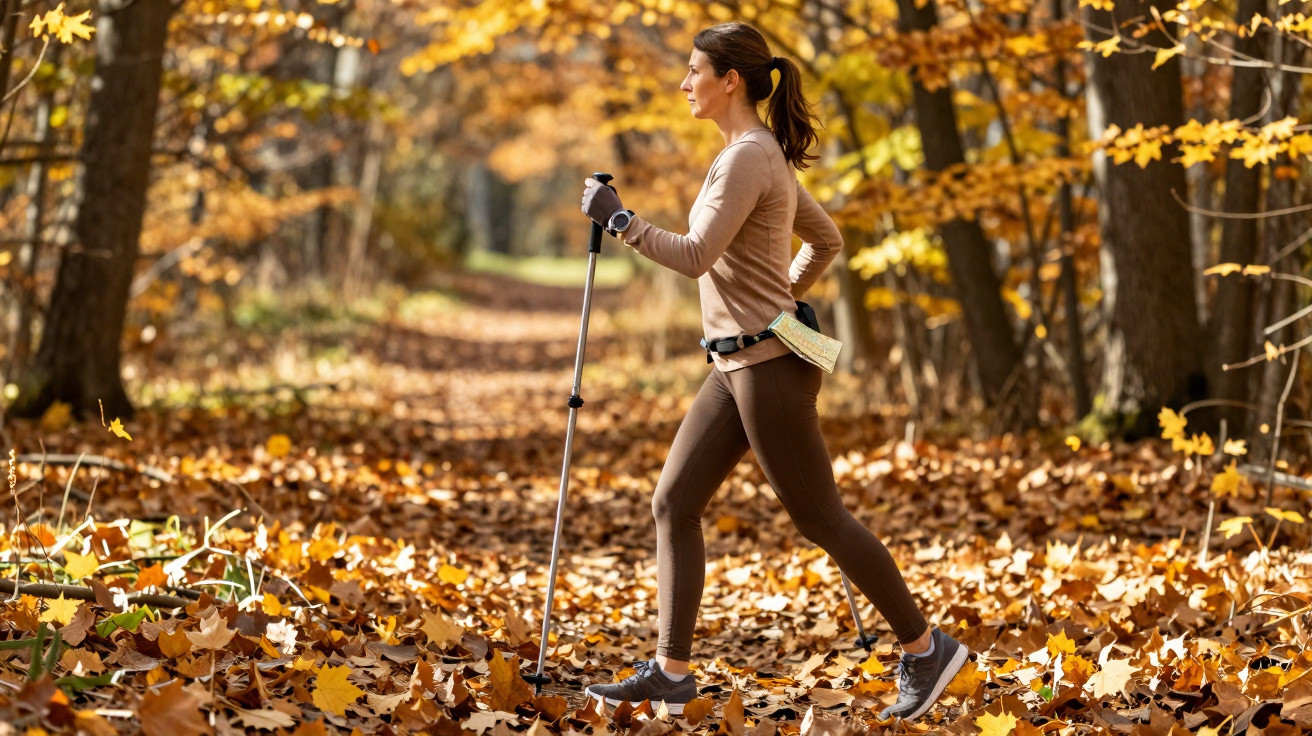
The air turns sharper, the paths feel gentler underfoot, and you start wanting exercise that builds you up without battering you. Nordic walking fits neatly into that space: low impact, high return, especially when the season is when knees and hips tend to protest most.
In the park, everything had shifted to copper and ash-grey. Leaves crackled with a sound you could almost taste, while the poles made a clipped, off-beat rhythm that had people glancing over. A man in a wool beanie moved past on the path-relaxed shoulders, even stride-his poles striking just behind his step. “My knees?” he said when I drew level. “They stopped complaining when I started this last October.”
We skirted a pond that had gone perfectly still, until a dog burst through and sent geese scattering like confetti. There was no rush-just the near-musical tap of carbon tips and the smooth roll from heel to toe. In that light, walking felt like a quiet agreement with your body. Your knees notice.
Why autumn is the sweet spot for Nordic walking and your joints
Nordic walking shares out the effort. The poles effectively become an extra set of limbs, shifting some of the load that would normally pile into your knees and hips into your arms, shoulders and back. The result is fewer harsh braking forces with each step. On softer autumn tracks, the ground gives a little; that slight spring is its own kind of mercy. And cooler air usually means less heat stress. Poles offload your knees.
Picture a runner who adores speed but dreads the ache afterwards. I met Maria, 42, who took up poles last October when her left knee began complaining on climbs. Two weeks later she was comfortably doing 45 minutes with no swelling. She laughed at the idea it was “just walking,” then opened her app: her heart rate sitting higher than on an ordinary stroll, her pace consistent, her mood improved. Several studies suggest that using poles can reduce joint loading and ground impact while increasing energy expenditure-so you can do more work without the thud.
The mechanics are the reason. With a diagonal stride-left foot, right pole-you settle into a four-point pattern that helps steady the pelvis and spine. When you plant the pole behind your hip and push, you drive yourself forward, which means your knees are less likely to act like anchors when you accelerate or head downhill. Autumn adds two extra advantages: more forgiving surfaces (pine needles, damp soil) that soften impact, and crisp air that lets you keep going longer before you feel overheated. Soft autumn trails are natural shock absorbers.
How to walk: technique tweaks, common slip-ups, and trail ideas
Begin with the diagonal rhythm: as your left foot steps, your right pole plants a little behind your heel; then switch sides. Aim for elbows bent at roughly 90 degrees, keep your wrists relaxed, and let the strap take the load rather than your grip. The cue is “push, don’t poke”: set the tip behind your foot and use it to propel you forwards. Look ahead, lift your chest, and allow a small, natural movement through the hips. Let the poles swing like your arms on a brisk walk.
A common mistake is clamping down on the handles and lifting the shoulders. That tension quickly creeps into the neck and upper back. Soften your hands, drop your shoulders, and on the back swing allow the strap to support your hand. If the poles feel awkwardly long, they probably are-shorten them until the handle lines up with your wrist crease. Most of us know the feeling: a new habit seems ridiculous for ten minutes, and then it suddenly makes sense. Give it time. And, honestly, nobody does this every single day.
Two cues make a big difference: stand tall, and push backwards. Technique beats speed.
“Poles spread the load so your knees stop acting like brakes,” a sports physio told me on a misty trail near the lake. “Get the angle right, and your joints breathe a sigh of relief.”
- Choose a pole length of about 0.68–0.72 of your height (or start with elbows at a comfortable right angle).
- Fit rubber tips for pavement; swap to carbide tips on dirt for grip without sliding.
- Footwear: flexible through the forefoot, a grippy outsole, and light cushioning-trail-ready rather than bulky.
- Warm-up: 3 minutes easy, then gradually add the push. Cool down with 30 seconds of gentle calf and hip stretches.
- Quick autumn trail shortlist: Lake District’s Tarn Hows loop (UK), Monsal Trail in the Peak District (UK), Wicklow Way forest sections (IE), Nordmarka near Oslo (NO), Skåneleden oak stretches (SE), Black Forest’s lower Westweg (DE), Fontainebleau sandstone paths (FR), Huelgoat’s mossy boulders in Brittany (FR), Vermont’s Kingdom Trails foliage loops (US), Pine Creek Rail Trail, Pennsylvania (US), Forest Park’s Wildwood Trail, Portland (US), Golden Gate Canyon State Park meadows, Colorado (US), North Shore State Trail, Minnesota (US), Emmental farm lanes, Switzerland (CH), Salzkammergut lake edges, Austria (AT).
What autumn gives back
Autumn encourages a steadier tempo, where effort and ease can live in the same stride. Nordic walking turns that seasonal mood into movement that supports your joints rather than challenging them. You begin to spot the small victories: climbs feeling more manageable with poles, balance returning without fanfare, and knees arguing less on the stairs. The exertion becomes a form of attention.
Perhaps it’s the low, soft light, or the way trails quieten once the summer crowds thin out. Either way, your mind gains a pocket of space while your body does something genuinely helpful for itself. Walk a loop with a friend, lend someone your poles for a trial, or stitch together a fresh route between two old favourites. The season moves on. The habit might stay.
| Key point | Detail | Benefit to the reader |
|---|---|---|
| Autumn reduces joint strain | Softer surfaces, cooler air, steadier pace | Longer walks without the post-ache |
| Poles distribute load | Diagonal stride, push behind the hip | Less pressure on knees, hips, and ankles |
| Right technique beats gear | Relaxed shoulders, strap use, proper pole length | Immediate comfort and better results |
FAQ:
- How long should a Nordic walking session be?Begin with 20–30 minutes and add 5 minutes a week. Your breathing, not your watch, sets the limit.
- Does Nordic walking help with arthritis?Many people report less joint pain thanks to shared load and smoother mechanics. Start easy and keep the push gentle.
- What shoes are best?Light trail shoes with grip and a flexible forefoot. Road runners work on tarmac, but autumn dirt likes lugs.
- Are fixed or adjustable poles better?Fixed are lighter and quiet; adjustable fit multiple users and pack for travel. Choose what suits your routine.
- Can I Nordic walk on hills?Yes. Shorten your stride uphill and plant the poles slightly steeper; downhill, keep steps quick and land the tips first for control.


Comments
No comments yet. Be the first to comment!
Leave a Comment