
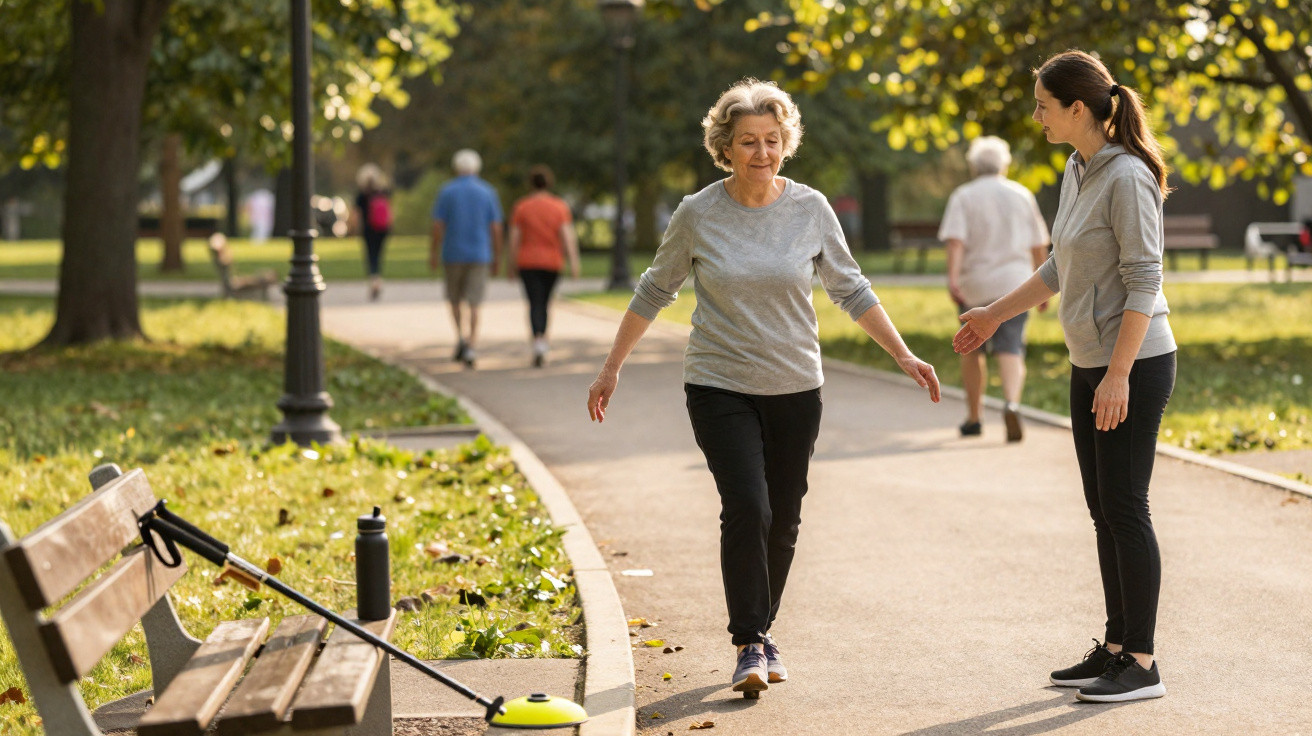
From the age of 70, the body goes through natural changes that can affect strength, reaction speed and the ability to maintain posture. Walking remains a recommended activity, but on its own it may not address all of these areas. For that reason, balance training has become an essential complement to help lower the risk of falls, maintain independence in everyday tasks and build confidence when moving around both indoors and outdoors.
Why is walking alone not enough after the age of 70?
Walking supports cardiovascular fitness, helps with the management of long-term conditions and benefits mental wellbeing, but it mainly develops aerobic endurance and a degree of leg strength. Balance, however, relies on elements such as foot sensation, core strength and the way the eyes, inner ear and brain work together-systems that are not fully challenged by simply walking in a straight line.
As we get older, there is a natural decline in muscle mass, bone density and the ability to respond quickly to trips and slips. Traditional walking on flat ground at a comfortable pace is a predictable movement that rarely demands sudden changes of direction or different types of support, which means balance can still deteriorate even in people who remain active.
How does balance training help older adults stay independent?
Balance training plays a direct role in preventing falls, which are among the leading causes of hospital admissions and loss of independence in later life. By practising stability, the body becomes better at responding to minor wobbles, strengthening stabilising muscles, improving coordination and increasing confidence for tasks such as showering while standing or going up steps.
These exercises can also improve posture and joint mobility, as well as sharpen awareness of where the body is in space. This makes everyday actions easier, such as turning your head when crossing the road, looking back when getting into a car, or bending to pick something up from the floor without losing your base of support.
Watch a video on the YouTube channel "Functionality – Rehabilitation and Physical Activity" showing the real importance of balance training for older people:
Which balance exercises work best alongside walking?
A number of straightforward exercises can be paired with walking to create a more complete routine focused on balance and safety. In general, combining moderate walking with single-leg holds, sideways movements and core strengthening can lead to meaningful improvements in stability and confidence when moving around.
Below are practical examples that can be adapted to each older adult’s ability level, always prioritising safety and, where possible, using professional guidance:
- Standing on one leg: stand still on one foot for a few seconds, alternating sides, while holding a solid support.
- Line walking: walk as if on an imaginary straight line, placing one foot directly in front of the other.
- Side steps: step sideways with knees slightly bent and posture upright.
- Sit-to-stand from a chair: stand up and sit down without using your hands, training balance and leg strength.
- Heel raises: rise up onto your toes and lower down slowly, holding the back of a chair.
How can you practise balance exercises safely day to day?
If you are practising at home, safety must come first: choose a spacious, well-lit area with no loose rugs or clutter on the floor. The back of a sturdy chair, the edge of a table or a wall can be used for support, allowing the older adult to gradually rely less on their hands as they feel steadier.
When walking is combined with balance training, cardiovascular endurance, strength, coordination and stability are developed at the same time. This can make it easier to walk on uneven pavements, climb stairs, carry shopping bags and get out of bed without assistance-reducing the risk of falls and helping to preserve functional independence, a key factor for quality of life and autonomy in later life.




Comments
No comments yet. Be the first to comment!
Leave a Comment