
You bend down, only planning to change your shoes quickly, and there it is again: that tug deep in the hip, like a tiny barb beneath the skin. We all know that moment when your body says “stop”, even though your mind is still charging ahead.
On the bench beside you, a runner rubs her side; a CrossFitter stretches out his legs, pulls a face, and takes a sip of his shake. The coaches call goodbye, the strip lights flicker once as the door swings open. Outside, the evening awaits - inside, one question sticks: what now, so it doesn’t pinch again tomorrow?
Later, a physiotherapist demonstrates a movement so subtle it’s almost invisible. No spectacle, no cracking, no big drama. The answer lives in millimetres.
Why your hip complains after sport
After hard sessions, the hip can feel tight - as if someone has tightened the bolts. Often it’s the combination of shortened hip flexors and an overworked gluteal system quietly pulling the strings. It sounds basic, and it is - right up until it becomes irritating and starts limiting your running.
Picture Jana, 34, a desk-based job, an after-work run along the canal. She sits for eight hours, then sprints up a bridge. Her hip flexors have been working since morning; her glutes have effectively been off-duty. By the end of the third kilometre, she feels a niggle at the side - a dull pull that lingers when she climbs stairs.
Anatomically, it fits. The iliopsoas muscle attaches at the front of the pelvis; the tensor fasciae latae (TFL) sits to the side. If you sit a lot and then train hard, both can end up doing too much pulling. They can draw the hip into a slight anterior tilt, the lumbar spine takes over, and the glutes switch off. The result is tension that can feel like “pressure in the joint”.
The simple stretch physiotherapists love
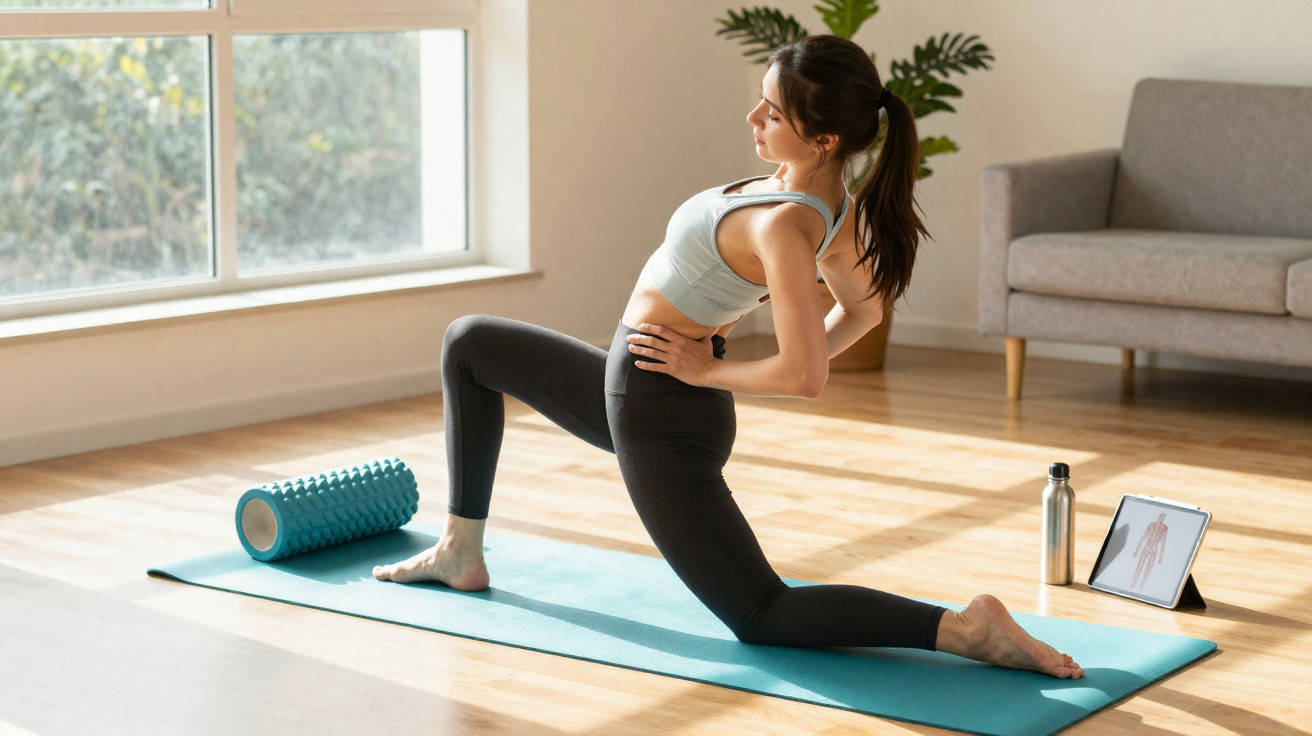
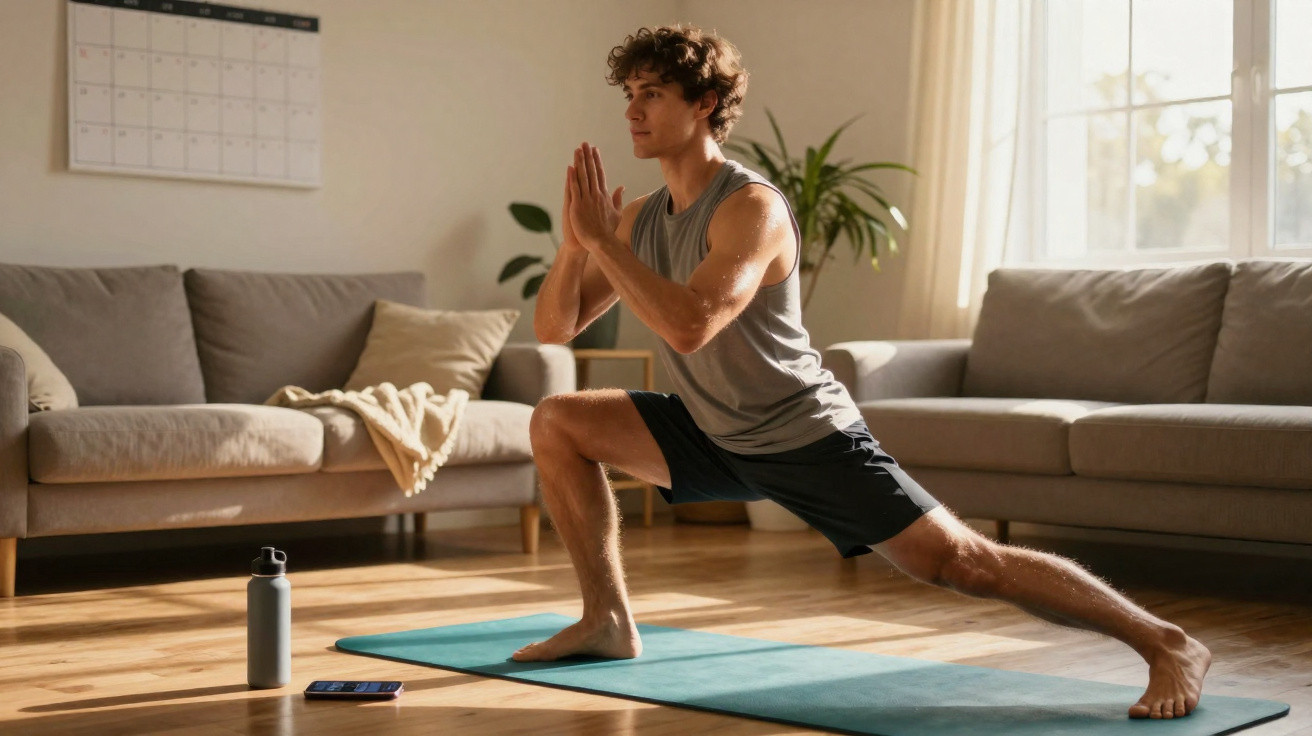
The half-kneeling hip flexor stretch is understated and exact. Come into a half-kneeling position: right foot in front, left knee on a mat. Now actively tip your pelvis backwards, as if you’re drawing the zip of your trousers up towards your navel - posterior pelvic tilt. Do you feel a gentle stretch at the front of the left hip? Hold it and breathe calmly for five deep breaths.
Stay tall, lightly brace your core, and gently engage the left glute. If you want more, raise your left arm, reach up towards the ceiling, and lean very slightly to the right. No forcing - think fine-tuning: one centimetre forwards, two millimetres sideways, breathe. Then swap sides. Two rounds are often enough before you wander off to the shower.
Common mistakes: tipping forwards like a deep lunge, collapsing into an arched lower back, flaring the ribs. That’s how the stretch misses the target. Put a cushion under your knee if pressure is uncomfortable. If you notice your back taking over, ease back a fraction and find the pelvic movement again. Breathing releases more than brute force.
Common stumbling blocks - and how to avoid them
This stretch doesn’t work because you do “more”; it works because you do it “accurately”. If you shove your torso forwards aggressively, you end up dumping into the hip joint rather than targeting the muscle. Begin small, hold the tilt, then use your breath to soften into it. Five calm breaths per side, two to three rounds - that’s plenty.
Let’s be honest: almost nobody does this every single day. Slot it in after hard runs or heavy squats, ideally in the evening once you’re near the sofa. If the knee complains, switch to a standing version: place the foot on a low step, tilt the pelvis, glide slightly forwards, lift the arm. No pain - just a comfortable pull.
“Most people only realise how tight their hips are when they learn to move the pelvis on purpose. Less leverage, more control - that’s when the relief arrives,” says an experienced physiotherapist.
- Key cue 1: Breathing matters - 5 calm breaths, no rushing.
- Key cue 2: Pelvis first, movement second.
- Key cue 3: A light glute squeeze keeps the hip tracking well.
- Dosage: 2–3 sets per side, 3–5 days per week.
- Stop signal: Sharp pain? Stop the exercise and get it checked.
Think it through instead of pushing it away
The hip is a small traffic interchange. When flow slows, irritation can back up from the back, thigh, and pelvic floor. This stretch creates space - nothing more - and that’s exactly why it’s powerful. When you make space, you give your body options again.
You might notice your next run starts more smoothly, your stride lengthens without you trying to lengthen it. Or you might simply find that putting your shoes on is no longer a mini test. That alone is a win.
Want a bit more long term? Pair the stretch with two sets of glute bridges or side leg raises. Release tension, add stability, tidy up the day - in that order. Patience wins, not a dramatic overhaul on a Monday night.
| Key point | Detail | Why it matters to you |
|---|---|---|
| Understand the cause | Hip flexors and the TFL often shorten after lots of sitting and sport | Helps you see why your hip pinches after training |
| The kneeling stretch | Tilt the pelvis backwards, lift the arm, hold for 5 breaths | Clear, step-by-step guidance |
| Avoid mistakes | No arched lower back, don’t “push” forwards, use your breathing | Feel the effect faster without overload |
FAQs:
- Does this stretch help with lateral hip pain too? Yes, it often reduces tension in the TFL and along the lateral chain. If pain is sharp or wakes you at night, get it checked medically.
- Should I do it before or after training? After training for relaxation. Before training, keep it brief and gentle, paired with activation (e.g. glute bridges) for stability.
- How long should I hold it, and how many times per week? 3–5 calm breaths per set, 2–3 sets per side. Three to five times per week is a solid starting point.
- What if my knee hurts on the floor? Use a thick cushion or mat underneath. Alternatively, choose a standing hip flexor stretch using a bench.
- What if I feel pulling in my back? Reduce leverage, “stack” the ribs, retip the pelvis. If needed, switch to 90/90 hip rotation - smaller angle, clearer control.

Comments
No comments yet. Be the first to comment!
Leave a Comment