
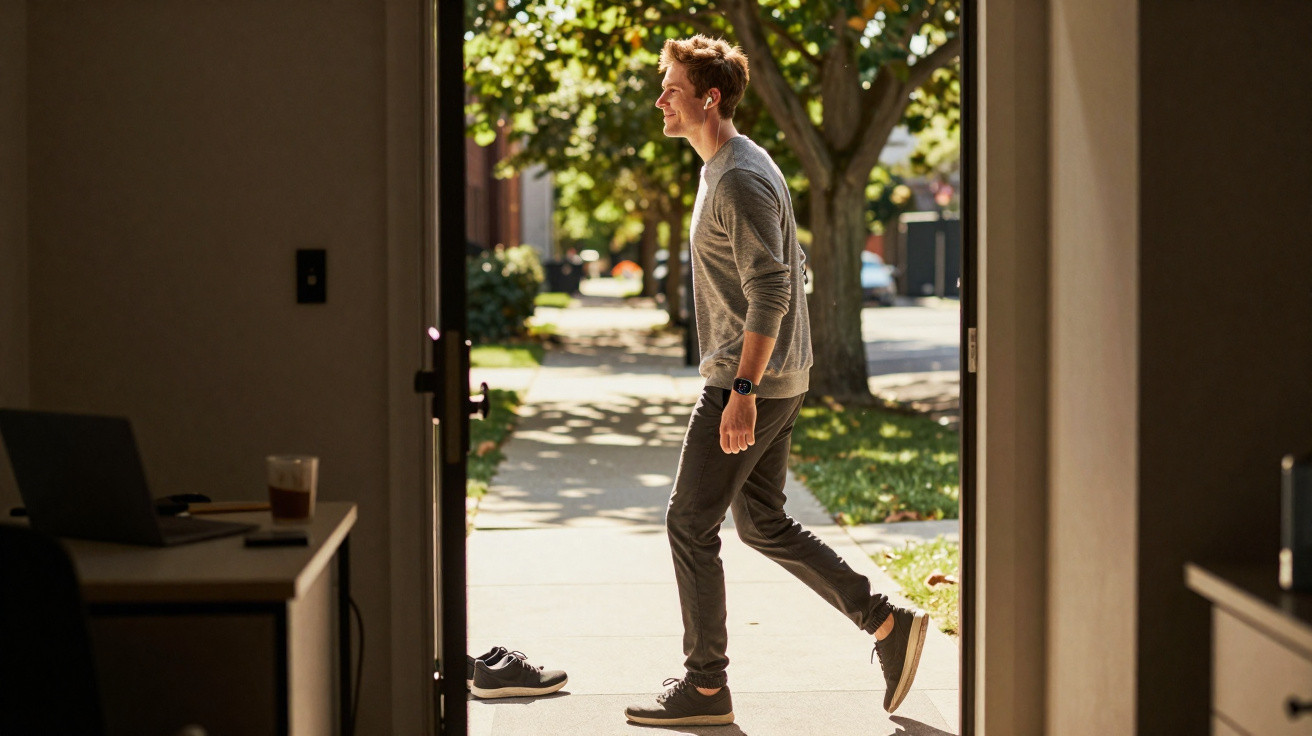
A man in a grey hoodie comes to a halt after precisely seven minutes.
He checks his watch; in the cold, his breath hangs in front of him. Then he turns and heads back towards his flat. Around him, dogs pull at their leads and runners glide by in fluorescent shorts, while he simply paces a small rectangle of city pavement. Identical route, twice daily. Brief. Almost comically brief.
On the bench close by, a woman in office heels flicks through emails with one hand and grips a takeaway coffee with the other. She keeps looking up at the time. Eventually she exhales, gets to her feet and begins circling a tiny square of grass at a slow pace, as if she’s trying to shrug something heavy off.
None of it resembles anything “sporty”. There’s no sweat, no split times, no personal bests. And yet, when they return to the same spot, something in their expressions has shifted. Their gaze is gentler. Their jaw isn’t clenched.
What if that’s the real victory?
Why the shortest walks often hit the hardest
The surprise is this: short walks don’t merely “count” - in the ways that actually affect everyday life, they can beat longer ones. A 5 to 10‑minute wander can cut stress, sharpen focus and settle cravings before they properly get going. Long walks are brilliant for a leisurely Sunday. But most weekdays are made of small gaps.
Your system responds quickly. Within minutes, blood sugar begins to move. Your heart rate starts to settle. Your shoulders loosen by a few millimetres. You’re not training for stamina here; you’re hitting a reset switch. The input is small, and the benefit arrives immediately.
On a Tuesday afternoon, that matters.
Consider blood sugar: studies suggest that three short 10‑minute walks after meals can improve glucose control more than doing one 30‑minute session. And among office workers, taking 5‑minute walking breaks every half hour is linked with better mood and less tiredness than staying stuck in a chair for hours.
In Japan, research into “forest bathing” indicates that even a short walk among trees can bring down cortisol - the stress hormone - in under 15 minutes. You don’t need woodland to notice a shift. A loop round your street, a circuit of the car park, or walking to the furthest loos in the building begins to nudge the same underlying systems.
That’s the low‑key truth: you don’t have to formally “go for a walk” to get the upside. You simply need to walk.
Short walks work so well because they slide beneath your brain’s alarm system of excuses. A 45‑minute workout demands planning, willpower, the right clothes, and sometimes even a shower afterwards. A 7‑minute walk mostly requires putting shoes on and stepping out of the door.
They’re gentler on your joints. Recovery barely registers. Instead of one big, intense hit, your nervous system gets frequent micro‑messages of movement and safety. Over days and weeks, those micro‑bursts influence habits, metabolism and even sleep.
Think of long walks as the road trip, and short walks as the daily commute for your health. Road trips are great. But the body tends to flourish on the commute.
How to make short walks insanely effective
There’s a straightforward way to make short walks far more effective: link them to moments, not to motivation. After your coffee, walk for five minutes. After lunch, do a lap of the block. After your final email, head to the end of the street and back. No bargaining, no big choice - just a small ritual.
Experiment with speed. Amble for the first minute, then pick up the pace with intention - like you’re late for the bus, but not actually running. Let your arms swing a little more. Notice your breathing deepen. Even a brief spell at this “purposeful” pace can lift circulation and switch your brain on.
If routines make you itch, keep just one element fixed: the time. Seven minutes. Ten minutes. Same number, different routes.
Many of us either make walking complicated or write it off as “not enough”. That’s where people stall. They wait for the ideal 30‑minute slot, in the ideal outfit, at the ideal time of day. The slot keeps shifting - and the walk keeps not happening.
On tough days, your brain mutters, “What’s the point if it’s only five minutes?” On better days, it argues, “You can do it later - you’re busy right now.” It isn’t laziness; it’s a brain designed to avoid friction and save energy. A short walk feels too small to justify a negotiation.
The irony is that its smallness is exactly why it happens. Tiny wins done daily beat ambitious plans abandoned halfway.
To cut through that resistance, it helps to change the label you give walking.
“I stopped calling it ‘exercise’ and started calling it my ‘reset lap’,” a 38‑year‑old project manager told me. “Five minutes around the block between calls. My smartwatch doesn’t care. My anxiety does.”
Words shape behaviour. When a walk becomes a reset, a breather, or a thinking tool, you stop scoring it by calories. You start valuing it in different currencies: patience, clarity, sleep.
- Choose one “anchor” moment in your day (after breakfast, after a meeting, after putting the kids to bed).
- Add a 5–10 minute walk to that anchor - no negotiation.
- Set the bar so low that even the exhausted, stressed version of you still agrees.
Let’s be honest: nobody manages this every single day without missing one. But each time you return to it - even after a chaotic week - your body re-adapts quicker than you’d expect.
Let short walks redesign your days
There’s something quietly bold about saying, “I’m going for a two‑song walk,” grabbing your keys and heading out. No fuss. No app telling the world. Just a small act of self‑respect woven into a hectic day. Those five or seven minutes can draw a line between one version of you and the next.
With time, these mini walks begin to shift things you didn’t see coming. You may feel less pulled towards that 4 p.m. sugar hit, or find you’re a touch less snappy with your partner in the evening. Your phone stays in your pocket for a couple more breaths. The world starts to look slightly more three‑dimensional again.
We’re often sold the idea that health lives in gyms, marathons and big efforts. Yet the quieter revolution might be in how you walk to buy bread, the way you move after dinner, or the five minutes you spend circling the block while the pasta cooks. Short walks are small enough to fit inside real life - and that’s exactly why they’re powerful.
| Key point | Detail | Benefit for the reader |
|---|---|---|
| Repeated short walks | 3×10 minutes or several 5‑minute breaks can outperform a single 30‑minute block on certain health markers | Makes it possible to build activity in without overhauling your whole schedule |
| Walking “anchored” to moments | Consistently pair a walk with coffee, a meal, or finishing work | Builds an automatic habit with almost no mental effort |
| Mental and emotional role | Micro‑walks act like a reset button for stress, concentration and sleep | Helps you feel calmer, clearer and more present day to day |
FAQ:
- Do short walks genuinely improve health? Yes. When you do them regularly across the week, short walks can support blood sugar control, mood, energy and even cardiovascular health.
- How short is “short” for a walk to be worthwhile? Even 5 minutes can help. It’s usually better to aim for 5–10 minute pockets across the day than to wait for one long session.
- Is an easy stroll still beneficial, or must I walk quickly? A relaxed pace supports your joints, your mind and circulation. If you want more impact, add brief bursts of “purposeful” walking - slightly out of breath but still able to talk.
- Can short walks help with weight loss? On their own, they aren’t a magic solution, but frequent walking increases daily energy use and can reduce cravings and stress eating, which can quietly support weight goals.
- What if my job has me sitting for most of the day? Build in micro‑walks: use a toilet on another floor, go round the block after calls, or pace during phone meetings. Even small breaks reduce the damage of long stretches of sitting.


Comments
No comments yet. Be the first to comment!
Leave a Comment