
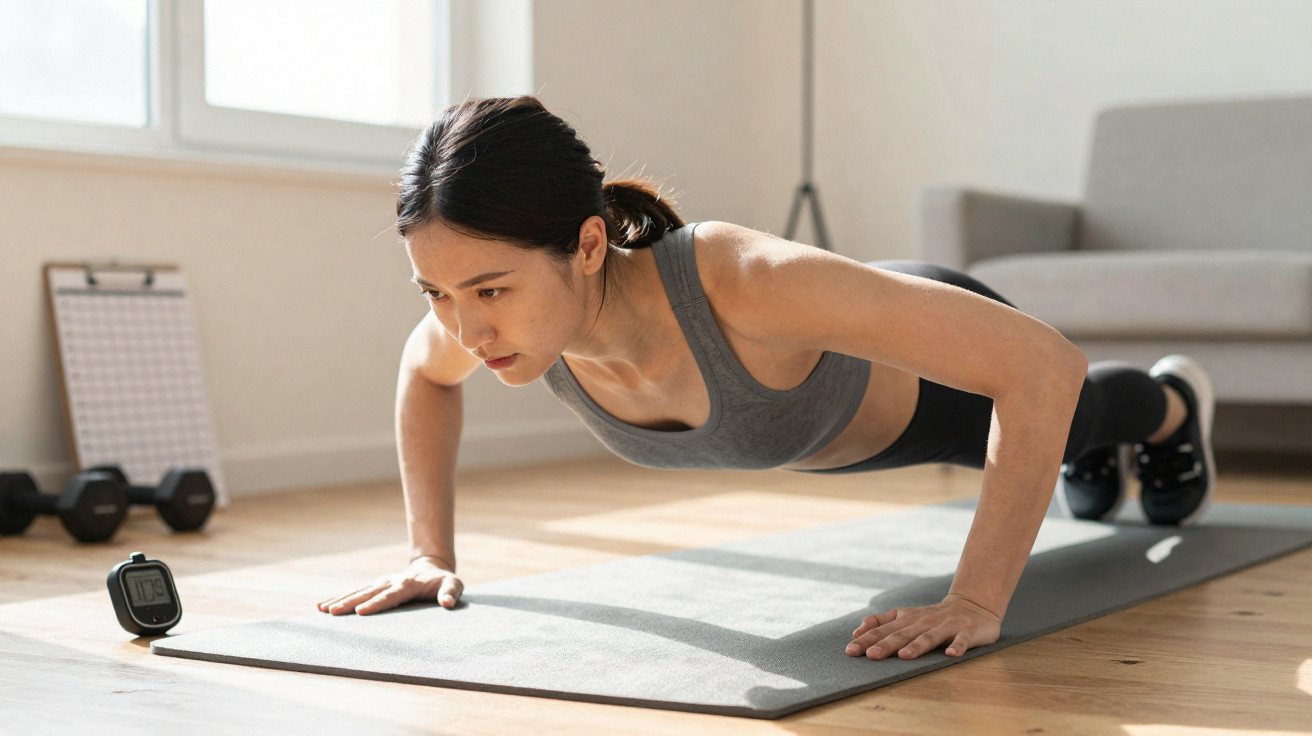
Press-ups are often used as a straightforward way to gauge general fitness. How many you can complete in one unbroken set can reflect muscular strength and endurance - provided your technique is solid. Because they require no equipment and very little space, they feature heavily in gyms and home workouts, recruiting multiple muscle groups at the same time.
Do press-ups indicate a good level of fitness?
Press-ups are not a medical test, but they do offer a practical benchmark for upper-body and core strength and endurance. In adults, results can vary widely depending on age, sex, body weight, training background and any joint limitations.
For women, performance is often considered good at roughly 20 repetitions (ages 20 to 29), 19 (30 to 39), 14 (40 to 49), 10 (50 to 59), 10 (60 to 69) and 8 from age 70 onwards. For men, guideline figures are around 28, 21, 16, 12, 10 and 8 to 10 repetitions across the same age brackets. These numbers are only broad reference points: people with an advanced sporting background, greater muscle mass or targeted strength training may exceed them easily, while beginners or those with chronic shoulder and wrist pain may score lower - without that automatically indicating poor overall health.
Watch a video on the YouTube channel Leandro Twin to learn more about the benefits of press-ups.
How to do press-ups correctly and avoid common mistakes
Good form starts with your hands placed about shoulder-width apart, your body in a straight line from heels to head, and your abdomen gently braced. As you lower, bring your chest towards the floor with your elbows angled slightly back; as you push up, straighten the arms without snapping or aggressively locking the joints.
A few checkpoints can help you spot and fix the most common faults during the movement:
- Hips dropping or piking up, which breaks the body’s alignment.
- Neck jutting forwards, placing extra strain on the cervical spine.
- A very short range of motion, which reduces effective muscular work.
- Shoulders shrugging up excessively, creating compensations and overload.
It also helps to keep your hands firmly planted, share your weight between palms and fingers, and breathe with a steady rhythm: inhale on the way down and exhale as you push up. This supports trunk stability, protects the spine and can improve performance across sets.
What to do when traditional press-ups are too difficult
For beginners or anyone returning after a long period of inactivity, standard floor press-ups can feel tough. Rather than forcing uncontrolled repetitions, it is better to use variations that allow good posture and safe progression.
One approach is to do press-ups with your hands on an elevated surface, such as a sturdy bench or a solid handrail, which reduces the direct load. Another option is the knee-supported press-up, still keeping the trunk steady and the abdomen engaged. Two to three sessions per week, with two to three sets, is enough to encourage gradual strength gains.
Over the following weeks, you can lower the height of the surface or slowly increase the number of repetitions, always putting movement quality first. For people with joint pain, adjusting hand width and completing a light warm-up for shoulders and wrists before the sets can make the exercise more comfortable and safer.
Are press-ups enough to assess health and physical conditioning?
Press-ups mainly test upper-body strength and endurance, along with trunk stability, but they do not assess flexibility, balance, leg power or cardiorespiratory fitness particularly well. For that reason, they are often paired with running or walking, lower-body tests and mobility checks.
Even someone who manages only a few repetitions may still be very fit in other activities, especially if shoulder or wrist issues are present or if they have a higher body weight. Tracking how the number of well-executed press-ups changes over the weeks can be a useful point of interest: it reflects improvements in strength, coordination and postural control that help preserve functional independence, particularly as we age. Even so, for a fuller picture of health, it is advisable to combine this kind of test with regular clinical check-ups, blood pressure assessment, evaluation of cardiorespiratory fitness and other important markers such as muscle mass and body composition.




Comments
No comments yet. Be the first to comment!
Leave a Comment