

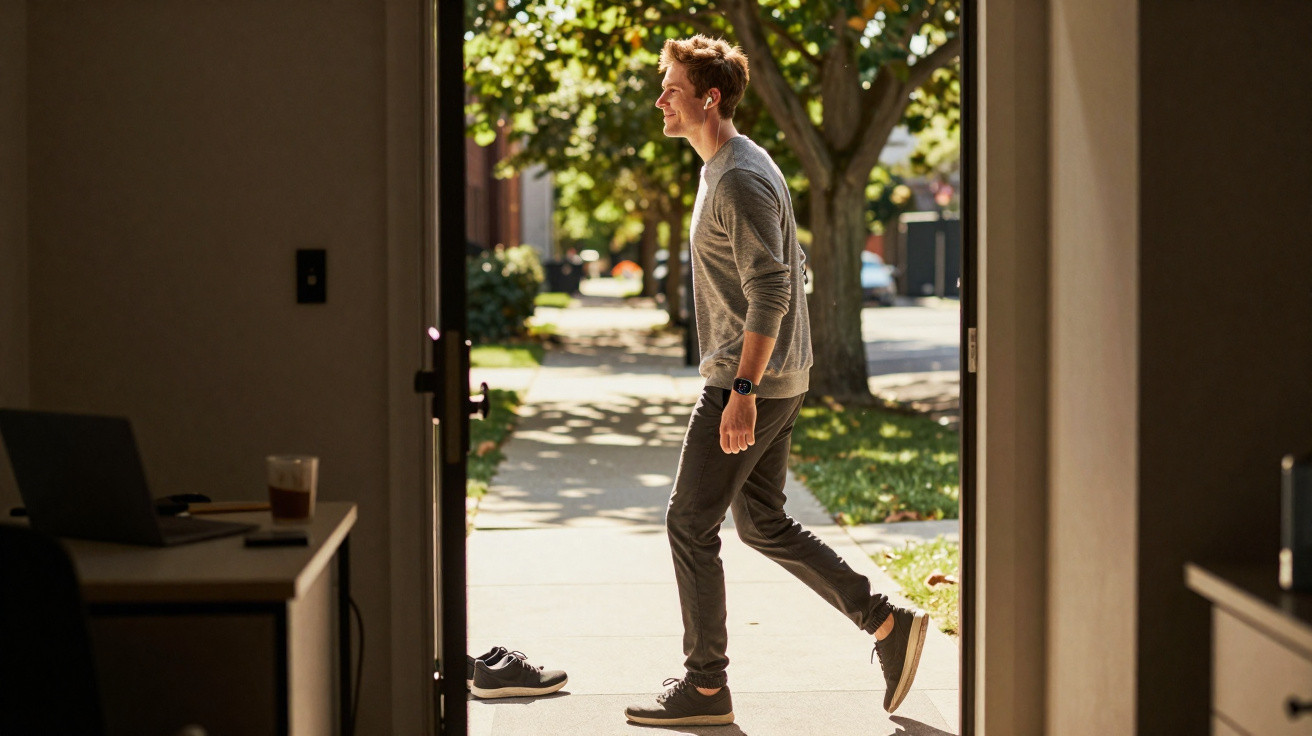
No machines, no thumping playlist, no sweat-soaked selfie. Just one man walking alone in the pale morning light down a quiet residential road. And yet his smartwatch is going off nonstop: heart rate rising. Zone 2. Calories ticking upwards. A few streets away, a shiny new gym sits almost deserted, with treadmills glowing in standby. Fees have been paid; bodies haven’t shown up.
We’re constantly told real change happens in the gym: heavy plates, bright lights, mirrors everywhere. But an increasing number of specialists are calmly pushing a message that sounds almost provocative: a well-done walk can do more for your health than that unused membership. The problem is that it only holds true if you stop treating walking like a lazy potter to the kitchen.
They put it plainly: walking can beat the gym - but only under one strict condition.
Why your “simple” walk can outsmart an expensive gym
Look around any busy city at 7 a.m. and you’ll see modern fitness split in two. One group hauls gym bags and checks the clock with rising stress. The other pulls on trainers, walks the dog, commutes on foot, or takes the longer route through the park. From the outside, one side looks committed, while the other seems to be merely… getting about.
What experts keep stressing (sometimes with visible exasperation) is that the “just getting about” group may be closer to the real advantage. Not because walking is some miracle trick, but because it’s realistic. You can do it again tomorrow. And the day after. It’s sustainable effort - the sort your exhausted brain doesn’t have to battle every single day.
Once a walk reaches a certain intensity, your body starts changing in quiet ways that most people seriously undervalue.
Consider the now-famous 10,000-step idea. It didn’t come from a laboratory; it came from a 1960s marketing campaign for a Japanese pedometer. Even so, research keeps landing on an uncomfortable point for the fitness industry: people who walk briskly for 30–45 minutes on most days often improve health markers that match - and sometimes outperform - those of occasional gym-goers who go hard once or twice, then vanish.
Researchers at the University of Leicester, for instance, reported that brisk walkers lived longer than slow walkers regardless of body weight. “Brisk” meant you could talk, but not sing. Straightforward enough. Another Harvard study followed thousands of people and found that consistent walking reduced heart disease risk by roughly the same margin as running - provided the total energy burned was similar.
The snag is that most people’s “walk” looks more like a gentle drift between emails than an actual health strategy. That’s where the whole argument turns.
Experts keep returning to a blunt point: the benefit isn’t in walking by default - it’s in the way you walk. Pace, regularity and intent are what turn a pleasant stroll into what some cardiologists now describe as the most underrated drug in modern medicine.
When you move fast enough to lift your heart rate into a light cardio zone, your muscles start soaking up blood sugar more effectively. Blood flow improves. Stress chemistry begins to settle. And unlike many gym plans, this kind of effort doesn’t punish your joints or rely on guilt as fuel. It slips beneath your brain’s resistance.
So yes, walking can beat the gym - but not if you’re shuffling along, scrolling, and pausing whenever your phone buzzes.
The one condition: turn your walk into “intentional walking”
When professionals describe walks that genuinely compete with a gym session, they keep using the same word: intentional. That doesn’t mean stomping around in a bad mood or marching like you’re on parade. It means that, for a short window, this isn’t “background movement” - it’s the focus.
Their easiest rule of thumb is this: walk like you’re slightly late. Not running. Not jogging. Just the steady, purposeful pace you naturally adopt when your train leaves in six minutes. Your breathing becomes deeper, your arms swing more, and your mind switches on.
If you want a number, many coaches suggest 100–120 steps per minute, which is a brisk pace for most adults. Others prefer the talk test: you can still chat, but you’d rather keep it brief. Go easier than that and you’re back in the territory of “nice, but not enough”.
On a dreary Tuesday afternoon, Emma, 43, noticed her gym membership had become a quiet “shame tax”. Each monthly payment simply reminded her she wasn’t “the sort of person who works out”. Then one day, walking home from the supermarket with two heavy bags, she checked her phone and saw her heart rate sitting in the same zone her trainer had targeted on the cross-trainer.
She set herself a simple deal: 30 minutes of “late-for-the-bus” walking, five days a week. No outfit changes. No travelling to the gym. Just trainers by the door. Six weeks later, she’d missed no more than two days. Her jeans felt looser. Her resting heart rate had dropped. Sleep felt heavier - like proper rest rather than collapse.
And she still hadn’t walked into the gym.
Her experience is far from rare. People who struggle with rigid gym schedules often find they can quietly build up 150–180 minutes of solid, intentional walking each week. Your body doesn’t care where the effort came from; it responds to the work.
Cardiologists explain it simply: your heart prefers consistency to theatrics. A punishing HIIT class every second Sunday does less for long-term cardiovascular health than repeated moderate efforts that your life can actually accommodate. Done this way, walking becomes a low-drama training plan for your whole system.
That’s why the “only if” matters. A slow wander can be excellent for your head, and sometimes that’s exactly what you need. But if you want walking to truly rival the gym, it has to cross a line: your body must register the effort. Your legs should be working. Your mind should feel lightly tested.
Hit that sweet spot, experts say, and you unlock a form of movement that’s almost unfairly effective for how ordinary it appears.
How to walk so it really beats the gym (and what people get wrong)
The approach many trainers now push is almost embarrassingly straightforward. Treat your daily walk as three phases: a warm-up, your engine time, and a cool-down. Spend five minutes building up, then do 20–30 minutes at that brisk “I’m slightly late” pace, and finish with five minutes easing off.
That middle section is where the gym-like benefits sit - your “engine time”. Choose a route where you won’t be forced to stop every 50 metres. Traffic lights, crossings and shopfront distractions wreck momentum. Some people do loops in a park; others pick a gently uphill road. A mild incline lifts your heart rate without needing frantic leg speed.
Twice a week, many coaches also recommend “power intervals”: two minutes faster than your usual pace, then two minutes back at brisk, repeated 4–6 times. It’s a low-impact cousin of interval training that can improve fitness without turning your walk into misery.
A very common mistake is letting a walk become a scrolling session. Your feet move, but your pace fades, your posture collapses, and your breathing turns shallow. Researchers and coaches see the same pattern repeatedly: people assume they’re active, yet their heart-rate data looks more like they’re standing in a queue.
Another trap is the “all or nothing” mentality. Miss a day, feel guilty, and abandon the habit. That mindset kills gym routines - and it quietly wrecks walking habits too. On rough days, even 10 brisk minutes still matter. They preserve the identity: someone who moves, even when life is chaotic.
We’ve all had evenings where the sofa wins and the hours vanish into mindless scrolling. Intentional walking isn’t about flawless streaks; it’s about creating a sustainable default that feels close to automatic. Let’s be honest: nobody truly nails that every single day.
Experts also keep circling one emotional reality: walking doesn’t threaten your sense of self in the way the gym sometimes can. There’s no need to “perform fitness”. You simply move with purpose, push a little beyond comfortable, and repeat.
“If brisk walking were a pill,” says one preventive cardiologist, “it would be the blockbuster drug every doctor prescribed. But because it looks ordinary, people underestimate it - and that’s the tragedy.”
So what does “doing it properly” look like in everyday life? Many specialists suggest a short checklist you can scan before you head out.
- Choose a route with minimal stops and, ideally, a slight incline.
- Walk as if you’re a little late: heart rate up, talking possible but not effortless.
- Keep your arms free and let them swing naturally to support your pace.
- Treat the walk like an appointment: same time, most days.
- When motivation is low, reduce the minutes - not the intent.
Walking as a quiet revolution against “perfect fitness”
There’s something subtly defiant about choosing walking over the gym in a culture that worships extremes. No dramatic transformation montage. No flashy before-and-after shots. Just the steady, almost unglamorous rhythm of feet on the pavement, repeated day after day.
That’s precisely why so many physiologists, cardiologists and mental health professionals are fighting to restore walking’s status. They see what most people overlook: the compound effect of small, repeatable effort. They see blood pressure coming down, anxiety easing, sleep deepening - all from a habit that rarely earns attention online.
Walking with intention doesn’t demand a new personality. It asks for a tweak to what you already do: leave 10 minutes earlier, take the longer route, lean into the pace. Stop treating it as a filler between “real” workouts and start viewing it as the backbone of your physical life.
Some people will always love the gym, and that’s perfectly fine. Heavy lifting, classes and community matter. But if the gym has turned into a monthly reminder of failure, walking can be your route back to movement that feels human again - not punishment, but something your body already recognises.
And perhaps next time you pass an almost-empty gym during your brisk evening loop, you’ll feel something unexpected: not guilt, not envy, but a quiet certainty that your “simple” walk is doing far more than it looks.
| Key point | Detail | Why it matters to you |
|---|---|---|
| Intensity before distance | Walk as if you’re slightly late for 20–30 minutes | Turns an everyday stroll into genuine cardio training |
| Quiet consistency | 150–180 minutes of intentional walking per week | Delivers benefits comparable to irregular gym sessions |
| Simple logistics | No travel, no fancy kit, just a pair of shoes | Makes it easier to stick with and actually see results |
FAQ:
- How fast do I need to walk for it to “beat” the gym? Aim for a brisk pace: you can talk, but you wouldn’t sing. For most people that’s about 100–120 steps per minute, or feeling slightly out of breath without struggling.
- Do I really need 10,000 steps a day? Not necessarily. Many experts now prioritise intensity and total minutes of brisk walking (around 150–180 minutes a week) over hitting a fixed step target.
- Can walking fully replace strength training? Walking is excellent for heart health, mood and weight management. For joint support and healthy ageing, it’s still sensible to add a little strength work a couple of times a week.
- What if I can only manage 10–15 minutes at a time? It still counts. Keep it brisk and treat those minutes as focused. A few short intentional walks across the day can add up to meaningful health gains.
- Does it matter whether I walk on a treadmill or outside? Both are effective. Outdoor walks often support mood and long-term motivation, while treadmills let you control pace and incline. The best option is the one you’ll actually do most days.




Comments
No comments yet. Be the first to comment!
Leave a Comment