
The rain was still hanging heavy in the air when the running group slumped against the stadium fence after their intervals. Faces flushed, breathing shallow - that familiar mix of pride and mild nausea. One person went straight for their water bottle, another was already scrolling through their training log, while thighs slowly started to set like concrete. Only Lisa didn’t get into the car. Instead, she wheeled an unremarkable trekking bike out of the rack.
“I’m just going to roll easy for half an hour,” she muttered, as the others stared at her like she’d lost the plot.
The next morning, she was the only one who walked up the steps to the track completely relaxed. No shuffle, no swearing about sore legs. Something about it stuck.
Why did her body feel so much more alive after hard runs - just from a bit of easy cycling?
Why easy cycling suddenly makes tired running legs feel supple
Anyone who has finished a tough running session, “put their feet up for a minute” on the sofa, and then stood up two hours later like a tin man knows the issue. Yes, the body needs recovery - but total stillness can leave the legs feeling even tighter.
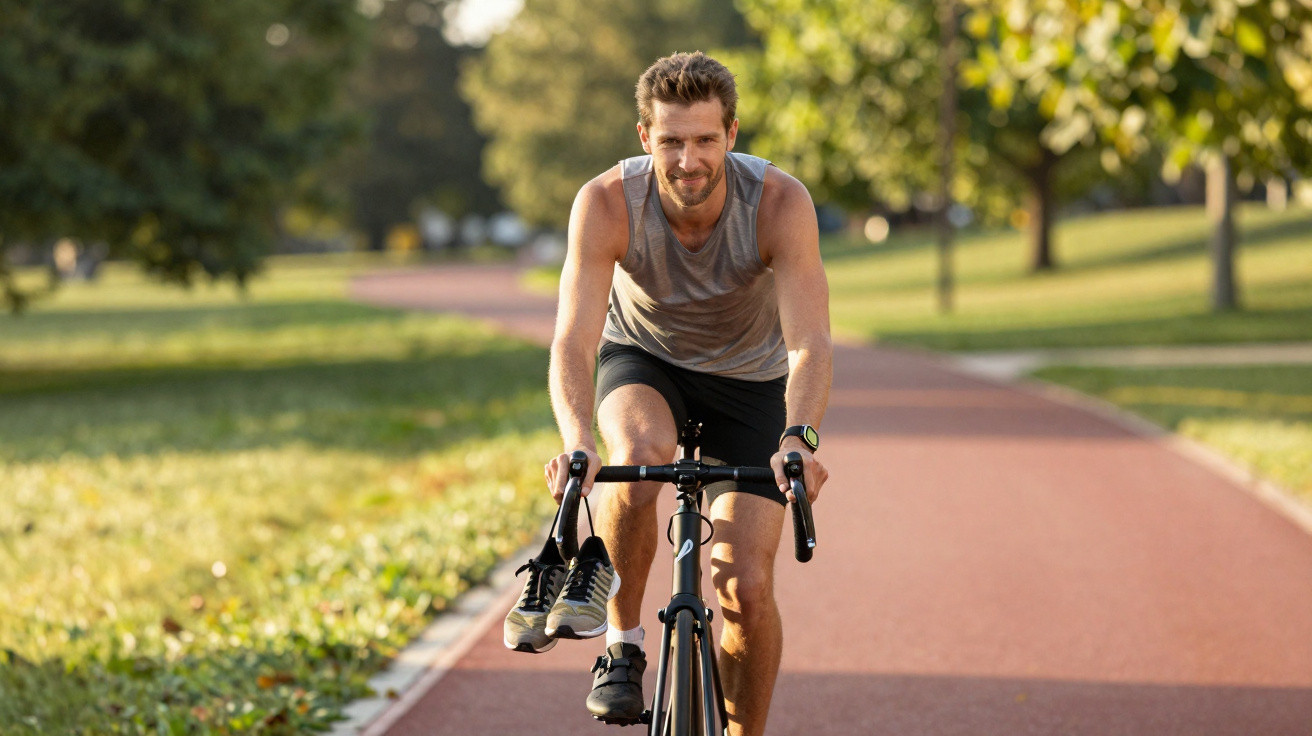
Easy cycling offers a different route. The pedal stroke is circular, the joints take far less impact, yet you still push fresh blood through the thighs and calves. That swollen, heavy sensation starts to fade. The weight lifts, almost like a warm shower from the inside. It’s recovery that doesn’t feel like stopping, but like gently keeping things moving.
In plenty of running clubs, the “recovery ride” has quietly become a staple. Take Paul - 42, an ambitious recreational marathon runner with an office job and two children. His Sunday evenings after long runs used to be spent on the sofa with an ice pack and pain gel. Then an older club mate suggested something simple: 30 to 45 minutes of very easy cycling.
Now, after his long runs, Paul pedals to the ice cream shop at a barely-there pace, picks up tubs for the family, loops around a couple of extra streets, and rolls home. The effort stays so low that his heart rate hardly rises above what he’d see on a brisk walk. Even so, he says his legs feel noticeably fresher on Mondays - and that leaden Monday slump many runners recognise shows up far less often.
From a physiological point of view, this kind of easy spinning acts like a gentle clean-up crew. The heart works a little harder than at complete rest, but remains well below threshold. Blood flow helps clear metabolic by-products from the muscles, vessels open up, and tiny areas of tension get “moved through” without creating fresh micro-trauma. When you run, every step drives your body weight - multiplied - through the knees, ankles and hips. On the bike, that repeated impact simply isn’t there.
And let’s be honest: hardly anyone manages daily ice baths, stretching, foam rolling and perfect sleep. Easy cycling sits in the sensible middle - a kind of active massage that fits real life, whether you’re on a city bike, a gravel bike, or an old Dutch bike dragged out of the shed.
How to use the bike as a real recovery booster
The secret ingredient in recovery cycling isn’t the bike - it’s the intensity. It should feel almost comically easy: a pace where you can tell a full story without needing to grab a breath. Many people aim for 60–65 % of maximum heart rate, or a very gentle GA1 zone.
A useful duration is 20 to 45 minutes, depending on how hard the run was. After short but brutal intervals, 20–30 minutes is often enough. After a 30-kilometre run, 40–45 minutes tends to make more sense. Cadence matters too: keep it on the higher side - roughly 80–90 revolutions per minute - so the legs circle smoothly rather than grinding.
The most common mistake is letting an easy spin turn into “go on then, I’ll push a bit” - and quietly making it a second workout. Many runners are wired to treat every movement as a chance to improve performance. That’s exactly where the benefit flips: recovery becomes extra stress.
During a recovery ride, feeling slightly under-challenged is a good sign. If you finish thinking, “That barely counted,” you’re probably doing it right. It also helps to choose routes that don’t constantly force you to surge because of traffic lights, cars or hills - a flat riverside cycle path, an easy evening loop, or even an indoor trainer ride with a good podcast.
After one track session, an experienced coach once told his group:
“The skill in endurance sport isn’t training even harder. The skill is training hard and still turning up at the start line recovered.”
Taking easy cycling seriously is one way to build that kind of system - especially if you:
- sit a lot for work and your legs feel like they “lock up” after running
- are prone to shin pain or irritated Achilles tendons
- want to run more weekly kilometres without constantly getting injured
- often swing emotionally between “full gas” and “nothing at all”
- want your training to feel more structured, but not more complicated
At its heart, it isn’t about gadgets or elaborate plans. It’s about not pulling the plug on your body after a hard effort - but turning the lights down a notch.
Why recovery on the bike can be a mental game-changer too
Easy cycling after intense runs doesn’t just help muscles and tendons - it also shifts your headspace. Running is often tied tightly to times, pace and performance pressure. Plenty of people spend sessions staring at a watch, comparing segments, debating VO₂max numbers.
On the bike - in true recovery mode - those yardsticks fade. You’re moving and getting outside, but nothing has to be fast. Your mind can quietly process those nasty final intervals, while your body tidies things up in the background. This brief hovering space between effort and the sofa creates a small but noticeable gap in the day - and many describe it as unexpectedly freeing.
| Key point | Detail | Benefit for the reader |
|---|---|---|
| Joint-friendly movement | Cycling avoids impact loading and lets tired running muscles keep turning | Recovery without extra joint strain, especially with high running volume |
| Active blood flow | Low intensity, higher cadence, 20–45 minutes of easy rolling | Faster clearance of metabolic by-products, less of a “DOMS” feeling |
| Mental reset | Away from pace and time pressure, towards playful movement | Lower perceived stress, more enjoyment across the whole training process |
FAQ:
- How often should I do an easy ride after a run? For most people, it’s enough to add an easy spin after the truly hard sessions - intervals and very long runs - around 1–3 times per week.
- Does easy cycling count as its own training session? In many training plans it’s listed as “active recovery”, not as a full session. The goal is recovery, not fitness building.
- Can I cycle the next day instead of straight after the run? Yes - especially if time is tight post-run. A very easy ride the following day can noticeably take the edge off lingering soreness.
- Is a basic city bike or an e-bike enough? Absolutely. As long as you can pedal easily and keep the intensity low, any bike does the job. An e-bike can help too, as long as you use the motor so the effort stays comfortably light.
- What’s better for recovery: cycling or walking? Both are useful. Cycling often allows slightly higher blood flow with less joint loading, while walking is even more accessible. Many people mix the two depending on how they feel that day.





Comments
No comments yet. Be the first to comment!
Leave a Comment