
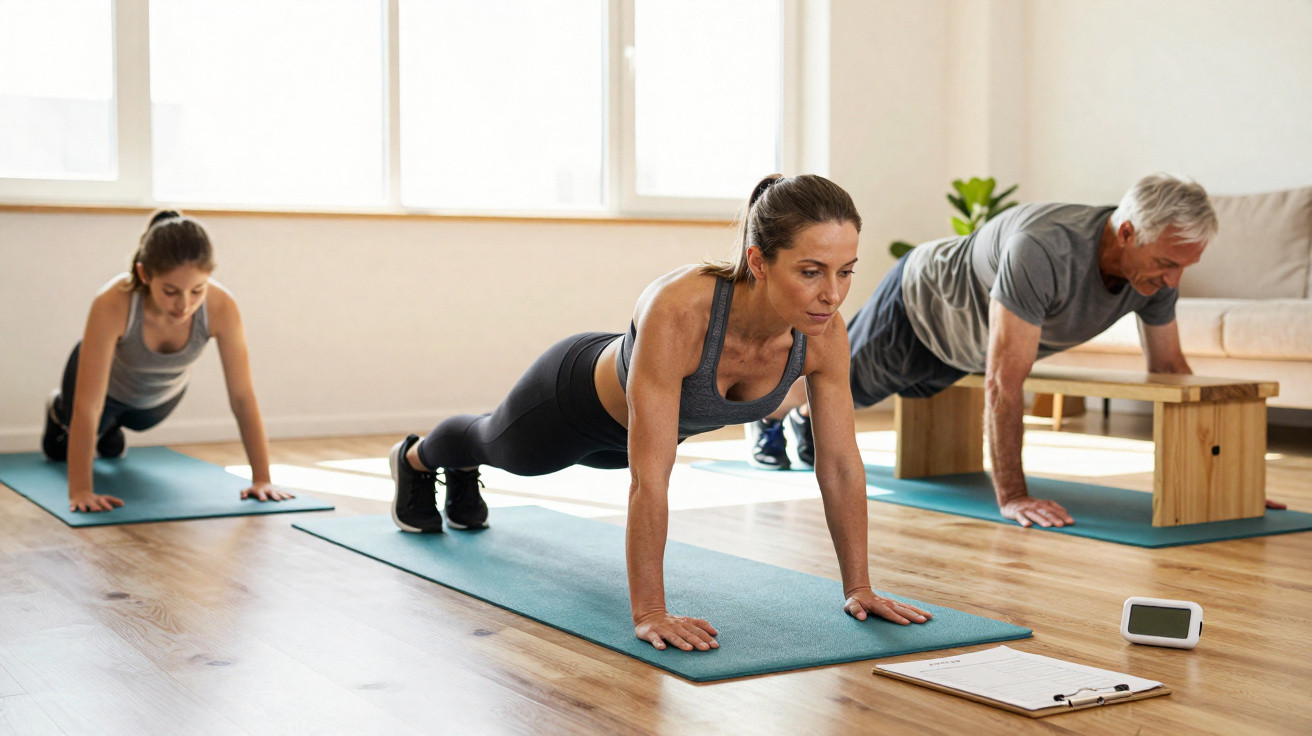
Push-ups are often used as a straightforward strength benchmark because they work the chest, arms, shoulders and abdominal muscles at the same time. The “right” number varies with age, training habits, body weight, technique and injury history. That is why the ranges below should be treated as general guidance, not a rigid standard for everyone.
Why are push-ups used as a fitness test?
A push-up is convenient because it needs no equipment and it reveals how well you can control your own body weight. When performed properly, it reflects upper-body strength, core stability and muscular endurance.
The catch is that many people count repetitions without paying attention to form. A partial rep-hips sagging, shoulders taking the strain, or a rushed descent-doesn’t provide the same reference point as a full, steady, well-controlled push-up.
How many push-ups are expected at each age?
The ranges below are a rough average for healthy adults who can already perform the movement on the floor. If you’re new to it, start with incline push-ups or knee-supported push-ups before aiming for these figures.
- 20 to 29 years: roughly 20 to 30 well-executed push-ups suggest good endurance.
- 30 to 39 years: 15 to 25 repetitions is often a sensible target.
- 40 to 49 years: 10 to 20 push-ups can already show solid body control.
- 50 to 59 years: 8 to 15 repetitions may be a realistic reference.
- 60 to 70 years: 5 to 10 push-ups-modified if needed-can be a strong starting point.
How do you do a push-up without overloading shoulders and wrists?
In push-ups, quality matters more than quantity. Before chasing higher reps, prioritise a straight body line, a controlled lowering phase and a strong press away from the floor without “jamming” the shoulders.
- Technique: keep your head, torso and hips in one straight line.
- Place your hands slightly wider than shoulder width.
- Lower only as far as you can while staying in control-don’t drop your body.
- Brace your abdominal muscles so your lower back doesn’t sag.
- Stop if you feel sharp pain in your wrists, shoulders, elbows or chest.
When is adapting the exercise better than pushing through?
Modifying the movement is not a sign of weakness. Wall push-ups, push-ups on a sturdy bench, or knee-supported push-ups let you build strength while placing less load on the joints. This can be especially helpful for beginners, people over 50, or anyone returning to training after a long break.
An adaptation is also recommended if you have shoulder pain, sensitive wrists, or you struggle to keep your body aligned. The aim is safe progression-not hitting a number at any cost.
How can you progress safely over the weeks?
A practical approach is to train two or three times per week, leaving at least one rest day between sessions. Start with a small number of high-quality reps, add volume gradually, and track your progress without measuring yourself against other people.
If you experience persistent pain, unusual shortness of breath, dizziness, or you have a history of heart problems, your training should be guided by a professional. Push-ups can be an excellent strength indicator, but the best number is the one that respects your age, your technique and your current fitness level.



Comments
No comments yet. Be the first to comment!
Leave a Comment