
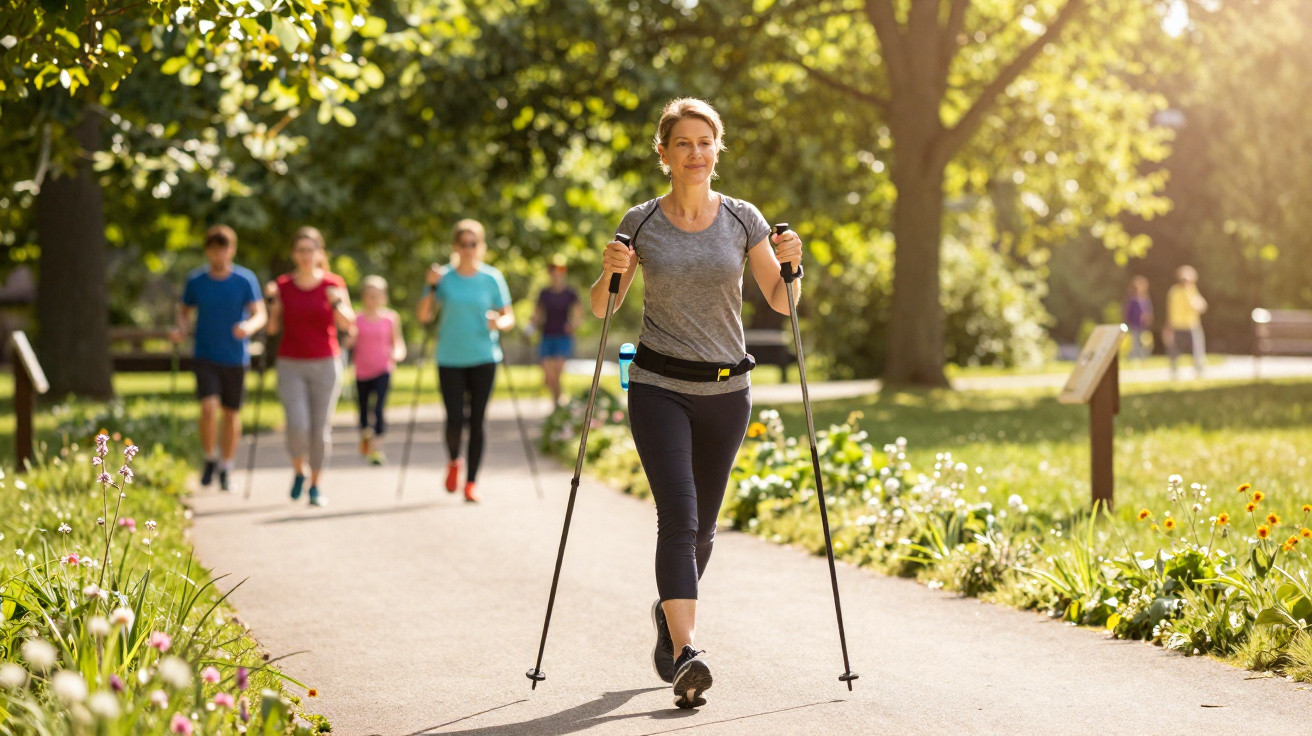
A lot of people picture Nordic Walking as a gentle pensioners’ stroll around the park. In reality, it’s a surprisingly effective full-body workout that challenges your heart and circulation, is kind to the joints, and can noticeably lighten your mental load. For anyone returning to exercise or feeling overloaded by jogging, it’s a very practical, everyday-friendly way to get moving again.
What makes Nordic Walking so special
Nordic Walking has its roots in cross-country ski training: professionals used it in the summer to maintain their fitness. Today, more and more people pick up poles because this way of moving recruits far more muscle than ordinary walking. Arms, shoulders, back, core, and legs all work together.
The movement pattern is straightforward to learn: your right arm swings forward with your left leg, and your left arm with your right leg. Using the poles creates an active push from the arms, turning a walk into a dynamic session that still feels well controlled.
"Nordic Walking uses almost 90 per cent of the musculature – with significantly less impact than jogging."
A major plus is that you can adjust pace and intensity at any time. If you feel strong, you lengthen your stride and drive the poles more firmly. If you’re not at your best, you simply slow down without having to change the technique completely.
Cardio training without joint stress
With Nordic Walking, your cardiovascular system works at a moderate level that’s easy to control. Your heart rate is usually higher than on a normal stroll, but lower than when running. That creates an ideal zone for building endurance and supporting fat burning.
- More stamina: Your heart is challenged regularly, the lungs work harder, and breathing becomes more efficient.
- Calorie burn: Bringing the arms into play increases energy use noticeably compared with walking.
- Joint-friendly: The poles take some of the load off the knees, hips, and ankles with every step.
- Suitable if you’re overweight: You can stay active without overloading the joints.
Many doctors recommend Nordic Walking for beginners after a longer break from sport, for people with mild high blood pressure, or after certain operations-provided you have medical clearance. Your body works hard, but without the harsh impacts that come with jogging on tarmac.
Strong muscles, mobile joints
The long, guided motion of Nordic Walking doesn’t just train muscles-it also helps keep joints supple. Pole use helps maintain shoulder mobility, the hips move through a larger range, and the knees are stabilised.
If you go out with poles regularly, you strengthen in particular:
- Back extensors and abdominal muscles – for greater day-to-day stability
- Glutes and thigh muscles – important for stairs, standing up, and longer walks
- Shoulder girdle and arms – useful for everyday tasks such as lifting or carrying
Each pole plant also creates light, repeated vibrations through the body. These stimuli support bone formation and counter the loss of bone substance that tends to increase with age. This is especially relevant for women after the menopause, when the risk of osteoporosis rises.
Upright posture and better balance
Many people sit too much-head forward, back rounded. Nordic Walking helps break that pattern. The technique encourages an upright posture, an open chest, and an active core. When you use the poles correctly, you naturally straighten up more.
"Nordic Walking trains the deep postural muscles that keep us upright in everyday life and can help prevent falls."
The poles don’t just provide propulsion; they also act like extra points of support. On uneven ground they add security and improve sure-footedness. Older people in particular often gain confidence in their mobility and feel comfortable heading back onto woodland paths or gentle terrain.
Coordination benefits too: arms and legs have to work in rhythm, and the brain constantly compensates for small disruptions caused by roots, stones, or slippery patches. This ongoing adjustment sharpens reactions and body awareness.
More mental lightness
When you’re out with poles, you often notice within the first few minutes that your mind feels clearer. The steady pace, the rhythm of your steps, and being in nature-or at least in fresh air-have a proven effect on reducing stress and inner tension.
Your body releases endorphins, which act like a natural mood-lifter. Many people report sleeping better after a round, or feeling more focused during the day.
| Mental effect | Typical observation |
|---|---|
| Stress reduction | Nervousness drops, and the pulse settles more quickly |
| Mood | A sense of contentment after the session |
| Concentration | Thoughts feel more organised, fewer spirals of rumination |
There’s also a cognitive element: adjusting speed, watching the ground, keeping obstacles in view, and matching someone else’s pace all engage the brain. Studies suggest that combined movement tasks like these may help keep mental abilities steadier for longer as we age.
Out together: why group sessions help
Nordic Walking groups are springing up in many towns and communities. For good reason: if you commit to regular meet-ups, you’re more likely to stick with it. At the same time, conversations happen, acquaintances form, and sometimes real friendships develop.
In loosely organised groups, it’s not about the fastest time but about arriving together. That reduces pressure and makes starting easier-especially for people who feel uncomfortable in gyms. Many clubs offer sessions led by qualified instructors who correct technical errors and keep an eye on overuse.
How to start without frustration or injury
Before your first session, a quick check with your GP is worthwhile-especially if you have known cardiovascular conditions, diabetes, or significant excess weight. Getting the all-clear provides reassurance and helps you set realistic goals.
To begin with, simple sports clothing is enough. Key points:
- Poles at the correct length: Rule of thumb: pole length is roughly 0.66 to 0.7 of your height.
- Hand straps / loops: They should fit well so you can release the grip yet still apply pressure.
- Shoes: Lightweight, flexible shoes with a grippy sole, similar to light trail or walking shoes.
- Surface: At first, choose firm woodland paths or park paths rather than steep mountain tracks.
Before each outing, allow a few minutes to warm up: relaxed shoulder circles, gentle marching on the spot, and a couple of mobility drills for hips and knees. After the walk, brief stretching helps keep muscle soreness manageable.
How often, how long, what pace?
For beginners, two to three sessions per week work well, each lasting 30 to 45 minutes. If you feel fitter, you can build up to around 60 minutes. The key test: you should still be able to hold a conversation while walking, without gasping after every sentence.
More experienced walkers can add short intervals-several minutes brisker, then easier again. This improves endurance without making the effort too intense. If you want to reduce weight, longer moderate sessions are particularly useful, keeping your pulse in the middle range.
Related activities and sensible combinations
Nordic Walking pairs well with other low-impact forms of movement. Popular options include:
- light bodyweight strength training to target weaker areas
- yoga or mobility work for improved flexibility
- swimming or aqua fitness on days when your joints feel sensitive
If you’d rather not go outside in winter, you can practise elements of the technique on a treadmill-poles are usually not allowed there, but the focus on deliberately long strides and active arm drive still applies.
Possible mistakes and risks – and how to avoid them
Like any sport, Nordic Walking has a few common pitfalls. Typical issues include poles that are too long, gripping too tightly, or starting off at too fast a pace. Any of these can place unnecessary strain on shoulders and wrists.
If your neck hurts after a session, it’s worth checking your stride length and arm action. A short introduction from a course leader often helps more than hours of online videos. Breaks matter too: two hard sessions back-to-back achieve less than three moderately paced walks per week.
With a little patience, Nordic Walking can become a routine that delivers a lot: improving fitness, easing pain, helping to prevent falls, and giving your thoughts a sense of order at the same time. Two poles, comfortable shoes, and a free slot in the day are all you really need.


Comments
No comments yet. Be the first to comment!
Leave a Comment