
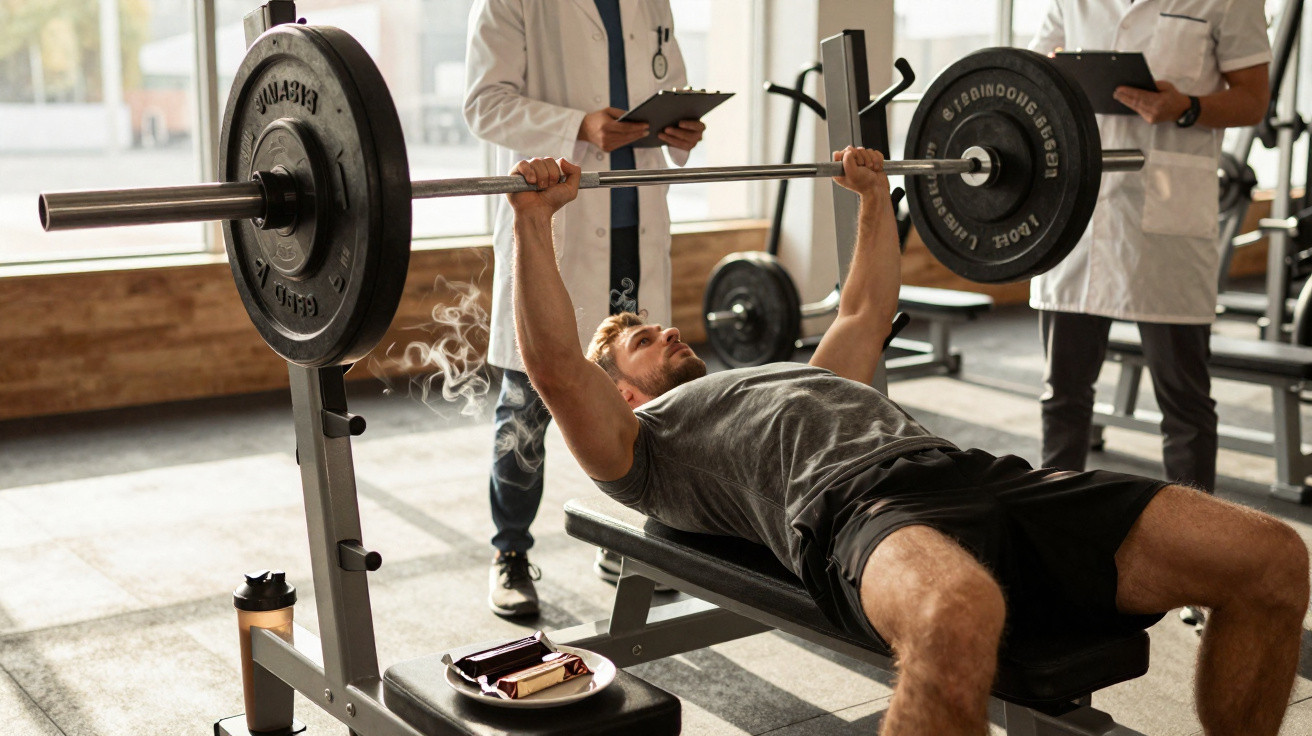
Simply catching the smell of chocolate between sets in the gym led men to complete many more repetitions than they managed with no aroma at all, according to a new study.
All of the participants had gone without food for at least ten hours. Even so, the performance lift still appeared, and it was most pronounced when the scent was dark chocolate. Despite doing more reps, they did not report that the work felt any tougher.
That mismatch points towards a central (brain-driven) effect rather than a change in the muscles themselves, raising the possibility that a straightforward sensory cue could support training on an empty stomach.
How the test worked
Researchers enlisted 23 moderately trained men in their early-to-mid-20s. Each volunteer arrived at the laboratory after fasting for at least ten hours. They then used a leg-extension machine, a common resistance-training exercise, performing sets until they could no longer complete another.
The study was led by Mohamed Nashrudin bin Naharudin, an assistant professor and the senior author, from the Faculty of Sports and Exercise Science at the University of Malaya (UM) in Kuala Lumpur. His aim was to test whether smell alone could alter how much a person could lift.
Every participant returned for three separate sessions, with one scent condition per visit. Immediately before each set, and again between sets, a researcher held a freshly prepared liquid beneath the participant’s nose. The three options were dark chocolate at 90% cocoa, milk chocolate at 60% cocoa, or plain water as the neutral control.
The results separated clearly by scent. When exposed to the dark chocolate odour, the men performed about 18 more leg extensions than they did with water; with milk chocolate, they managed about nine more. The load on the machine was kept constant throughout, meaning their muscles faced the same weight on every visit.
This is where the pattern became especially striking. Using a simple zero-to-ten scale to rate how hard the effort felt, participants’ scores rose as fatigue built up, but the smell presented under the nose did not shift those ratings.
In other words, extra repetitions came without an accompanying rise in perceived strain. “Seeing a substantial increase in repetitions without the athletes feeling like they were exerting themselves any harder is a fascinating psychobiological outcome,” said Naharudin.
Dark versus milk chocolate
The two chocolate scents did not produce identical effects, and the men’s appetite ratings highlighted the difference. Before lifting, participants used a sliding scale to record hunger, fullness, and their desire to eat.
Following exposure to the dark chocolate aroma, they reported reduced hunger, greater fullness, and a weaker pull towards food.
Milk chocolate, by contrast, did not shift those hunger-related signals. What it altered instead was enjoyment: participants judged the milk-chocolate smell to be more pleasant than either the dark chocolate or the water, despite it not reducing appetite.
Naharudin’s group interprets this contrast in terms of expectation. A strong, bitter dark-chocolate smell can act as a cue for something dense and filling, prompting the body to respond as though a substantial meal is imminent.
“The dark chocolate scent serves as a learned cue for a rich, bitter, and highly satiating food, which essentially tricks the system into an anticipatory state of fullness,” said Naharudin.
The sweeter milk-chocolate profile did not seem to trigger that anticipatory fullness. The researchers suggest it may have functioned more as a reward cue, subtly improving the experience and encouraging a few additional repetitions through pleasure rather than satiety.
Why scent works
Notably, none of this requires food to enter the stomach. Merely seeing and smelling food can activate digestive processes even before the first bite.
This early response is known as the cephalic phase – essentially the body’s head start on eating. One review describes anticipatory changes such as increased saliva, stomach acid secretion, and shifts in hormones.
If these signals can move someone along the spectrum from hunger towards fullness, they may also alter how exercise is experienced. Here, the men had eaten nothing, yet their bodies appeared to react as though food was near, with anticipation seemingly standing in for some of what eating would normally provide.
Scientists have also shown that smell connects deeply with brain areas involved in both appetite and emotion. One recent study mapped a pathway from the nose to the hypothalamus – a key hub for hunger – and found that a lingering food odour can dampen appetite.
What had not previously been tested was whether this sort of olfactory wiring could translate into changes in lifting performance.
Training while fasting
Many people train before breakfast, whether to fit exercise into a busy morning or to align with a fasting routine. The trade-off is well known.
Strength work on an empty stomach often feels more difficult and can bring a session to an earlier end. If a scent can increase repetitions without raising perceived effort, it could offer a calorie-free way to offset that downside.
The finding also aligns with an unusual but established phenomenon in sports science. In some workouts, athletes can push harder by rinsing their mouths with a sugary drink and then spitting it out, taking in no calories. The effect is most consistent when they have not eaten.
One trial reported that this mouth-rinse approach raised repetition counts on demanding lifts without changing how hard the exercise felt. The chocolate aroma produced a similar signature: more work completed, with no added sense of effort.
Looking beyond chocolate
The study does have important constraints. The sample was small and included only men, and it focused on a single exercise, so it remains uncertain whether the effect would extend to women, older lifters, or an entire workout. The researchers also did not measure hormones or brain activity, leaving the mechanism suggested rather than directly demonstrated.
Even so, the takeaway is specific and clear. A chocolate smell – particularly one that is dark and bitter – can help someone who is training on an empty stomach complete more repetitions without making the work feel harder.
The remaining question is whether chocolate is genuinely special, or simply one example among many familiar food scents that could produce a comparable effect.
“We don’t think chocolate is entirely unique, though it is a food cue with incredibly strong, universally recognized reward associations,” said Naharudin.
If other appealing food aromas are shown to have the same impact, the benefit may be modest but meaningful: a familiar scent used before a tough set could become another low-cost tool for getting more done while training fasted.





Comments
No comments yet. Be the first to comment!
Leave a Comment