
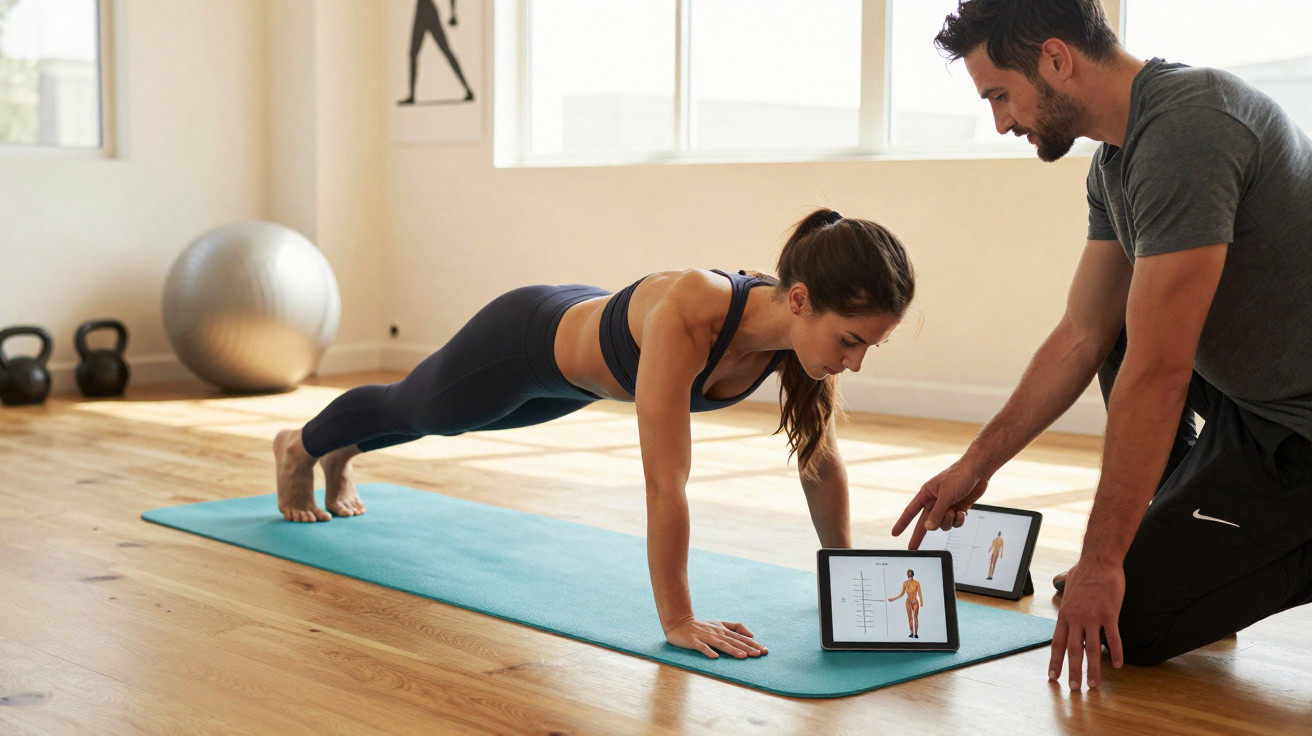
The plank position is a valuable exercise for core stability, body control and muscular endurance. However, specialist Lucía Aguado points out that simply holding a plank for several minutes, on its own, does not provide the same stimulus needed to build abdominal strength and hypertrophy efficiently.
Why might holding a plank for a long time not be enough?
In the plank position, the abdominals work isometrically - the muscles stay braced without any visible movement. This supports stability, but as the body adapts to the same demand, the exercise can become less effective as a driver of progress.
Aguado says that lasting for minutes in a plank is similar to trying to gain leg muscle purely by walking: it is a healthy habit, yet it may not be intense enough to trigger targeted muscle growth.
What’s the difference between endurance and hypertrophy?
Endurance is the ability to sustain effort for longer. Hypertrophy, by contrast, depends on progressive stimulus, appropriate loading, recovery, and exercises that push the muscle beyond what it is already used to.
- Long plank holds develop staying power and postural control.
- Hypertrophy requires progressive overload over the weeks.
- The core tends to respond better when the stimulus varies.
- Repeating the same hold time can become simple maintenance.
Which exercises can complement the plank position?
The plank position can still have a place in your routine, but it does not need to be your only abdominal exercise. Aguado highlights options that allow greater intensity, such as cable crunches, an ab wheel rollout, and breathing work to improve activation of the transversus abdominis.
These movements call for good technique and steady progression. For instance, the ab wheel should be performed with control to avoid overloading the lower back, while cable crunches make it easier to adjust the load to match your training level.
How can you train the core more safely?
A better approach is to combine exercises that challenge the abdominals without turning the session into lower-back pain or a timed endurance contest. Execution quality matters more than staying still until your posture collapses.
- Keep a neutral spine during exercises.
- Avoid holding your breath for too long.
- Stop the set if the lower back starts to compensate.
- Gradually increase load, repetitions, or difficulty.
- Include rest so the muscle can recover.
What does this comparison teach about abdominal training?
The plank-versus-walking comparison shows that an exercise can be beneficial without meeting every goal. Walking improves fitness and supports an active routine, but it does not replace strength training for the legs; in the same way, the plank position helps the core, yet it may fall short for developing abdominal strength in a more complete way.
Training becomes more coherent when each exercise plays its role. The plank position works as a stability base, while loaded, controlled movements with progression provide the stimulus the abdominals need to build strength, endurance and better day-to-day function.



Comments
No comments yet. Be the first to comment!
Leave a Comment