
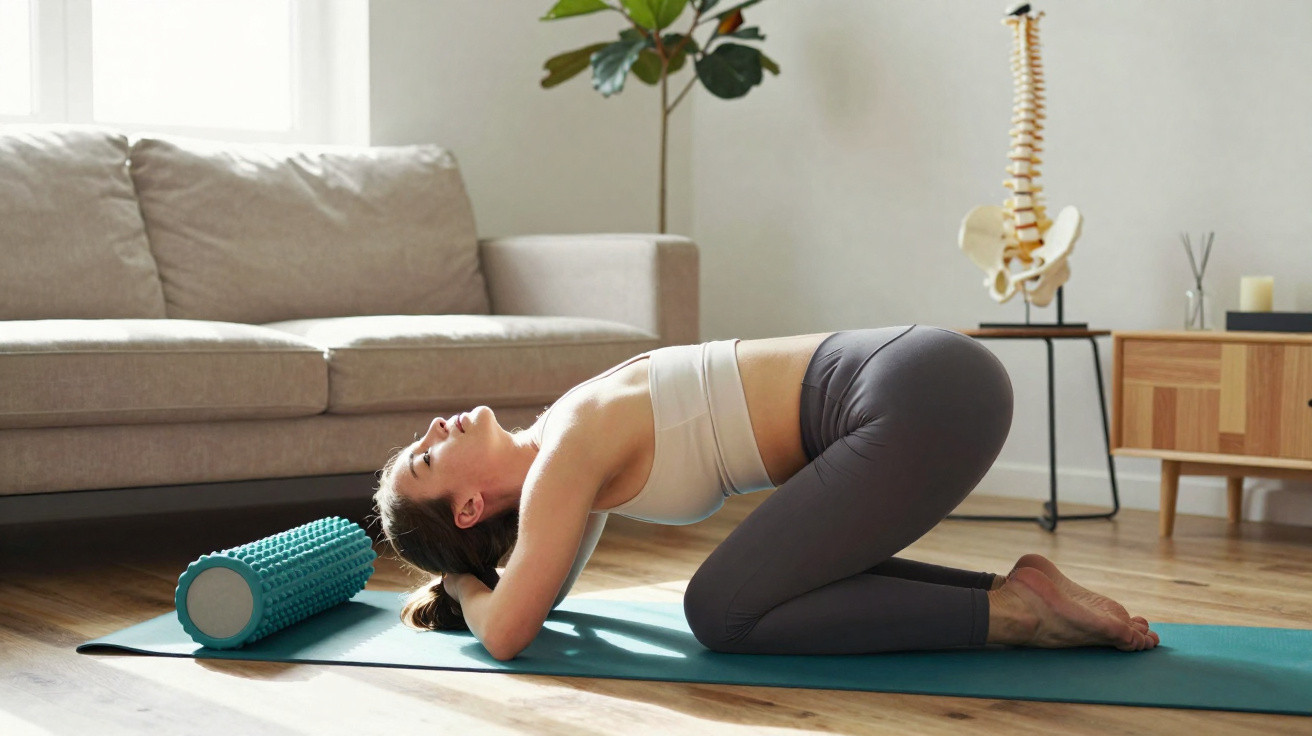
You roll out of bed, go to stretch, and your body answers back like an old hinge. Your neck feels tight, your back is stubborn, and your hip feels as if you’ve been secretly storing stones in it. It’s not sharp pain so much as that dull sense of “something isn’t quite right any more”.
By the time you’re walking to the coffee machine, you’re already doing the first tiny shoulder roll. When you sit down to work from home, you stay glued to the screen. Later you catch yourself thinking: am I really only 30, 40, 50 - or have I been living for years in a borrowed body designed for heavy labour? At the gym, even easy movements feel stiff, as if your whole system has pressed pause. And that’s where it gets interesting.
When neck, back and hip all creak in the same chorus
Most of us recognise the moment you try to fold forwards properly and your system complains - not in one place, but in three at once. Neck like concrete, back like a plank, hip refusing to play along. You don’t feel “old”; you feel like machinery that hasn’t been lubricated. Part of you assumes it will settle down. Another part suspects there’s a pattern.
What feels like three separate issues is usually one connected network. Your neck is influenced by the way your upper back is positioned. Your lower back takes cues from how much movement your hips allow. If you sit a lot, all three zones drift into energy-saving mode. Meanwhile your head often realises far too late that your body has already switched into “emergency running”. The end result shows up as whole-body stiffness.
You can watch the pattern in offices, on trains and in cafés: someone spends hours bent over a laptop, head slightly forward, shoulders creeping up, back rounded. When they stand, it’s almost slow motion. First the neck jerks, trying to stack itself again. Then the back cautiously unrolls. Finally the hip tests the waters for the first couple of steps, as if walking is being reintroduced.
If you talk to people living like this - home working, stress, hardly any real movement - you hear the same line again and again: “By evening I’m stiff, and by morning I’m stiff again.” Very few people do preventative stretching or mobility work. Let’s be honest: almost nobody manages it every single day. We all know the sitting statistics, but you don’t need a study if you simply look at people’s posture on the Underground. The picture tells you enough.
The plain truth is that your body isn’t “broken”; it’s behaving logically. Muscles and fascia held in one position for hours adapt to it. They become shorter, less elastic, and start to “save” movement. Neck, back and hip are three key junctions in that system. When one area tightens up, the others tend to follow.
A tight hip flexor, for instance, can increase the arch in your lower back, which pushes your upper back into compensation. Your neck then works overtime to keep your head level. That’s how you end up with a chain reaction that feels like one rigid block.
In this context, regular mobilisation isn’t a wellness luxury - it’s the counter-programme to modern life. Your body isn’t asking out of whim; movement is its only tool for creating space again.
Pro exercises to loosen “whole-body rust”
Picture a short mobilisation ritual you can do without a mat, without gym kit, even at your desk. Three areas, three priorities, in no more than ten minutes.
For the neck: gentle half-circles with your chin travelling from shoulder to shoulder, plus slow “yes/no” motions - as if you’re asking your body quiet questions. For the upper back: Cat-Cow while standing, hands resting on your thighs; round your back, then lift your breastbone forwards.
For the hip, simple Hip Circles do the job: feet hip-width apart, hands on hips, draw big circles - first one direction, then the other. Add a lunge where you glide the back hip forwards and rotate your torso slightly. That links hip, back and neck within one movement.
A pro option for more experienced movers is the “World’s Greatest Stretch”: step into a deep lunge, place your hand next to your front foot, and rotate your chest towards the ceiling. Go slowly - don’t do it heroically.
The most important point is this: mobilisation shouldn’t feel like an exam. Many people jump straight into aggressive stretches, hold their breath, and endure it until it’s over. That’s often another stressor rather than support. Gentle, dynamic movements - where you go into a mild pull and come back out - can work better than forcing a stretch. Your nervous system learns that movement is safe, and it gives you more range.
Typical mistake number two: doing it once and then ignoring it for months. Your body adapts through repetition, not through one-off acts of bravery. Three to five minutes of mobilisation in the morning and three to five minutes in the afternoon can change more than a one-hour stretching session every fortnight. And if you miss a day, it’s not a disaster. The body can hold a grudge - but it’s also surprisingly forgiving when you restart.
Many physiotherapists and trainers I’ve spoken with keep coming back to the same message: you don’t need perfect training; you need to begin moving regularly.
“Your body isn’t a device you take in for servicing twice a year,” a sports physio once told me. “It’s more like an instrument. If you never tune it, every note eventually sounds wrong - and you start thinking that’s normal.”
To make it practical, a small mental checklist for everyday life helps:
- Once a day: 1 minute of neck half-circles
- Twice a day: 5 standing Cat-Cow repetitions
- During any long sitting spell: 10 hip circles each direction
- Before bed: 3 deep belly breaths, let your shoulders drop
- One weekly ‘movement date’ with yourself: a walk, a mobility flow, relaxed dancing in the living room
Even these small rituals can be the difference between “I feel rusty” and “my body is at least negotiable again”.
What changes when you give your body room to move again
The longer you listen to people with chronically tight necks, rigid backs and restricted hips, the clearer it gets: it’s rarely only about muscles. There’s fatigue, irritability, sometimes a quiet frustration with their own body. “I used to just set off; now I need a run-up,” many say. Mobilisation can feel like yet another task at first. Over time it becomes a brief moment where you take the controls back.
Things get interesting when you notice the first effects. Suddenly reaching your shoes is easier. Checking your blind spot in the car no longer feels like you’re trying to twist your own head off. After a long day you may still be tired, but you’re not completely locked up. Your body is always signalling; stiffness is one of the louder messages. If you respond consistently, it doesn’t have to shout. And almost as a side effect, your view of movement shifts: away from a chore, towards a quiet agreement between you and your body.
| Key point | Detail | Reader benefit |
|---|---|---|
| The chain linking neck, back and hip | Tension in one area influences the posture and mobility of the others | Understands why it all feels stiff “at the same time” rather than like three separate issues |
| Short, regular mobilisation | Daily rituals of 3–10 minutes instead of rare marathon sessions | A realistic approach that fits normal life |
| Gentle, dynamic exercises | Neck half-circles, standing Cat-Cow, hip circles, World’s Greatest Stretch | Clear pro exercises you can try immediately |
FAQ:
- Question 1 How often should I do mobilisation exercises for neck, back and hip? Ideally, keep sessions short at 3–10 minutes, once or twice a day. Consistency beats intensity - brief and frequent is better than long and rare.
- Question 2 Is mobilisation alone enough if I sit a lot? It helps massively, but it can’t fully cancel out prolonged sitting. Pair it with small movement breaks: stairs instead of the lift, short walks, and standing periods during the working day.
- Question 3 What if I feel pain during the exercises? A mild pull or stretch sensation is fine; sharp or burning pain isn’t. If that happens, stop the exercise and get it checked medically or by a physiotherapist.
- Question 4 How quickly can I expect improvements? Some people feel more mobile within a few days; if stiffness has been there a long time, it’s more likely to take weeks. Your body needs time to “unlearn” old patterns.
- Question 5 Do I need equipment or a gym for these pro exercises? No. Most mobilisation work is done with bodyweight and a bit of space. A towel or mat can be nice, but it’s not required.



Comments
No comments yet. Be the first to comment!
Leave a Comment