
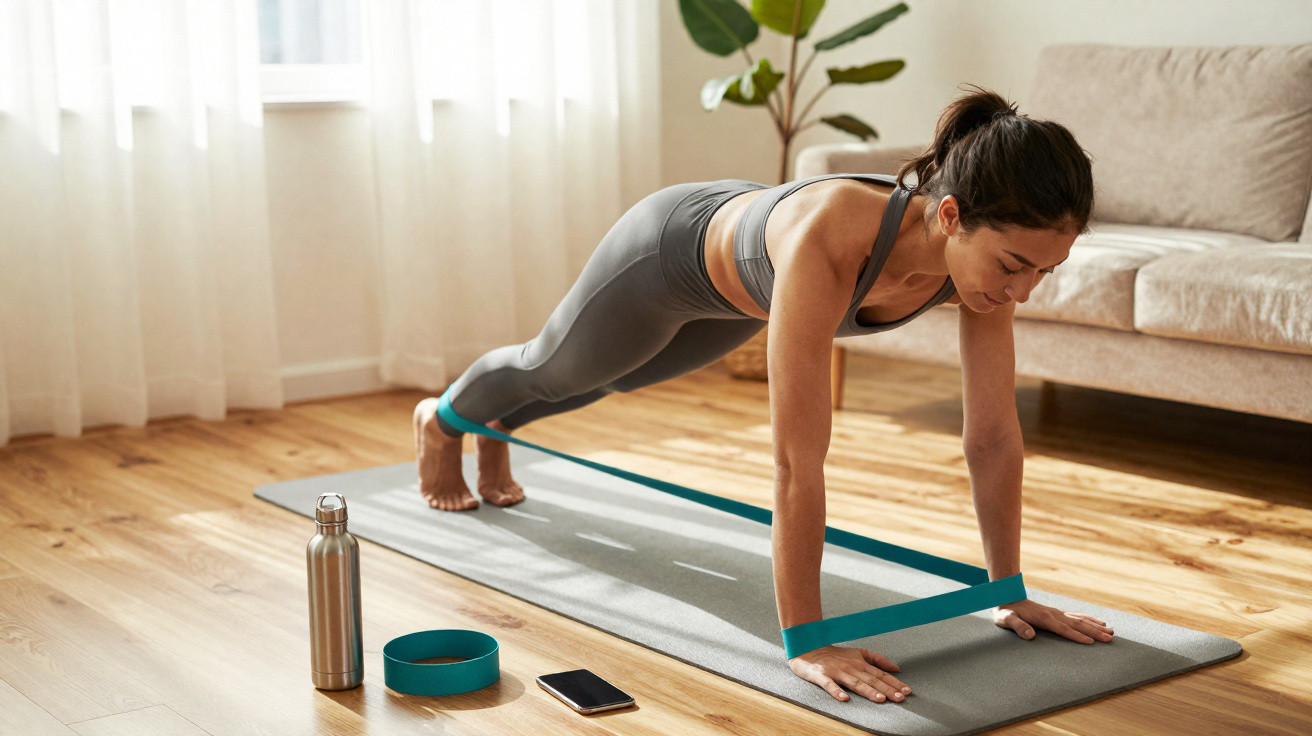
A single red resistance band sits on the coffee table - like a forgotten office rubber band, only thicker and more substantial. For many people, that unassuming strip of elastic is currently the difference between getting a workout done and pushing it back to “tomorrow” again. Everyone knows that moment after a long day when you have to choose between the sofa and some movement. Your body whispers “lie down”, your mind mutters “but you said you would…”. And somewhere in the middle, the band is just there. Quiet, but full of possibility. Because once you learn how to use it properly, you suddenly don’t need a gym membership or a roomful of equipment. Just a little space - and one simple method that slips into daily life almost without you noticing.
Why a resistance band is your smartest home tool
It can sound almost absurdly minimalist: a strip of rubber, and the claim that you can train your entire body with it. The first time people hear that, they often raise an eyebrow. In our heads, fitness has become tied to machines, plates, screens - to dumbbells that clank and kit that beeps. A band, by contrast, makes no noise at all. It feels more like rehab than progress. And that’s exactly where the surprise sits: this quiet tool adapts to you - not the other way round. More pull means more effort; less pull gives you a gentler entry point. It’s so straightforward it can seem suspicious.
You can see the shift in plenty of homes, not just on social media. People who once insisted nothing “counts” without the gym now loop a resistance band around a door, a railing, or their foot. A young mum does banded squats in the morning before the baby wakes up. An office worker slips it around their hands at lunchtime and does a few quick rowing variations between two Zoom calls. According to a GfK survey, significantly more Germans train regularly at home than they did five years ago, and resistance bands are among the most purchased tools. It makes sense: they cost less than a month’s gym membership, fit into any drawer - and they shrink excuses down to something embarrassingly small.
The reasoning is simple and unemotional: resistance is resistance, whether it comes from steel or rubber. Your muscles don’t “know” if you’re pulling on a shiny machine or on a green band - they only register tension. And with a band, you can dose that tension with surprising precision. Stretch it further and the load rises progressively, giving you a built-in “turbo” without changing a single weight plate. At the same time, the material tends to be kinder to your joints because the resistance builds more smoothly and doesn’t have harsh end points. Training doesn’t get louder; it gets smarter. That’s exactly what the method below leans on.
The simple 15-minute band method for home
The principle is almost cheekily basic: one resistance band, three movement patterns, five minutes per block - that’s it. Block 1: pushing - for example, a band chest press with the band anchored in a door or wrapped around your back. Block 2: pulling - seated rows with the band looped around your feet. Block 3: legs - squats with the band around your thighs, or hip thrusts with the band across your hips. Do each exercise for about 40 seconds, rest for 20 seconds, complete four rounds, then move on to the next block. 15 minutes. Done. No warm-up theatre, no complicated split - just a clear rhythm: push, pull, legs.
Most people don’t fail because the movements are too complex; they fail because the bar they set is too high. Many start with a “perfect” plan: eight exercises, three sets, rep ranges, precise rest times. It sounds professional, but it rarely fits real life. Let’s be honest: almost nobody actually does that every day. A small standard you can repeat beats a big plan you keep postponing. Fifteen minutes sits right on that threshold - short enough to squeeze in between appointments, while the pasta boils, even in your sleep T-shirt. Typical mistakes include choosing bands that are too heavy, yanking quickly instead of pulling with control, and giving up after three days because it doesn’t feel like “enough”. The reality is this: consistently easy beats brutally hard, done sporadically.
A trainer I spoke to for this piece put it bluntly:
“A resistance band is like a quiet reminder: you can ignore it, but it takes away every excuse to do nothing.”
To make the method stick, it helps to build a few simple anchors into your routine:
- Put the band somewhere visible - where you naturally end up in the evening: the sofa, your desk, the coffee table.
- Attach the workout to a fixed ritual, such as after brushing your teeth or before your favourite series.
- Start every session with the same first pull on the band, always the same, without overthinking. Automation instead of drama.
- After each mini-workout, write down one sentence: how did your muscles and your mind feel?
- Increase the resistance only when the 15 minutes consistently feel “too easy”.
What this simple band does to your daily life
After a few weeks of training with a resistance band, many people notice changes in unexpected places - not in the mirror first, but in the movements they used to do without thinking. Shopping bags feel lighter; the stairs up to the third floor seem less hostile. When you pick up a child, your lower back suddenly doesn’t complain in the same way. These moments are unglamorous and, at the same time, hugely meaningful - personally, in the most everyday sense. You realise your body is working for you again, not against you. And none of that required a weight bench in the living room - just a rubber band on the carpet.
The emotional effect can be at least as strong as the physical one. Band-based home training is private, sometimes almost quiet. No wall of mirrors, no blaring music, no comparing yourself with strangers. Just you, your breathing, your resistance. Some people describe that quarter-hour as a kind of reset: away from the screen and into a clear, repeatable sequence. Afterwards, your shoulders sit differently; your thoughts settle. If you’ve ever felt how your back becomes warm and present after a set of slow rowing variations, you understand that muscle tension doesn’t have to mean aggression. It can mean connection.
Perhaps that is the underestimated value of this unremarkable band: it democratises training. No entry fee, no dress code, no external performance pressure. You decide how hard you pull, how far you go, when you stop. And maybe, at some point, you mention it to a friend or colleague in passing - the way you might recommend a good book. Not because you’re trying to convert anyone, but because it has quietly improved your life. Then, suddenly, there’s a band in their living room too, half-rolled up, ready to turn one of those “I really should…” evenings into something tangible.
| Key point | Detail | Benefit for the reader |
|---|---|---|
| Simple 15-minute method | Three blocks: pushing, pulling, legs - 5 minutes each with a resistance band | Clear structure, instantly doable without fitness knowledge |
| Everyday practicality instead of perfection pressure | A small, repeatable standard rather than a complex training plan | Better chance of sticking with it and building a real routine |
| Band as a flexible full-body tool | Progressive resistance, joint-friendly, portable | Gym-like effect with minimal kit and cost |
FAQ:
- Which resistance band should I choose to start with? For most people, a medium resistance is enough, often colour-coded in red or green. Too light feels like chewing gum; too heavy quickly leads to form breakdown. Start with a moderate pull and add a stronger band later.
- How often should I train with a resistance band? Three sessions per week is a solid starting point for most. If you enjoy it, you can increase to four to five times, as long as your muscles recover between days and your body doesn’t feel constantly tired.
- Can a resistance band fully replace dumbbells? For many everyday goals - more strength, firmer muscles, and a healthier back - yes. Ambitious strength-sport targets or very high one-rep maximums often need additional weights, but for home training in daily life, a band goes surprisingly far.
- How do I know if the resistance is too light or too heavy? If you can do clearly more than 20 clean reps without any burn, it’s probably too light. If you can barely reach 6–8 reps and you tense up, it’s too heavy. A comfortable burn at 10–15 reps is a good rule of thumb.
- Is resistance band training suitable if I have back or joint issues? Often it can be even better than rigid weights, because the resistance ramps up smoothly and is gentler on joints. If you already have symptoms, it’s still worth a quick check with your GP or a physio to confirm suitable exercises and any restrictions.





Comments
No comments yet. Be the first to comment!
Leave a Comment