
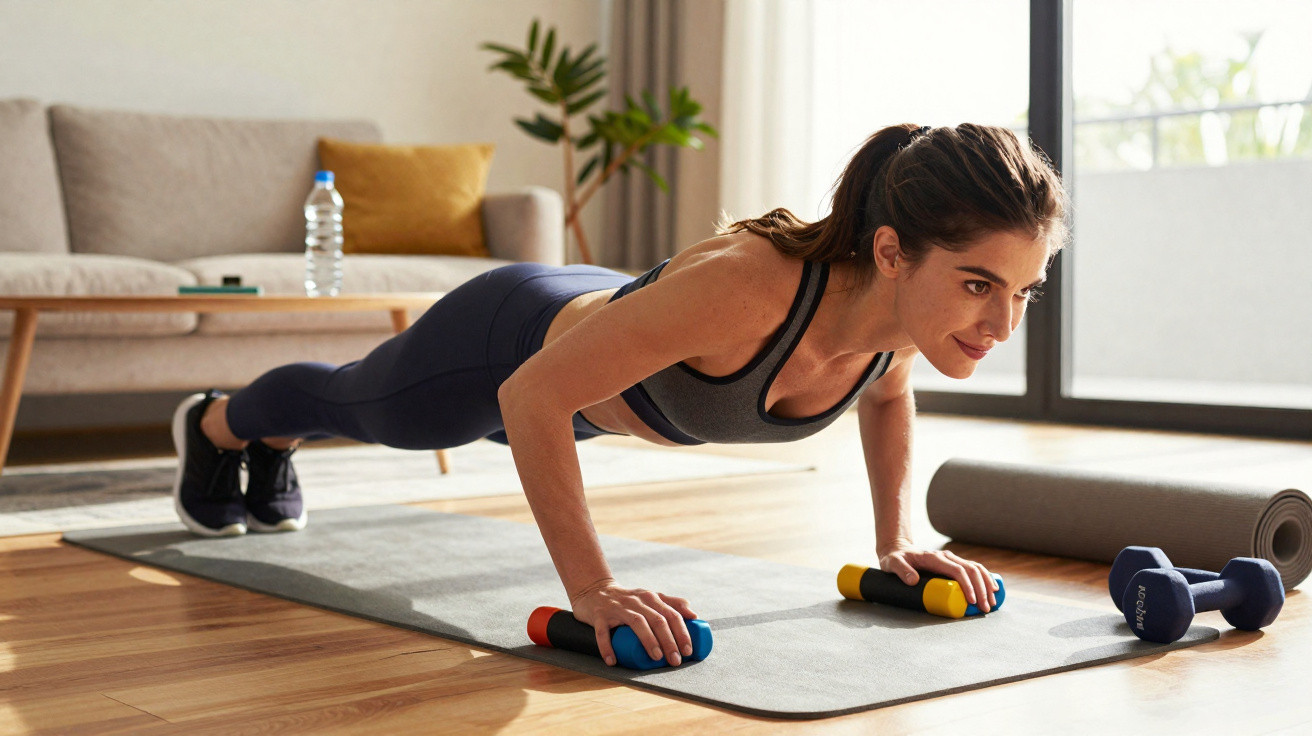
When work, family and everyday life leave you with barely a spare moment, the same pattern is familiar: the midsection feels softer and the drive to get to the gym starts to fade. At the same time, the goal becomes clearer-more tension through the core and a back that feels steadier. A compact piece of kit from Decathlon is designed to fill that gap and make home training noticeably more productive.
How the push-up and ab-training plate works
At the heart of it is a multifunctional push-up plate with an integrated counting module, sold at Decathlon as the HMS DBP03. At first glance, it looks fairly plain: a sturdy board, coloured markers, two removable handles and a small screen.
However, the straightforward look hides a well-thought-out set-up. The plate brings three roles together in a single device:
- A base for planks and ab exercises
- A configurable push-up station with several handle positions
- An automatic rep counter using an optical sensor
"The push-up plate is aimed at anyone who wants to work on abs, chest, shoulders and arms at home in a structured way, without buying lots of complicated equipment."
One particularly useful feature is the built-in sensor: it detects each downward movement during push-ups and counts it automatically. That means beginners and experienced trainees alike can track performance without constantly checking a watch or counting reps in their head.
More than an ab gadget: training for the whole upper body
The plate is deliberately designed to challenge the entire upper body. The colour system around the handle slots indicates which muscles are emphasised by each grip position. The main targets include:
- Chest muscles
- Shoulders
- Triceps
- Upper back
- Core / trunk muscles
The wide base board includes foam pads to add a bit of comfort and grip when you place your forearms or hands on it. This makes both static planks and more dynamic variations feel stable and secure.
According to the manufacturer, the unit uses a firm, anti-slip underside and ergonomically shaped foam handles. As a result, it stays put during a session-a detail that genuinely matters in a living room or on tiled flooring.
Suitable for beginners and advanced users
The push-up plate isn’t only relevant for already-fit gym regulars. Beginners, in particular, benefit from guided hand placement and a clear movement pattern. If you can’t yet manage clean floor push-ups, you can:
- start with elevated versions (hands on a sofa or table)
- keep your knees on the floor
- prioritise planks and static holds at first
More advanced users, on the other hand, can increase the stimulus by using a narrower grip, slowing the tempo, or adding extra weight (a weighted vest or rucksack).
How to use the push-up plate correctly
Operation is refreshingly straightforward, which is a major advantage for home workouts. There’s no need to open an app or connect Bluetooth-just set it up and begin.
Step by step to your first push-ups
- Insert the handles into your chosen slots-the colour system indicates the area you’re focusing on (chest, shoulders, triceps, back).
- Place the plate on a flat, non-slip surface.
- Grip the handles, align your body in a straight line, and brace your core.
- Bend your arms and lower yourself in a controlled, tidy movement.
- Press back up-the sensor records the cycle and counts the repetition.
The built-in counter shows your reps on the small display. If you like, you can set clear targets-for instance, three rounds of 10 push-ups with breaks in between.
Plank variations for a stronger core
For abs and trunk strength, the plate works just as simply. You can remove the handles or leave them in place depending on the exercise:
- Classic plank: Forearms or hands on the plate, feet stepped back, body in a straight line. Brace your stomach and avoid letting your hips sag.
- Alternating high/low plank: From the forearm plank, press up onto your hands one side at a time, then lower back down. This challenges shoulders and core together.
- Knee-to-chest variations: In a high plank, pull one knee towards the chest alternately. This noticeably increases the demand on the abdominal area.
"For a visible effect around the stomach, what matters most is combining regular planks, push-ups and an overall active lifestyle."
Can a device like this really melt belly fat?
The honest answer: no single device in the world can burn fat from the belly only. The push-up plate can help you build and stabilise upper-body and core muscles. That can improve posture and create a firmer look. But fat loss always happens across the whole body.
If you want a noticeable change in your shape, you generally need three building blocks:
- regular strength training (such as with this plate)
- moderate cardio (walking, cycling, running)
- a reasonably balanced diet with a small calorie deficit
This is exactly where a compact home-training tool can help: the barrier to “just doing 10 minutes” drops dramatically. No travel, no waiting for equipment, no contract hassle.
Practical tips for fitting the device into daily life
Buying a push-up plate and leaving it in the corner won’t deliver miracles. It pays off when it becomes part of a clear routine. A few ways to build it in:
- a mini-session after waking up: 2 sets of planks, 2 sets of push-ups
- in a home-office day, use every second coffee break for a quick round
- in the evening before streaming, plan three short 5-minute blocks
Many users say that small tech features-like an automatic counter-boost motivation. You can see straight away on the display what you’ve done, and next time you try to add one or two more reps.
What the push-up plate can’t do-and what it’s ideal for
The DBP03 plate is not a substitute for a full gym with dumbbells, machines and a cardio area. If your goal is to build legs and glutes specifically or lift heavy weights, you’ll need other tools.
For the following goals, it’s particularly well suited:
- stabilising the core and helping prevent back pain
- defining shoulders and arms
- establishing a simple, consistent training routine at home
- as a supplement to running, cycling or team sports
If you already train regularly, you can use the push-up plate as an extra stimulus-for example, a short core workout after a run. For beginners, it can be a way into more structured training without having to build a complete home gym.
Price, build quality and safety
According to the product text, Decathlon lists the price at 54 euros. That places the plate in the mid-range: more expensive than basic push-up handles, but cheaper than many large home-training machines.
The sturdy base board, the anti-slip coating and the padded grips look sensible at first glance. Still, as with any home workout, the usual rules apply:
- Stop training if you feel pain in the shoulders, wrists or back.
- If you have pre-existing conditions, speak to a doctor beforehand.
- Especially at the start, practise more slowly and with better form rather than doing too much in one go.
Terms like “plank”, “core” or “trunk training” can sound technical, but they mainly mean one thing: strengthening the muscles around the spine, abdomen and pelvis. That area stabilises the body in almost every daily situation-from lifting shopping bags to sitting at a desk.
If you understand that a firmer stomach is linked to muscle, posture and a generally more active lifestyle-not just sit-ups-you’ll use a tool like this more realistically and are more likely to stick with it. The Decathlon push-up plate offers a compact option that takes up little space, is quick to set up, and noticeably challenges the core.

Comments
No comments yet. Be the first to comment!
Leave a Comment