
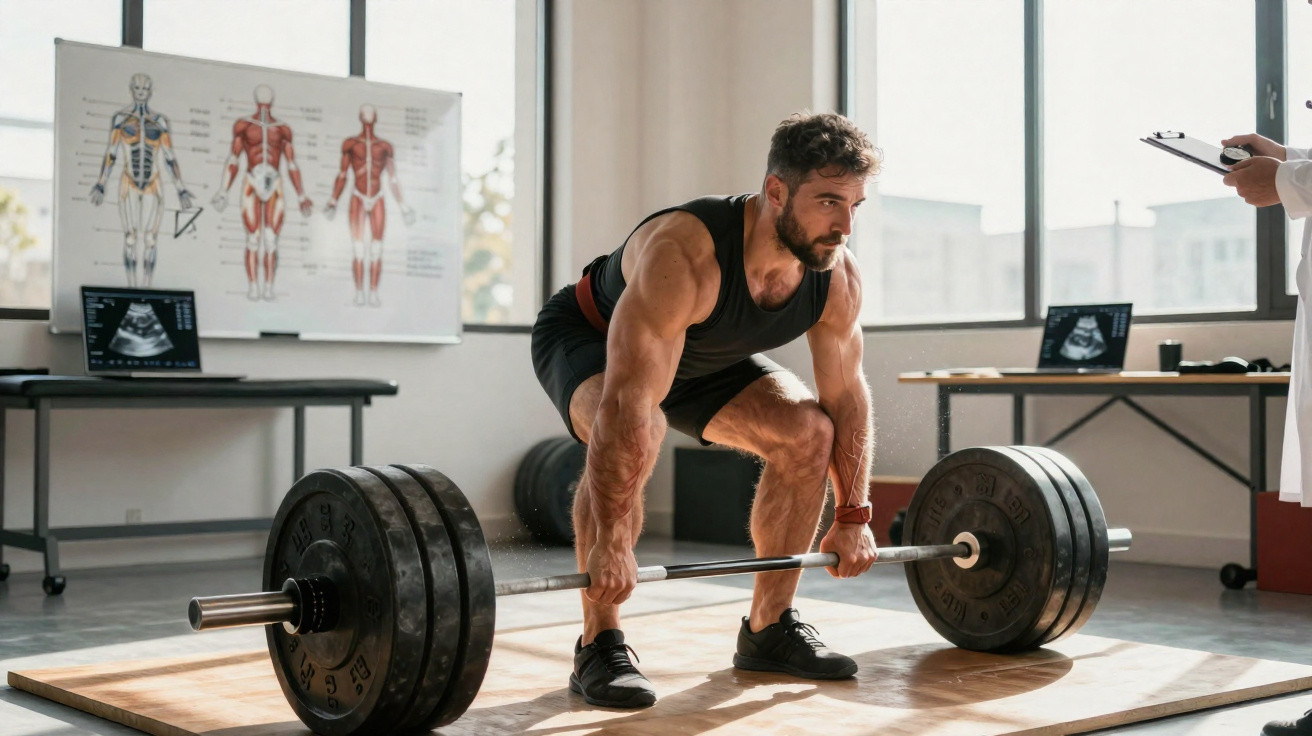
The idea of developing "superhuman" strength and power has been celebrated for centuries in cultures around the globe.
That fascination likely stems from how vital these attributes have been throughout human history, from hunting and gathering to building vast structures and monuments, fighting wars and, in modern times, competing in sport.
Today, the sport of strongman arguably showcases the upper limits of human strength and power.
What is strongman?
Strongman is growing in popularity, with events now held at regional, national and international levels for men and women across a wide range of ages and weight categories.
Preparation for strongman and the contests themselves typically combine classic barbell lifts-such as squats, deadlifts and pressing movements-with a series of strongman-specific challenges.
These events-such as the vehicle pull, farmer's walk, sandbag/keg toss or stones lift-usually ask competitors to shift unwieldy, heavy implements, aiming to lift them higher, move them faster, or complete more repetitions within a set time than their rivals.
Researching one of the greats
Since the World’s Strongest Man competition began in the late 1970s, strongman has expanded and become far more developed.
Scientifically, though, there are relatively few published studies that examine athletes competing at the very top level.
In particular, we still know little about how much total muscle mass elite strongmen carry, how that mass is apportioned across individual muscles, and how their tendon characteristics compare with those of people who do not train.
A recent study attempted to address some of these gaps by investigating the muscle and tendon morphology (structure) of one of the strongest men ever: England’s Eddie Hall.
Assessing an exceptionally strong athlete like Hall-who completed a 500kg world record deadlift and won the "World’s Strongest Man" title in 2017-offered a chance to identify the muscle and tendon features that may have supported his extraordinary strength.
What can we learn from a single case study?
Only a small number of athletes ever reach the genuinely elite tier in strongman, and fewer still set world records or win the sport’s biggest events.
Because recruiting even a modest sample of such rare competitors is so challenging, a case study of one elite strongman created a distinctive opportunity to learn more about his muscle and tendon characteristics.
Case studies do come with important drawbacks, including that they cannot establish cause and effect and that their findings cannot be readily generalised to other individuals in the same population.
Even so, Hall’s results were informative because they could be compared directly with several groups examined in the authors’ earlier published work.
Those comparison groups included untrained people, people who had undertaken regular resistance training for several years, and competitive track sprinters.
Including these reference populations made it possible to interpret, in a meaningful way, what is unusual about Hall’s muscle and tendon characteristics.
What they found
Hall’s lower-body muscle size was close to double that of a group of healthy, active young men who were untrained.
The way his lower-body muscle mass was spread across different muscles also followed a distinctive pattern.
In particular, three long, slender muscles-described as "guy ropes"-were especially large, measuring around 2.5 to three times bigger than those in untrained people.
These guy rope muscles share a tendon that attaches to the shin bone, and they help stabilise the thigh and hips by fanning out and connecting to the pelvis at multiple sites.
If these guy rope muscles are highly developed, they would be expected to provide greater stability during heavy lifting, carrying and pulling.
Hall’s thigh (quadriceps) muscle structure exceeded that of untrained people by more than twofold, yet the knee tendon linked to this muscle group was only 30% larger than that of an untrained population.
This suggests that, in this example of extreme quadriceps development, muscles and tendons do not enlarge to the same degree.
What do the results mean?
The most straightforward takeaway is that bigger relevant muscles are associated with a greater capacity for strength and power.
However, strongman-as well as ordinary tasks such as climbing stairs, carrying shopping and lifting items from the floor-depends on many stabilising muscles working in coordination alongside major force-producing muscles like the quadriceps.
Although Hall’s quadriceps were far larger than those of untrained people, the greatest proportional differences were found in the calves and in the long, thin "guy rope" muscles that contribute to stabilising the hip and knee.
This raises the question of whether extra-or more targeted-training for these smaller muscles could further improve strength and power.
Such an approach could be useful not only for strongman competitors but also for people in everyday life.
The comparatively modest difference in tendon size between Hall and untrained groups also indicates that tendons may not adapt and grow to the same extent as muscles.
Because tendons transmit muscular force to bones, muscle growing much more than tendon could mean that athletes like Hall face a greater relative risk of tendon injury than muscle injury.
This perspective broadly aligns with the high rates of tendonitis and strains reported in strength-sport athletes, including strongman competitors and weightlifters.
Justin Keogh, Associate Dean of Research, Faculty of Health Sciences and Medicine, Bond University and Tom Balshaw, Lecturer in Kinesiology, Strength and Conditioning, Loughborough University
This article is republished from The Conversation under a Creative Commons licence. Read the original article.




Comments
No comments yet. Be the first to comment!
Leave a Comment