
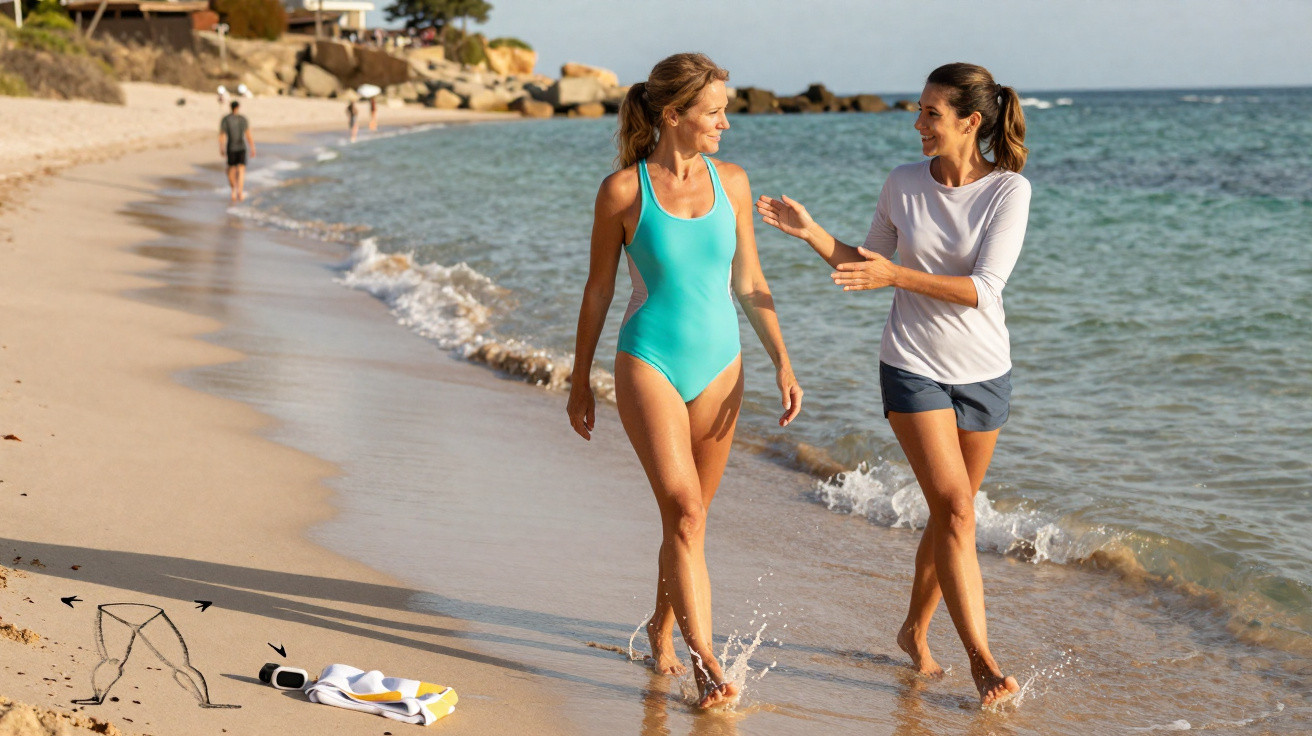
Maria Giner says that walking along the shoreline with the sea reaching up to your calves turns an ordinary stroll into something noticeably tougher. With each step, the drag of the water makes the legs work harder, and the uneven sand combined with shifting waves calls on the glutes and abdomen to keep you steady.
Why does walking in water take more effort?
Water pushes back from every angle, which makes it harder to drive the legs forwards. The quicker you try to step, the greater the resistance you are likely to feel. Even when the water is shallow, the calves, thighs and hips have to keep pressing through it repeatedly to maintain forward movement.
At the same time, buoyancy absorbs some of the impact that usually comes from the feet striking the ground. Research on walking in shallow water indicates that the pattern of movement differs from walking on land because of water resistance, an apparent reduction in body weight, and a lower comfortable speed.
- Calves help propel the body forwards;
- Thighs work to overcome the water’s resistance;
- Glutes contribute to hip extension and stability;
- Abdomen supports trunk control against waves and uneven ground;
- Ankles adjust foot placement on wet sand.
How do legs, glutes and abdomen contribute to the movement?
Because of the water resistance, the mechanics of each step change and a different mix of muscles becomes involved. In Maria Giner’s guidance, walking with water at calf height is framed as gentle training, rather than a direct replacement for more demanding strength exercises.
Step-by-step: how to do the beach water walk
Start on a shallow stretch where you can clearly see the seabed and there are no strong waves. Keep the water roughly at calf height, and walk with an upright posture at a comfortable pace.
Maria Giner advises keeping the abdomen lightly engaged to help stabilise the body. Let the arms swing naturally, without tensing the shoulders. Beginners should begin with just a few minutes and only extend the time once they have adapted to the effort.
- Pick a flat, familiar section of the beach;
- Keep the water close to calf height;
- Walk at a steady pace, without dragging your feet;
- Avoid leaning the torso too far forwards;
- Walk the same route in both directions;
- Stop if you notice pain, dizziness, or unusual fatigue.
What precautions help prevent falls and overload?
The strip of sand near the waterline may hide holes, stones, shells, currents, and sudden changes in depth. Spending a long time walking on a sloping beach can also leave one foot lower than the other, which unevenly distributes load across the ankles, knees and hips.
Does walking in water replace strength training or aerobic exercise?
It can be a useful addition to an active routine, but it does not automatically provide the same stimulus as a structured workout. Trunk stability is required to cope with waves and irregular sand, yet that alone does not guarantee meaningful gains in strength or muscle mass without progression in duration, speed and resistance.
The result varies with pace, time spent walking, depth, and sea conditions. When done in a safe area, walking with water up to the calves adds resistance to a seaside walk and moderately recruits the legs, glutes and abdomen, while keeping the light nature of the activity Maria Giner proposes.





Comments
No comments yet. Be the first to comment!
Leave a Comment