
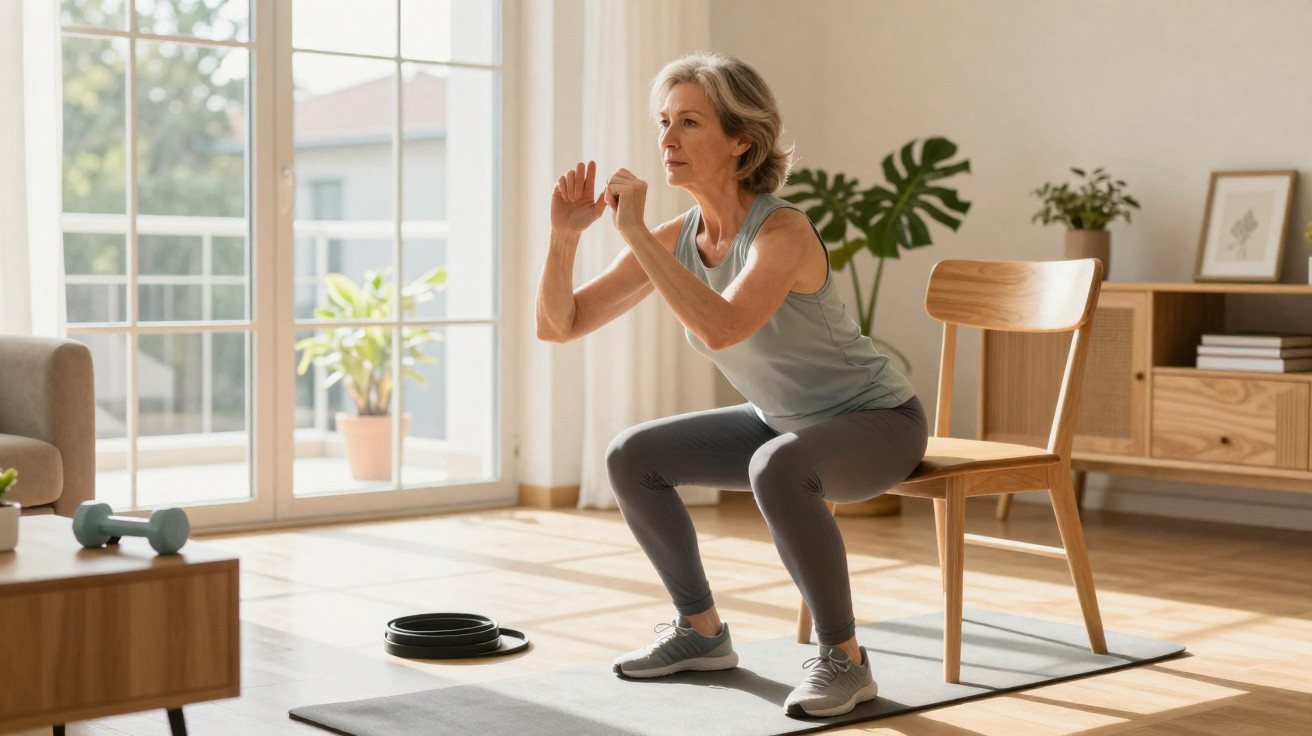
The assisted squat is one of the most valuable exercises for people in their 60s or 70s because it builds strength for everyday movements: sitting down, standing up, climbing stairs, walking more steadily and picking things up from the floor. Unlike the deep gym squat, the assisted version uses support-such as a chair or a wall-to improve safety and reduce fear of losing balance.
Why is the assisted squat recommended after 60?
As we age, it is common to lose leg strength, hip stability and confidence in the knees. That can make simple tasks-like getting up from the sofa or getting into a car-feel harder. The assisted squat trains exactly this movement pattern, but with control and external support.
It is considered functional because it mirrors something people do daily: sitting and standing. By practising that action with attention, the thighs, glutes, calves and core learn to work together, which supports both strength and balance at the same time.
How does the movement protect the knees and hips?
When performed correctly, the assisted squat should not aggressively “force” the knee. Having support makes it easier to control the descent, limit how low you go and keep your weight shared across the feet, hips and legs. This helps reduce excessive stress and strengthens the muscles that support the joints.
The hips also play a major role. By gently sending the hips backwards-like you are about to sit on a chair-you engage the glutes and the hamstrings. These muscles help stabilise the pelvis and make the movement feel safer.
How to do an assisted squat at home
A good starting setup is a sturdy chair without wheels, placed against a wall so it cannot slide. Stand in front of the chair with your feet about hip-width apart (or slightly wider). Your hands can rest on the back of another chair, a worktop or the wall for added support.
- Stand tall with both feet firmly planted on the floor.
- Move your hips back, as if you are sitting down.
- Lower yourself slowly until you lightly touch the chair.
- Keep your chest open and your spine long.
- Stand back up by pressing your feet into the floor.
- Repeat 6 to 10 times, taking your time.
At the beginning, there is no need to go very low. Simply touching the chair and standing again is already an excellent way to rebuild strength safely.
How to progress without overdoing it
Progress should be gradual. Start by learning to sit and stand with support. After that, you can rely less on your hands, increase the number of repetitions slightly or choose a slightly lower chair. Your body needs time to build confidence before you add difficulty.
A sensible starter routine is to practise two or three times per week, with rest days in between. If you feel sharp pain, dizziness, unusual shortness of breath or a sense of insecurity, stop and seek professional guidance.
Who needs to adapt the exercise?
People with advanced osteoarthritis, recent surgery, significant knee pain, hip problems, frequent dizziness or a history of falls should use the easiest version and always keep a firm support within reach. In some cases, the movement may begin as simply sitting down and standing up from a higher chair, without attempting a deeper squat.
The key to the assisted squat is staying within your body’s limits. It does not need to be deep or fast to be effective. When done with support, good posture and gradual progression, it strengthens the legs, knees and hips in a practical way-helping to maintain independence and confidence in day-to-day life.





Comments
No comments yet. Be the first to comment!
Leave a Comment