
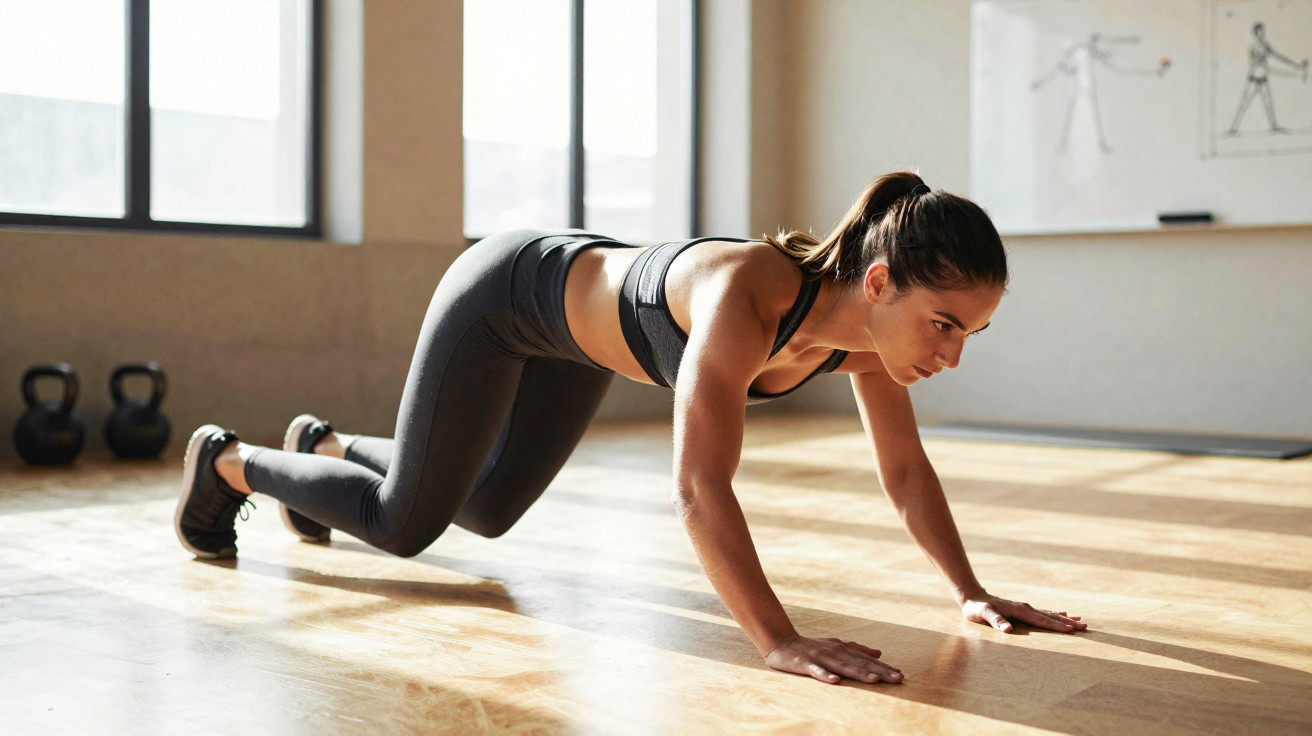
The bear crawl (also known as the bear walk) is a bodyweight exercise that simultaneously tests strength, stability, and motor control. In this movement, your hands and feet stay on the floor while your knees hover off the ground, and your abdominals, lower back, and shoulders work together to support you as you travel.
How do you do the bear crawl correctly?
The set-up looks like a tabletop position supported on four points. Place your hands directly under your shoulders, keep your knees under your hips, and rest on the balls of your feet. From there, lift your knees a few centimetres off the floor-without hiking your hips too high.
Move forward using short, deliberate steps, alternating opposite limbs. Step your right hand forward with your left foot, then your left hand with your right foot. To keep good alignment during the bear crawl, follow these cues:
- Keep your abdominals braced throughout the entire movement;
- Avoid swaying your hips from side to side;
- Share your weight evenly between hands and feet;
- Look down at the floor to keep your neck in a neutral line;
- Master short steps before trying to speed up.
Which muscles work during the bear crawl?
The bear crawl calls on multiple muscle groups because your body must hold up its own weight while moving. This whole-body integration is a hallmark of functional training, combining strength, balance, and coordination through movements in different planes. The main areas involved are:
- Abdominals and lower back, which stabilise the trunk;
- Shoulders and arms, which bear part of your bodyweight;
- Chest and back muscles, which control your support points;
- Glutes and quadriceps, used to keep the knees lifted;
- Calves and the muscles of the feet, engaged as you travel.
Why does the movement strengthen the core so much?
Your core has to stop the spine from sagging and the pelvis from rotating with every step. Even though your arms and legs are moving, the middle of the body must stay firm, creating a demand similar to what you feel in plank variations. In general, the slower you move, the more control is required.
This activation is not limited to the front of the abdomen. The obliques, transverse abdominis, lower-back muscles, and glutes work together to keep the hips parallel to the floor. That stabilising role helps explain why a few high-quality steps can feel tougher than rushing through a longer distance.
How does the bear crawl improve coordination between both sides of the body?
The cross-body pattern requires your right arm and left leg to travel together, followed by the opposite pair. This contralateral coordination also happens in walking and running, but it becomes more challenging when your body is close to the floor. If you are looking for other integrated movements, you may want to explore a bodyweight exercise that recruits several muscles at the same time.
In practice, certain mistakes reduce the coordination challenge and increase stress on the joints. The most common include:
- Moving the hand and foot on the same side forward at the same time;
- Lifting the hips too high and turning it into a regular walk;
- Taking long steps that disrupt posture;
- Letting the knees touch the floor between steps;
- Continuing the set after losing control of the trunk.
How do you add the exercise to your training without losing technique?
Beginners can start with short distances or sets of 15 to 20 seconds, resting before repeating. You can progress by gradually increasing time, distance, or changing the direction of travel. Crawling backwards or sideways makes it harder without needing any equipment-as long as the hips remain steady.
Let coordination set the intensity, not speed. Pain in the wrists, shoulders, or lower back is a sign to stop and reassess your form. When you keep the steps controlled, the knees hovering, and the trunk solid, the bear crawl combines muscular strength, stamina, and body awareness in a single exercise.



Comments
No comments yet. Be the first to comment!
Leave a Comment