
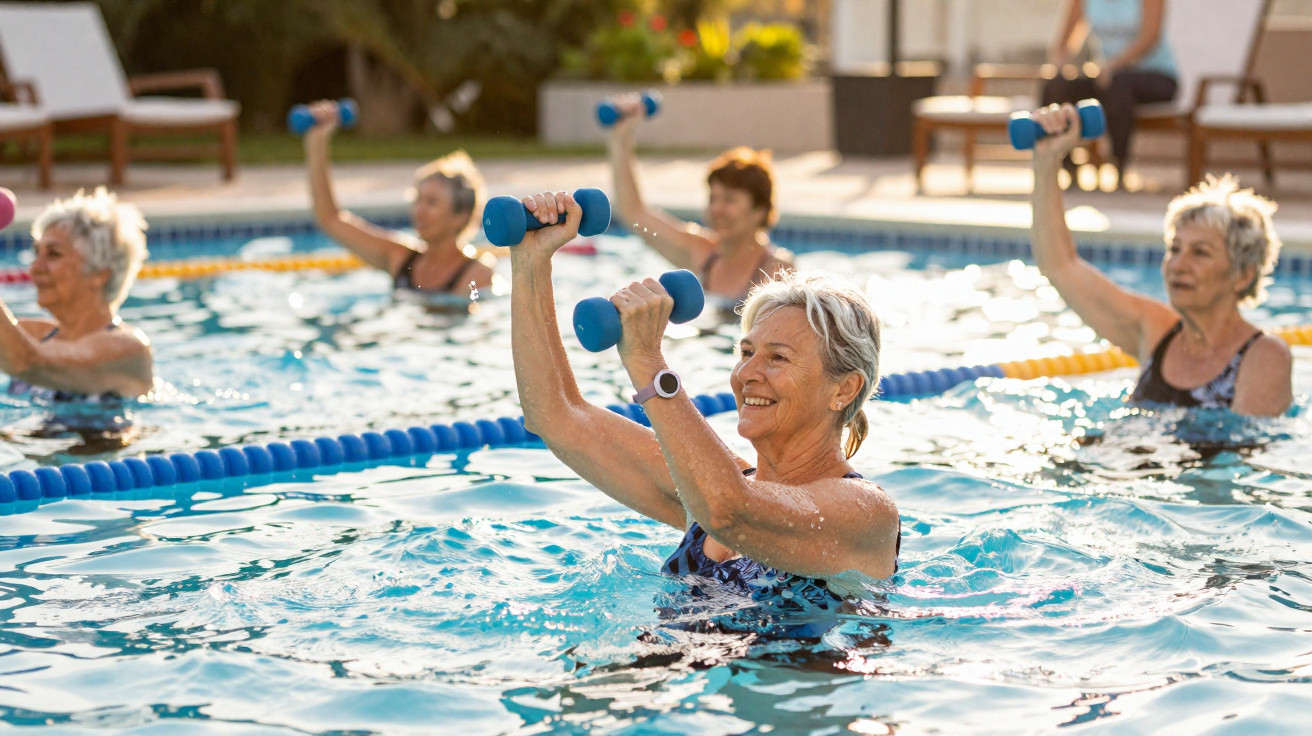
Water aerobics is one of the most suitable choices for anyone over 65 who wants to stay active without making joint pain worse. In the pool, the water lessens the impact on knees, hips and ankles, while its natural resistance supports muscle strengthening, better balance and renewed confidence in everyday movement.
Why does water aerobics protect the joints more effectively?
Water aerobics lowers the load of body weight because the water supports part of you. That means you can move your legs, arms and torso with reduced pressure on sensitive cartilage, tendons and ligaments.
If walking on hard pavements or climbing stairs triggers pain, exercising in a pool can feel like a safer setting. The water also slows sudden actions, which helps reduce the chance of twists and loss of balance during a class.
How does this exercise build strength without impact?
Because water resists every movement, muscles have to work throughout each step and reach-even without weights, dumbbells or equipment. Legs, glutes, abdomen, back and arms are all engaged through straightforward drills such as marching, pushing the water and lifting the knees.
- Legs develop strength through walking up and down the pool.
- The core works to keep the body steady in the water.
- Shoulders can move with less strain than they would outside the pool.
- Balance improves because posture needs constant adjustment.
- Circulation is encouraged by continuous movement and the water’s pressure.
Why might it be better than traditional weight training at this stage?
Weight training can be beneficial when properly supervised, but not every older adult with joint pain adapts well to machines, external loads or standing exercises for long periods. Water aerobics provides strengthening with lower impact and less fear of falling.
Consistency matters too. People living with osteoarthritis, stiffness or knee pain often stop workouts that increase discomfort in the first few sessions. In the pool, movement is usually easier to tolerate, making it more realistic to keep an active routine going for more weeks.
How to start safely at home or in a pool?
It is best to practise in a shallow pool, with the water level between waist and chest height, and with support close by at the pool edge. Anyone with severe pain, breathlessness, dizziness, recent surgery or heart disease should speak to a healthcare professional before starting.
- Start by walking slowly in the water for 5 minutes.
- Do gentle knee lifts, holding the pool edge if you need to.
- Move your arms by pushing the water forwards and out to the sides.
- Avoid jumps, fast turns and any movement that causes pain.
- Finish with slow steps and calm breathing for a few minutes.
What frequency helps you notice improvement in the first few weeks?
For beginners, two to three sessions a week can already improve energy levels, mobility and confidence when walking. Each session can begin with 20 to 30 minutes, then increase gradually as long as the body is not left with excessive pain the following day.
Progress should come from more time in the water and a wider range of movements, not from rushing. When water aerobics is done consistently, the pool environment makes it possible to strengthen supporting muscles, loosen stiff joints and stay active-without turning exercise into an ordeal.


Comments
No comments yet. Be the first to comment!
Leave a Comment