
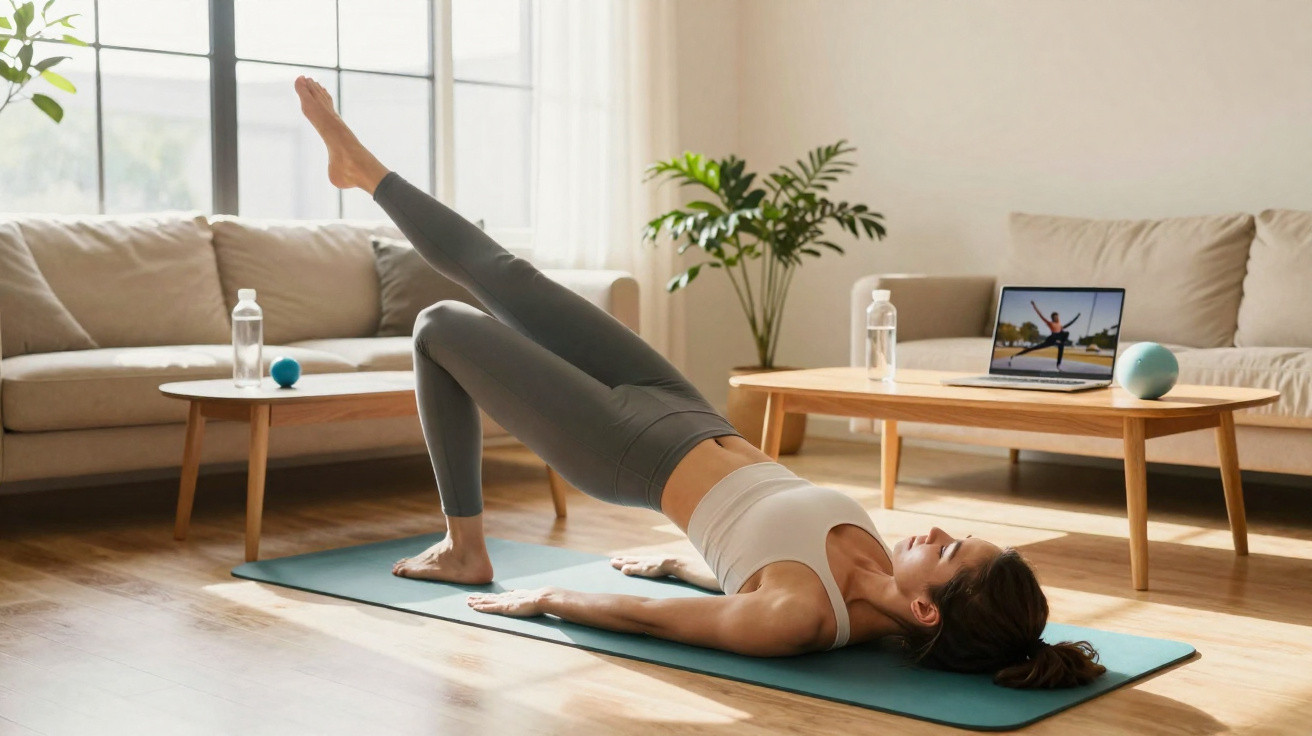
An experienced Pilates instructor swears by a short at-home routine that targets the deep abdominal muscles.
If you can barely fasten your jeans, feel bloated after meals, and sit-ups leave you with a stiff neck, it’s only a matter of time before you look for a gentler option. That’s exactly where Pilates comes in: less sweat-and-spectacle, more precise activation of the core. One coach has shared a straightforward sequence you can do at home which, in around three weeks, is said to lead to a noticeably flatter stomach - no gym, no equipment.
Why Pilates firms the stomach without wrecking your back
At the heart of the method is a distinction many people overlook: the visible abdominal muscles versus the deeper layer. When most of us think of ab training, we picture the rectus abdominis and the obliques - the muscles you see on six-pack photos. But the key contributor to a slimmer waist sits underneath: the transversus abdominis, often referred to simply as the “deep core”.
Pilates combines breathing and body alignment in a way that primarily activates the deep muscles of the abdomen and trunk - like an inner corset.
This “inner corset” supports the spine, eases strain on the lower back, and can help reduce a slight lower-belly bulge. When you deliberately exhale on each Pilates movement and gently draw the abdomen inwards, you’re not only working towards a narrower waist - you’re also improving posture and body awareness.
Coaches repeatedly highlight three fundamentals:
- exhale first, then gently draw the navel towards the spine
- only begin the movement once the centre is engaged
- choose a smaller range of motion rather than allowing an arched lower back or provoking neck pain
That exact approach underpins the at-home routine a Pilates expert recommends, built around five key exercises.
The 5-step routine for a flatter stomach
The instructor relies on a consistent set of five Pilates classics that feature again and again in her abdominal programme. Every exercise can be done on a mat in your living room.
1. Single Leg Stretch - an entry point for the deep core
In Pilates, this move is one of the first for learning how to sense and control your centre. It mainly challenges the transversus abdominis along with the obliques.
The basic idea: lie on your back and lift both legs. Draw one knee closer towards your upper body while extending the other leg slightly forwards. With each breath, you switch legs, keeping your abdomen flat and allowing the lower back to feel heavy against the mat.
Many people notice within just a few repetitions how hard the deep muscles have to work to keep the pelvis steady.
2. Double Leg Stretch - whole-body control instead of ab burnout
The Double Leg Stretch follows directly from the first exercise but raises the difficulty. Now both legs move at the same time, and the arms and shoulder girdle join in.
The challenge: you lengthen arms and legs away from the body, then bring them back to centre with control. Breathing stays calm, the abdomen remains gently drawn in, and the lumbar spine stays, quite literally, glued to the floor. This trains not only the abdominals, but also mobility through the shoulders and hips.
3. Double Leg Lower Lifts - targeting the lower abdomen
This move puts the often-frustrating area below the navel front and centre. Many people think of it as the “stubborn little belly” that seems immune to everything.
Double Leg Lower Lifts are considered one of the most effective Pilates exercises for the lower-abdominal area - provided the back stays stable.
Start lying on your back with both legs straight up in the air in a typical “V” position. As you exhale, lower the legs slowly by a small amount - only as far as you can while keeping the back neutral. Then lift them back up in a controlled way. A handful of clean reps will do more here than lots of fast, swingy ones.
4. Shoulder Bridge with Kick - glutes, core and abdominals working together
At first glance, the Shoulder Bridge with a leg kick looks like a glute exercise, but it places strong demands on the entire trunk. You lift the pelvis until knees, hips and shoulders form a line. Then you extend one leg up towards the ceiling and lower it again until it’s level with the other knee.
While the standing leg and glutes keep you steady, the abdominals have to continuously adjust so the pelvis doesn’t tip or twist. The result is a simultaneous workout for the posterior chain, the abdominals and the spinal extensors - an ideal combination for countering an excessive lower-back arch and a weak centre.
5. Scissors - mobile hips, an engaged centre
To finish, you do the classic “scissors”. Return to lying on your back with both legs straight in the air. One leg reaches upwards while the other lowers forwards and down without the back lifting off the mat. With small, quick actions, you draw the top leg fractionally closer, then swap.
The hips are mobilised as you go, while the abdomen stays under constant tension. That makes it far tougher than it looks at first glance.
How to fit the routine into everyday life
The coach suggests a clear sequence for a short session at home. The flow can look like this:
- Single Leg Stretch
- Double Leg Stretch
- Double Leg Lower Lifts
- Shoulder Bridge with Kick
- Scissors
To begin with, around eight to ten repetitions per exercise at a steady pace are enough. If you’ve had a long break or you know you’re prone to back issues, reduce the range of movement and start with six repetitions.
| Exercise | Area | Tip for beginners |
|---|---|---|
| Single Leg Stretch | Deep abdominals, posture | Keep your head on the floor if your neck feels tight |
| Double Leg Stretch | Whole abdominal wall | Only extend the arms halfway to maintain control |
| Double Leg Lower Lifts | Lower abdominals | Lower the legs only within a pain-free range |
| Shoulder Bridge with Kick | Glutes, posterior chain, trunk | Practise without the kick first, holding the bridge only |
| Scissors | Abdominals, hips | Slow the pace and focus on your breathing |
Many users report their first visible changes after around three weeks, provided they practise two to three times per week and keep day-to-day habits reasonably balanced. A flatter stomach doesn’t come purely from the mat - sleep, stress levels and diet all play a part.
Living room instead of studio: how Pilates works without equipment
One approach Pilates coaches recommend more and more is simply turning the living room into a studio. If you have a smooth floor, you can use basic socks or a small gliding pad to mimic certain Pilates Reformer-style movements. That way, you can add sliding actions for the legs and arms that intensify the session - without buying expensive equipment.
What matters is having a non-slip surface for the supporting foot, using bare feet for better grip, and setting a clear stop rule: the moment you feel unfamiliar, sharp pain in the back, knees or neck, you stop. Pilates should challenge you, not hurt you.
How often to train, from what age - and what to watch for
Most experts recommend doing this routine two to three times per week. The emphasis is less on clocking up huge repetition counts and more on executing each movement well. If you forget to breathe, fail to set the abdomen before moving, or drop into an arched lower back, you lose the effect and increase the risk of tightness.
People over 60 can benefit too, as long as they keep the movements smaller and, if needed, get medical advice - particularly with heart issues or chronic back conditions. A gentler version using shorter levers (for example, bent knees rather than straight legs) can be a good way to start.
What “deep abdominal muscles” actually help with in daily life
A flatter stomach can be a big motivator, but the real payoff goes further than appearance. A strong, deep-working core can:
- ease back pain by holding the spine more securely
- improve posture - shoulders away from the ears, chest more open
- make everyday movement safer, such as lifting shopping crates
- support the pelvic floor, which can be especially important after pregnancy or as you get older
If you already do endurance exercise such as running or cycling, you can add the Pilates routine two to three times a week. The combination of a stable core and an active cardiovascular system often does more for shape and wellbeing than any diet. The key is consistency - not perfect form or a long session.
Comments
No comments yet. Be the first to comment!
Leave a Comment