
There’s another way.
More and more people are turning their backs on the gym and moving their training into the living room. Not out of laziness, but because a well-planned routine with just ten simple exercises is enough to noticeably change your shape, strength and energy - with no equipment, no contract and no performance.
Why training at home suddenly works so well
Working out at home doesn’t just save time - it massively lowers the barrier to getting started in the first place. There’s no journey, no pressure to look perfect, and no sense that everyone is watching. That’s often what makes the difference.
"The key isn’t the toughest workout, but the session you actually do - and do regularly."
In real life, many gym memberships fail for predictable reasons: not enough time, bad weather, crowded rooms, and feeling drained after work. At home, the maths looks different: put on something comfortable, slide the coffee table aside, find ten minutes - that’s enough to begin.
How less effort leads to more consistency
Motivation is like fresh groceries: it goes off quickly. If you have to drive through the rain, hunt for a parking space and endure the changing rooms, your mood can collapse before the first set.
Home training removes that mental baggage. Starting is designed to be as easy as possible. And that’s how routines form - which is exactly what produces results:
- You can make use of short gaps of 10–15 minutes.
- You train more often instead of saving everything for one monster session.
- You can adjust intensity and duration on the fly to suit your day.
Consistency beats perfection. Three straightforward sessions a week do more for body fat, muscle and wellbeing than a heroic hardcore workout once a fortnight.
Why bodyweight exercises are so effective
A lot of people underestimate training without equipment. In reality, your bodyweight acts like a natural multi-gym: the movements are practical, and they challenge several muscle groups at the same time.
Instead of isolating your biceps on a machine, functional exercises constantly ask your body to stabilise through the core, hips and shoulders. That builds better balance, coordination and day-to-day strength.
"The aim isn’t just a nicer look in the mirror, but a body that can carry you - when you’re hauling shopping bags, playing with children, or getting up from the floor."
If you train regularly with your own bodyweight, you benefit from:
- a stronger core and fewer back niggles
- improved posture thanks to trained back muscles
- more stable joints through active muscles around the knees, hips and shoulders
- generally better mobility and body control
The 10-Circle: How to turn your living room into a training space
The programme below covers all the key muscle groups. You only need a little floor space and comfortable clothing. Begin with one round, then build up over time to two to three circuits.
Block 1: Legs and pulse - the foundation
Start by getting the lower body working and your heart rate up.
| Exercise | Target | Beginner guideline |
|---|---|---|
| Squats | Thighs, glutes, core | 10–15 repetitions |
| Reverse lunges | Legs, balance | 8–10 per side |
| High knees on the spot | Cardiovascular fitness, hip mobility | 30–40 seconds |
| Glute bridge | Glutes, lower back | 12–15 repetitions |
| Side steps or star jumps | Full body, endurance | 30 seconds |
How to perform the key lower-body moves with good form
Squat: Stand with feet roughly shoulder-width apart, toes slightly turned out. Sit back as if you’re lowering onto a chair. Keep the weight through your heels, brace your torso and look ahead. Only go as low as feels comfortable - never push into knee pain.
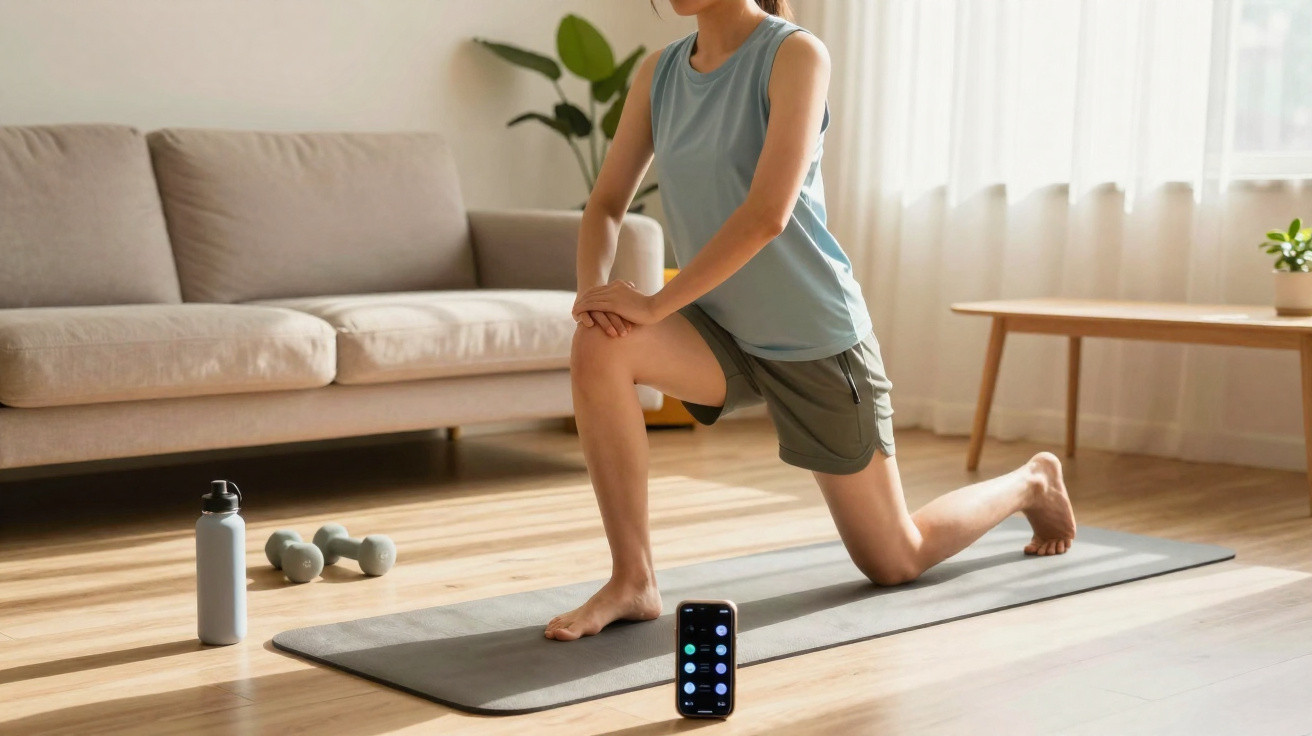
Reverse lunge: From standing, step back in a long stride and lower the back knee towards the floor. Keep the front knee stacked above the foot rather than drifting past it. Press back up and switch legs.
High knees: Alternate drawing your knees up towards your chest while standing on the spot. Match the pace to your breathing: if you feel fresh, run quickly on the spot; if you’re new, lift your knees more slowly and with control.
Glute bridge: Lie on your back with your feet planted close to your bottom. Drive your hips up firmly until knees, hips and shoulders form a straight line. Hold briefly at the top, then lower under control.
Block 2: Core and upper body - the stability centre
Now the focus shifts to the upper body, with emphasis on core tension and posture.
- Forearm plank - keeps your midsection stable
- Press-ups - chest, shoulders, arms
- Superman - back muscles, glutes, posterior chain
- Chair-edge dips - triceps, shoulders
- Mountain climber - abs, shoulders, cardiovascular work
Do it properly rather than pushing too hard
Forearm plank: Place your forearms under your shoulders and extend your legs. Your body should form a straight line. Brace your abs and don’t let your hips sag. It’s better to hold 15–20 seconds with perfect form than a minute with a hollow lower back.
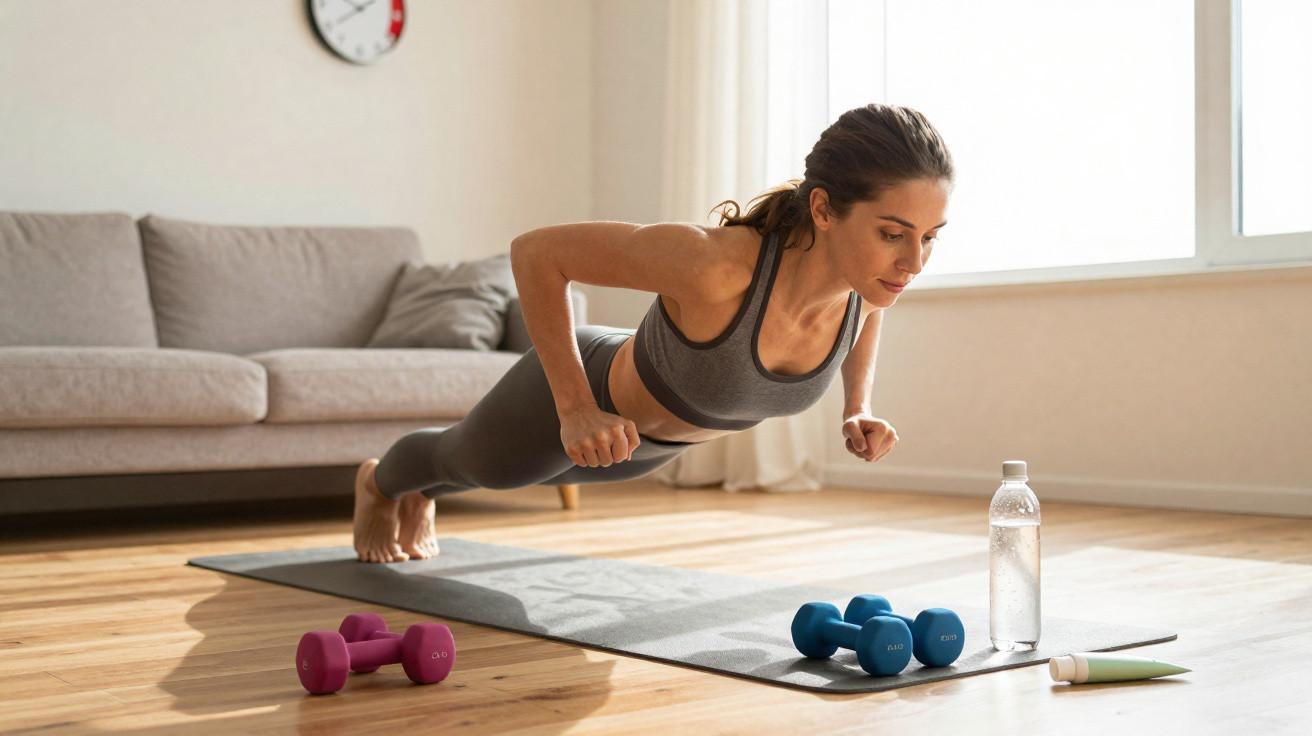
Press-ups: If a full press-up is too much at first, begin against a wall or with knees on the floor. Hands slightly wider than shoulder-width, lower your chest until your nose is close to the floor, then press strongly back up.
Superman: Lie on your front with arms stretched forward, then gently lift arms, chest and legs - without overdoing it. Hold briefly, then lower slowly. Great for countering the typical desk-worker rounded upper back.
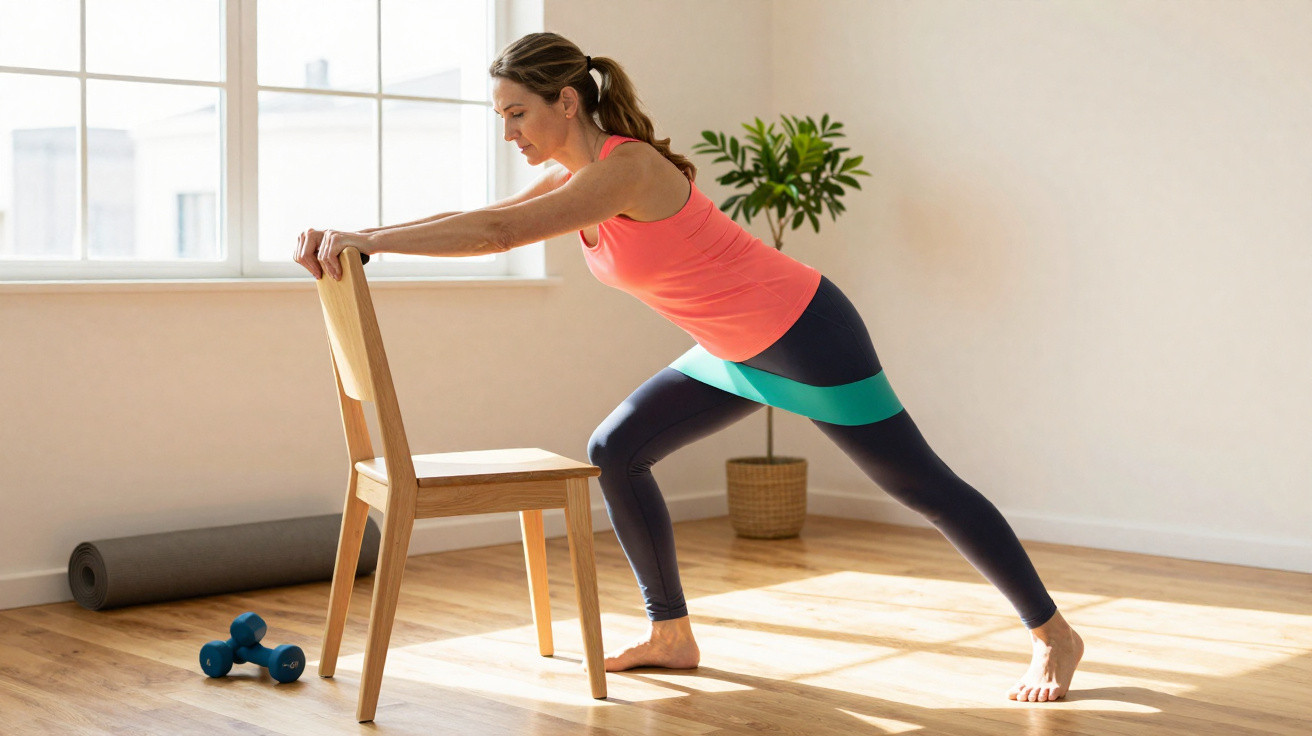
Chair-edge dips: Push a chair against a wall, place your hands on the edge and step your feet forward. Move your hips just in front of the chair, bend your arms until your elbows reach roughly 90 degrees, then press back up.
Mountain climber: From a press-up position, alternately drive one knee towards your chest. Let your breathing and strength set the pace. This one is tougher than it looks - increase gradually.
How to fit the programme around your day
Think of the ten exercises as a modular toolkit. You don’t have to do all of them every day - what matters most is keeping a steady rhythm.
"Three sessions a week of 15–20 minutes will change more in a few months than you believe right now."
Practical options for different kinds of day
- Quick morning round: just Block 1 or Block 2, but a bit more intense
- After-work reset: all ten exercises, but with fewer repetitions
- Weekend plus: two circuits, with a one- to two-minute break between them
As you progress, you can make the work harder by slowing the pace and extending time under tension: for instance, lower slowly into the squat, hold for two seconds at the bottom, then stand up explosively. Small tempo changes are enough to keep your muscles challenged.
Staying motivated: tricks that genuinely help
A plan on paper is one thing; sticking with it is another. Especially at the beginning, a few levers make a big difference:
- Fixed time: better to train for 15 minutes every day at 19:00 than to aim for “30 minutes sometime today”.
- Mini goal: for example, at least two sessions per week for four weeks - no more and no less.
- Track progress: date, exercises, repetitions. After a month, you’ll see in black and white what has changed.
- Ritual: same music, same kit, same order. The less thinking you have to do, the easier it is to start.
What to watch for - health, limits, progression
If you haven’t trained for a long time or you have health concerns, start gently and seek medical advice if in doubt. Joint pain is a warning sign: adjust your angles, shorten the movement, or switch to an alternative.
A positive muscle burn is normal; sharp or pulling pain isn’t. With the back, knees and shoulders in particular, it’s worth choosing an easier version and prioritising clean technique.
Worth knowing: even three months of light, consistent bodyweight training can clearly improve blood pressure, sleep quality and stress levels. If you add short walks or cycling, you give your heart and circulation a double boost.
In the end, what matters isn’t how “sporty” your training looks to someone else. What counts is finishing the session feeling more alert, more stable and a little prouder - and still wanting to do those ten simple living-room movements again tomorrow.



Comments
No comments yet. Be the first to comment!
Leave a Comment