
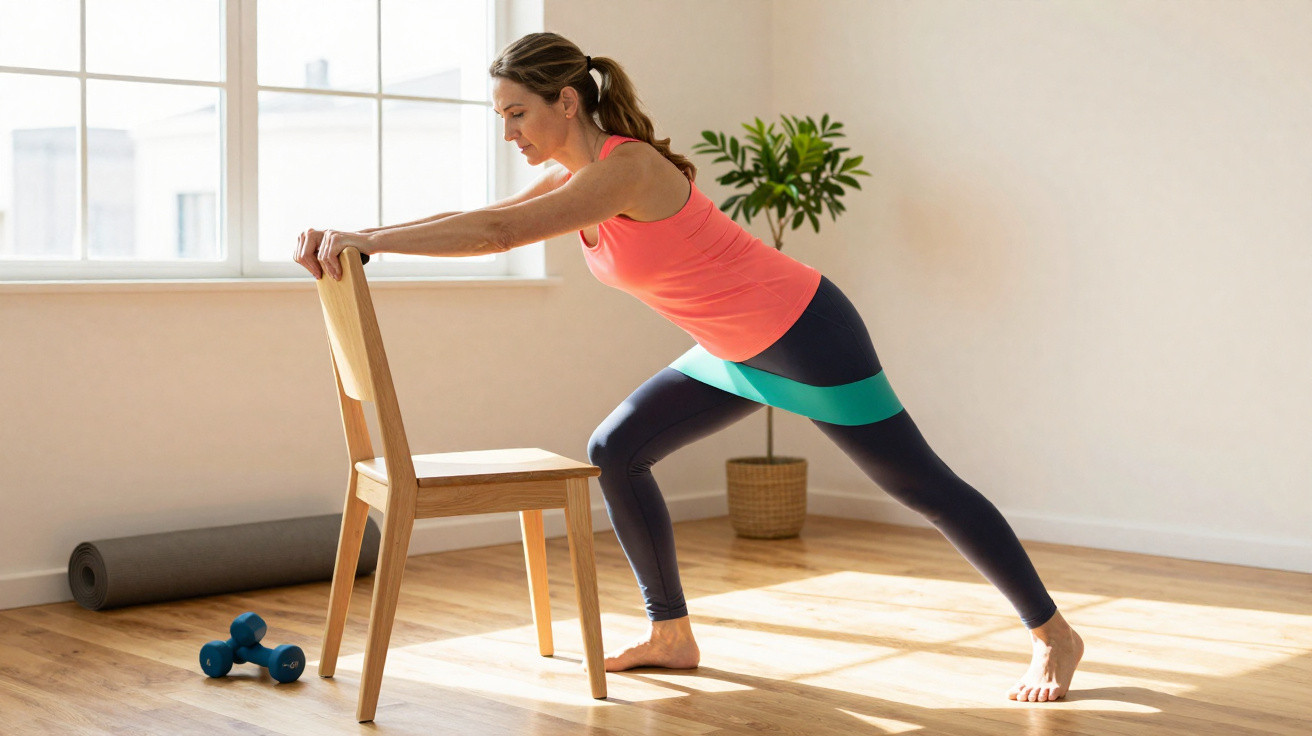
After the age of 50, many people look for ways to build stronger legs without putting excessive strain on the knees, hips and spine. Elastic resistance bands stand out as a straightforward, low-cost option that’s easy to store, allowing you to train strength, balance and stability with less joint impact than heavier weights or high-impact activities.
Why use elastic bands to strengthen legs after 50?
Elastic bands provide progressive resistance: the more you stretch them, the harder your muscles have to work, without the sudden “jolt” that can come with fixed, rigid loads. This is particularly helpful if you’re returning to exercise, dealing with joint discomfort, or aiming to maintain mobility and day-to-day independence.
Another advantage is how adaptable they are. With a single band, you can move forwards, backwards, sideways and through rotation, engaging thighs, calves and glutes in a more all-round way. As a result, everyday actions such as climbing stairs, getting up from a chair and walking with good stability can feel safer, with a lower risk of falls than when using tall machines or very heavy dumbbells.
Watch a video on the YouTube channel Treino em Foco covering effective mini-band and elastic band exercises to strengthen legs with complete joint safety:
https://www.youtube.com/watch?v=G3w7B8n9M_U
How do the main elastic band exercises work the leg muscles?
Leg exercises with elastic bands are easy to follow yet effective. For instance, a squat with the band positioned just above the knees makes the glutes work harder to stop the knees collapsing inwards, supporting better alignment and helping to protect the joints.
A seated knee extension with the band anchored behind the chair strengthens the quadriceps, which are crucial for controlling your descent when sitting down and for climbing steps with confidence. Meanwhile, hip abduction (side leg raises) and band work for the calves reinforce muscles that stabilise the pelvis during walking, help drive each step forward, and can also encourage blood circulation in the legs.
Which elastic band exercises deliver the best results for legs?
Many professionals place emphasis on functional movements-exercises that mirror what you do in everyday life. The focus is often on training the legs and hips together, supporting balance and helping protect the joints in typical daily situations.
Below are some widely used examples with leg resistance bands:
- Squat with band above the knees – targets thighs, glutes and the core stabilising muscles.
- Lateral steps with band around the ankles – strengthens the hips and improves steadiness during walking.
- Standing side leg raise – emphasises the gluteus medius and minimus, which are important for pelvic balance.
- Seated knee extension – builds the quadriceps, key for standing up and sitting down with control.
- Standing knee flexion – works the back of the thigh (hamstrings), useful for climbing steps.
How to build and progress a safe at-home elastic band routine
If you prefer to train at home after 50, you can follow a simple routine two or three times a week, starting with light or medium bands. A brief warm-up-such as walking around the house or repeatedly rising up onto your toes-helps prepare the muscles and joints for effort.
Progress gradually: first increase repetitions and sets, then move to a stronger band or slightly shorten the band to raise tension. Aim for slow, controlled movements, breathe normally without holding your breath, stop if you feel sharp pain, and reduce the range of motion if your knees or hips feel sensitive. If you’ve had previous surgery, have advanced osteoarthritis, or live with other chronic conditions, it’s worth getting professional guidance to tailor band use and benefit from it safely.


Comments
No comments yet. Be the first to comment!
Leave a Comment