
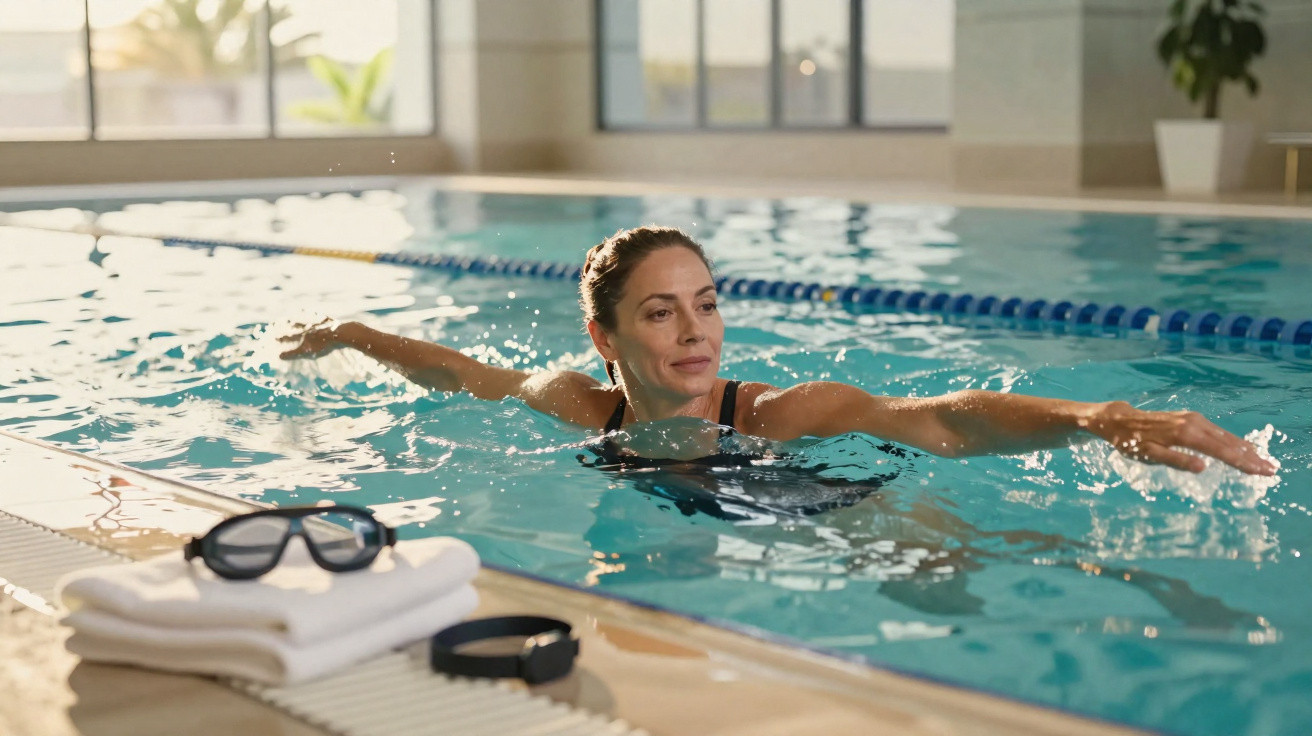
A slim woman with a grey plait glides past in a steady front crawl - no frantic strokes, no splashing. At the pool edge, a man in his 50s wipes the chlorine from his eyes, pulls his goggles back on and says to his mate: “I used to run; now I save my knees in the water.” They both laugh, though there’s a seriousness underneath it.
We know that blend well: your mind still feels 30, but your body starts sending different messages. After 40, exercise suddenly stops being a contest and becomes a negotiation with your joints. And that’s exactly where something genuinely interesting begins.
Why slow swimming after 40 suddenly makes so much sense
If you head to the pool after 40, you notice it quickly: the pace is no longer what it was on school swimming lanes. Most people settle into calm, even lengths; you can hear the breathing; the movements are almost meditative. That “easy” tempo isn’t a sign of weakness - it’s a quiet change of strategy. Your body starts asking for training that challenges it without punishing it. Joints, lower back, neck - all of them speak up more loudly than they used to. In the water, their objections suddenly feel muted.
An orthopaedic doctor in Cologne told me she almost automatically recommends slow swimming to patients over 40. No sprints, no wild butterfly experiments. “Just 30 to 40 minutes at an even pace, two to three times a week,” she says. A 47-year-old IT consultant I meet at the poolside backs that up with his own story: marathon running before, meniscus surgery now. His doctor banned running, so he ended up in the indoor pool, thoroughly fed up. Three months later, he talks about less knee pain, better numbers - and a resting heart rate he can feel proud of again.
Physiology makes it easy to understand. Depending on how deep you are, water supports up to 90% of your body weight. That takes pressure off the knees, hips and ankles while your muscles, heart and lungs still work properly. The repetitive movement helps stabilise the core without overloading it. Tendons and ligaments get mobilised rather than “tortured”. Slow swimming works like a full-body reset, where the joints get a seat at the table instead of interrupting uninvited as a pain signal.
How to use slow swimming as real joint training
The key is in the word “slow” - and for many people, that’s the hardest part. A joint-friendly water session starts at a pace where you can still exhale smoothly without gasping. Begin with 5 to 10 minutes of easing in - actually arriving: breaststroke or backstroke, relaxed strokes, attention on flow. Then do 3 blocks of 8–10 minutes at a steady, comfortable tempo, with 2 minutes of rest between them at the pool edge or by drifting very gently. Finish with 5 minutes of easy gliding. It sounds basic, but it feels surprisingly effective.
Many people over 40 step into the water with their heads full of old sporting myths: “No pain, no gain”, “If I’m not completely wiped out, it didn’t count.” That’s how you end up with tight shoulders, frantic breaststroke with your head held high, and that classic question: “Why do I get neck pain after swimming?” Let’s be honest: nobody swims perfectly every time, or follows a plan to the letter. The difference isn’t discipline; it’s being willing to drop the pace radically and listen to your body rather than your stopwatch.
A sports physician put it to me very bluntly in conversation:
“After 40, joints are like a long-term savings account. If you swim slowly in the water, you pay in. If you smash the pace, you withdraw.”
If you want slow swimming to genuinely act as a joint-saver, a few clear pointers help:
- Choose a pace where, after 10 lengths, you’re not panting - you simply feel like you’ve “done good work”.
- Keep it to a maximum of 2 strokes per session, so you don’t create unnecessary movement chaos.
- In breaststroke, bring your head as far into the water as you can to take strain off the neck.
- Once a week, prioritise technique over distance - short sessions, clean strokes.
- Plan at least one joint-friendly “day off” for your body between tougher sessions.
What slow swimming does to our minds - and our years ahead
If you swim slowly on a regular basis, you’ll notice after a few weeks that it isn’t only your joints that quieten down. Your sense of time shifts, too. The lane turns into a calm space - no phone, no screen - with just one clear rhythm: inhale, exhale, stroke, stroke, glide. Many people say the water is the first place in a long while where they feel “back with themselves”. Worries about work, caring for parents, teenage drama - they sit on the pool edge for half an hour. And as your thoughts settle, your body quietly follows.
What’s striking is how quickly your habits start to move. Once you’ve felt that your knees and hips complain less after a slow swim than after an attempt at jogging, you begin to do the maths differently: how much energy do I want to spend on performance, and how much on quality of life? Suddenly, the sentence “I’m going for a gentle swim tonight” doesn’t sound like an excuse - it sounds like a smart plan. And at some point, you realise you’re looking less at the fast swimmers in the next lane; the pressure to compare simply loses its grip.
Slow swimming after 40 is therefore far more than a fitness tip. It’s a quiet statement against the constant push to go higher, faster, further. Your body makes it very clear what no longer works - but in the water it also shows, just as clearly, what is still possible. If you accept those signals, you build not only muscle but trust: in your ability to adapt, in the joints you still need for many years, and in the right to see movement not as punishment, but as an ally.
| Key point | Detail | Benefit for the reader |
|---|---|---|
| Joint protection through buoyancy | Water reduces effective body weight by up to 90%, lowering pressure on knees, hips and the spine | Understand why slow swimming can be intense yet causes hardly any joint pain |
| Constant, moderate pace | Longer sessions in a calm rhythm train the heart, lungs and muscles without overload | A simple training principle that fits even a packed daily routine |
| Mental relief | Rhythmic movement and fewer stimuli in the water act like a “reset” for the mind | Motivation to stick with it because the mind benefits as well as the body |
FAQ:
- How often should I swim slowly after 40 for it to make a difference? For most people, 2–3 sessions per week of 30–45 minutes have a noticeable effect on joints and fitness. One session a week is better than none, but progress builds more slowly.
- Which swimming stroke is the most joint-friendly? Backstroke and front crawl are considered especially gentle on the knees and hips. Breaststroke can be fine if the kick isn’t exaggeratedly “frog-like” and the head isn’t held above the water the whole time.
- Can I really lose weight with slow swimming? Yes - if you swim regularly and keep your diet roughly in check. Slow, longer sessions burn calories reliably without leaving you feeling “destroyed”.
- I have osteoarthritis - is swimming still suitable? Many orthopaedic doctors explicitly recommend moderate swimming for osteoarthritis because the joints move without heavy impact. If you have acute pain, it’s worth having a quick chat with your doctor first.
- What should I do if I get out of breath quickly? Start with shorter blocks, for example 3–4 minutes swimming and 1–2 minutes rest. Build up gradually, and keep an eye on stroke quality rather than the number of lengths.


Comments
No comments yet. Be the first to comment!
Leave a Comment