
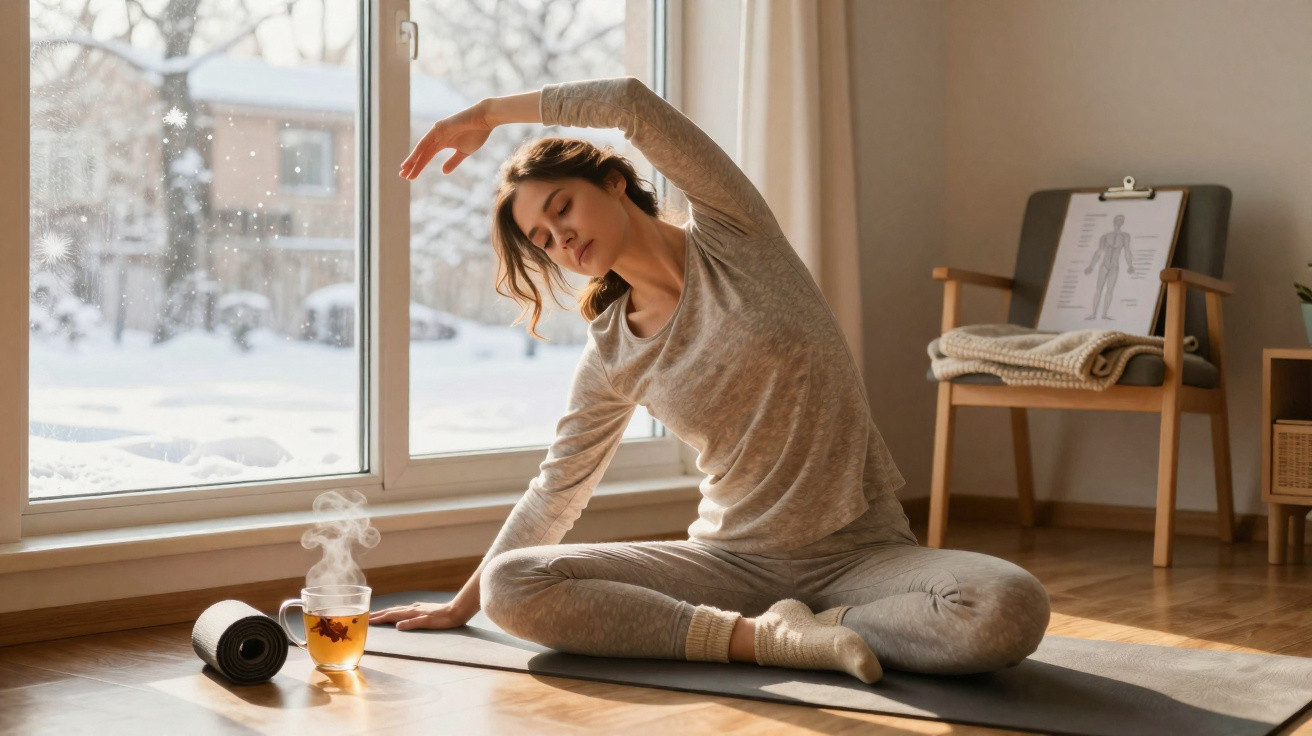
Waking up on cold days, many people instinctively stretch their bodies forcefully, assuming it will help ward off aches later on. Physiotherapists, however, point out that a cold, just-awakened muscle responds differently to intense effort, which can cause discomfort and may even aggravate existing pain-particularly in areas such as the spine and neck.
Can stretching as you wake up in the cold be harmful?
In low temperatures, peripheral circulation decreases and muscular stiffness increases. When muscles are cold, they are less elastic and tend to respond poorly to strong static stretches held for several seconds under high tension.
In this situation, the body can read an aggressive stretch as a threat and trigger the stretch reflex-a protective contraction that acts as a natural brake. The result may be a feeling of increased tightness, minor discomforts, and a worsening of pre-existing pain, especially for people with lower back pain, neck pain, tendinitis or herniated discs.
What is the difference between gentle morning mobility and stretching after exercise?
It is essential to distinguish light mobility on waking from stretching done after a walk or a training session. First thing in the morning, the aim is simply to “switch on” the body, stimulate circulation, and get joints and muscles ready for the day’s tasks-without forceful pulling.
After physical activity, the body is warmer and usually tolerates positions held for longer. Even so, physiotherapists registered with CREFITO advise that you should feel only mild tension-never severe pain, sharp twinges, or lingering discomfort that lasts for several hours after stretching.
How can you adapt stretching in cold weather to reduce risks?
If you want to keep the habit of stretching on cold days more safely, it is worth adjusting both intensity and the order of movements. The best approach is to prepare the body gradually, using small warm-up actions and mobility work before attempting broader stretches.
A few practical strategies can make this routine safer and more effective, especially in the morning:
- Warm up lightly before stretching by walking around the house or going up and down stairs for a few minutes.
- Choose dynamic back-and-forth movements, without pushing into ranges that cause pain.
- Respect your personal limits, rather than copying movements from videos without individual adaptation.
- Lower the intensity on very cold days, avoiding jerks and sudden, forceful stretches.
- Watch for warning signs such as sharp pain, stabbing sensations, or symptoms that worsen after stretching.
When is it important to seek guidance from a CREFITO-registered physiotherapist?
Support from a physiotherapist registered with CREFITO is particularly important when morning stretching is linked to recurring pain, a feeling of “locking up”, or a history of injuries. This professional can assess posture, movement patterns, joint stiffness, and muscular imbalances that may be made worse by intense stretching when you wake up in the cold.
From that assessment, the physiotherapist develops a personalised mobility, strengthening and stretching programme, tailored to each person’s routine, age and fitness level. In this way, stretching on waking stops being an automatic reflex and becomes a deliberate self-care strategy-helpful for reducing pain flare-ups and improving comfort throughout the day.






Comments
No comments yet. Be the first to comment!
Leave a Comment