
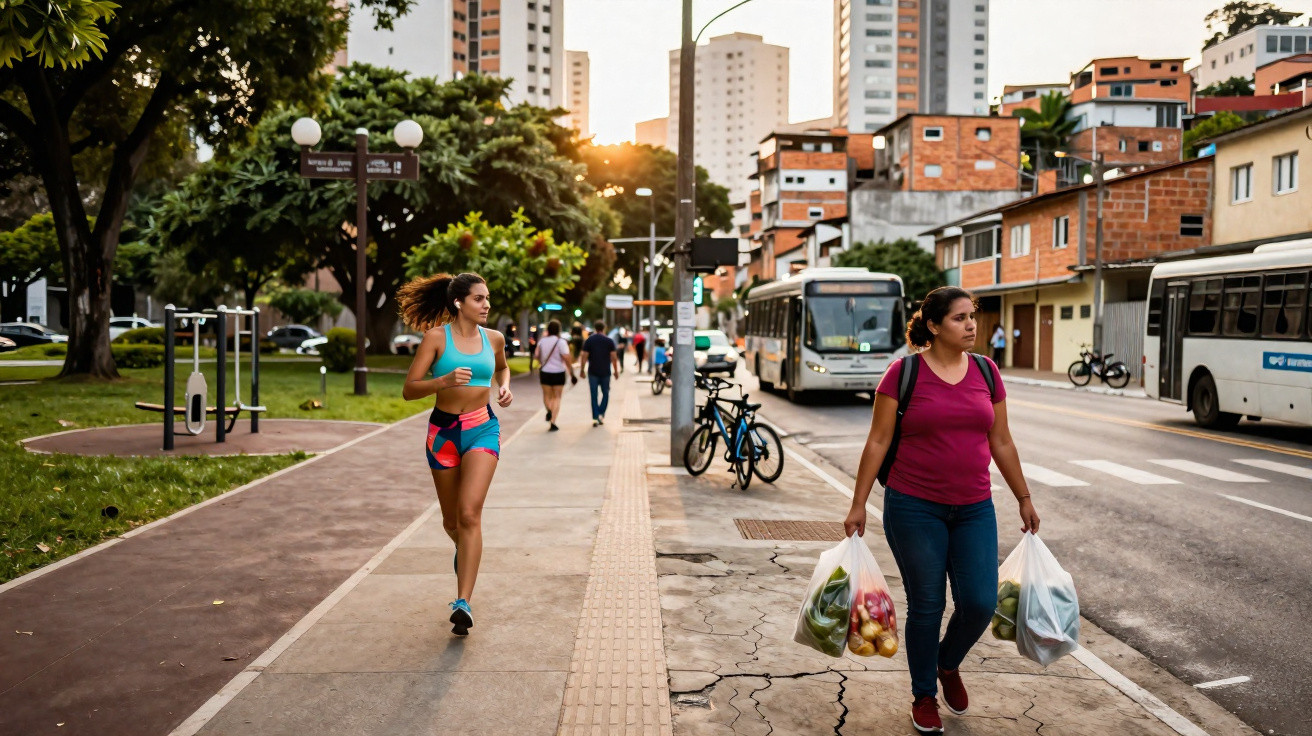
A ten-year investigation tracking residents of São Paulo has found that inequality in leisure-time exercise is increasing, with the divide between social groups continuing to grow.
Across the period, highly educated white men became even more active in their free time, whereas women of colour with lower levels of education consistently recorded the lowest levels of leisure-time physical activity.
By comparison, walking undertaken as part of getting from place to place was spread much more evenly across the population.
The research was conducted by scientists at the University of São Paulo (USP).
Researchers followed 978 participants from 2014 to 2024, gathering information at three distinct time points: 2014/15, 2020/21, and 2023/24.
The roots of exercise inequality
Although studies in the Global North have already explored how social conditions influence participation in sport and exercise, this project is notable as an early effort of its kind in its own setting.
The team focused on how overlapping social characteristics-described as intersectional social identities-shape people’s opportunities to be active over time.
Drawing on these results, the authors argue that policies designed to promote physical and recreational activity should focus first on those in the most vulnerable circumstances.
“We concluded that engaging in physical activity for leisure doesn’t depend solely on motivation or individual choice. It’s shaped by environmental, structural, and social factors,” said corresponding author Andreia Alexandra Machado Miranda, a nutritionist at USP.
“We found that inequalities persisted and the gap between groups widened over ten years of follow-up.”
“Unfortunately, this type of activity remains a privilege of the most socially advantaged groups, which we identified as white men with higher levels of education.”
“Conversely, the most vulnerable are Black, Brown, Asian, or Indigenous women with fewer years of schooling.”
Exercise depends on more than willpower
Florindo interpreted the results through the ecological model of physical activity, a framework used to pinpoint the drivers that influence whether people are able to exercise in practice.
“We work with the ecological model of physical activity, whose main objective is to explain it in terms of its determinants,” Florindo said.
“Engaging in it doesn’t depend solely on people’s willingness but also involves the experiences they may have throughout their lives.”
“There’s a significant gap between those who are able to engage in physical activity during their leisure time and those who aren’t, even if they want to.”
The figures show how large that divide became. In the first survey wave, leisure-time physical activity prevalence was 51 percent among highly educated white men, compared with 29 percent among the most vulnerable group.
By the third assessment phase, those values had risen to 65 percent and 39 percent, respectively-indicating that the difference between the groups widened across the decade.
Barriers keep women inactive
Miranda highlighted practical constraints that can make it harder for women to treat exercise as a priority.
“In addition to dealing with an unequal distribution of domestic work, they often earn lower wages and face a lack of safety when visiting public spaces.”
“Depending on the neighborhood where they live, especially in outlying areas, there’s a lack of urban infrastructure, poorly lit areas, and few open spaces.”
To reflect how these pressures overlap, the researchers used both face-to-face and remote interviews, applying the long version of the International Physical Activity Questionnaire alongside a Multiple Jeopardy Index.
This index combines information on sex, race or skin colour, and educational attainment into a single score ranging from 0, least vulnerable, to 4, most vulnerable.
Exercise as a public health issue
As well as improving physical and mental well-being in general, exercising regularly is associated with major health gains.
It lowers the likelihood of stroke and cardiovascular disease, supports weight management and the control of metabolic conditions such as diabetes, and helps maintain immune function.
The World Health Organization advises that adults should accumulate 150 to 300 minutes of moderate-intensity activity each week.
Alternatively, they may target 75 to 150 minutes of vigorous-intensity activity. Examples include walking, running, swimming, cycling, dancing, and team sports.
Even so, recent figures indicate that almost one third of adults globally-around 1.8 billion people-did not reach these minimum recommendations in 2022, the latest year with global data available.
Sedentary ways of life are associated with roughly 5 million deaths each year.
In Brazil, figures from the Ministry of Health show that 42.3 percent of adults achieved at least 150 minutes of moderate physical activity per week in 2024. The national target is to lift this proportion to 50.7 percent by 2030.
When separated by sex, the present rates are 47.7 percent for men and 37.9 percent for women.
Commuting levels the playing field
The researchers also looked specifically at walking used for transport, where the pattern contrasted sharply with leisure-time exercise.
They observed no significant relationship between the social vulnerability index and physical activity associated with commuting.
Across the study period, participation in walking for transport increased overall, moving from 61.8 percent in the first assessment to 71.6 percent by the third.
This form of activity was most frequent among young Black or mixed-race men with a high school education, a profile that differs markedly from the group that most dominates leisure-time exercise.
“It’s possible that factors such as access to public transportation, neighborhood characteristics, and socioeconomic conditions influence this type of commuting.”
“However, our study found no statistically significant association between the social vulnerability index and this type of physical activity.”
The authors add that commuting on foot can slot easily into everyday life. It also supports public health and can encourage greater use of public and shared transport rather than private cars.
The geography of exercise inequality
The initial sample for the project was drawn from the São Paulo Municipal Health Survey.
That survey collects information on health and service use to inform public policy. It later developed into the longitudinal ISA Physical Activity and Environment Study, which tracked the same population for an entire decade.
Participants were stratified across five health zones in São Paulo, a city characterised by marked socio-spatial inequality.
About 963,700 households-representing 22.5 percent of the city’s residents-are located in areas rated as having high or very high social vulnerability under the São Paulo Index of Social Vulnerability.
Although this was not the direct subject of the present study, previous research has shown that socially vulnerable neighbourhoods in São Paulo also experience greater exposure to heat islands.
This trend is concentrated in outlying eastern, northern, and southern zones, which are measurably warmer than other parts of the city.
Making exercise more accessible
Against this context, the authors stress the importance of joined-up public policies that advance health equity and broaden access to physical activity, in line with the United Nations Sustainable Development Goals.
Florindo cites São Paulo’s recent growth in cycle lanes as one example of a policy already producing measurable effects by prompting more residents to cycle.
In a separate study he led, the presence of a cycle lane within 500 m (1,640 feet) of a person’s home emerged as an important factor in encouraging cycling.
The team is continuing to analyse this dataset to explore additional variables linked to health and physical activity.




Comments
No comments yet. Be the first to comment!
Leave a Comment