
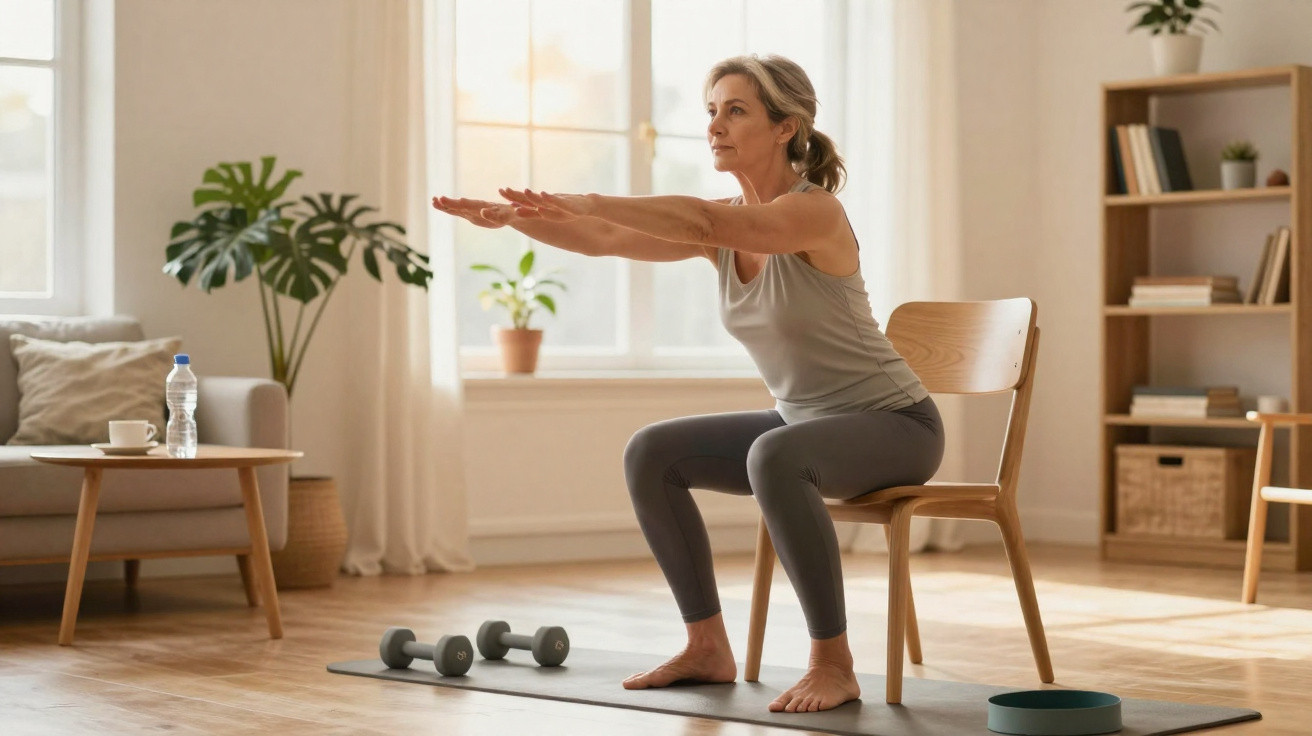
After turning 60, many people look for ways to build strength without relying on gym machines and, above all, without increasing their risk of injury. Among bodyweight options, physiotherapy and sports medicine specialists often highlight the chair squat as one of the safest, most complete and easiest movements to fit into everyday life, because it mirrors the daily act of sitting down and standing up.
Why is the chair squat so recommended after 60?
The best bodyweight exercise for those over 60 needs to be safe, straightforward to learn and able to strengthen multiple areas of the body at once. The chair squat meets these requirements by respecting each person’s individual range of movement, providing constant support, and allowing you to stop immediately-simply by staying seated.
From a muscular point of view, it works the quadriceps, glutes and the trunk stabilising muscles, which supports everyday tasks such as getting out of bed, climbing stairs and staying on your feet for longer. It also encourages circulation, helps maintain bone density and contributes to fall prevention-an especially important concern in this age group.
Watch a video on Prof. Bruno Giglio’s YouTube channel explaining why the squat is considered the main exercise for older adults.
How do you do the chair squat safely in everyday life?
To make the chair squat genuinely safe, a few basic precautions matter. Choose a sturdy chair with no wheels, ideally placed against a wall, and avoid a seat that is too low, as this can place excessive demand on the knees and hips. A brief warm-up-moving the ankles, knees and hips-helps prepare the joints.
Here is a simple step-by-step guide to perform the movement more confidently and effectively:
- Sit on the chair with your feet flat on the floor, about shoulder-width apart.
- Lean your torso slightly forwards while keeping your spine aligned, avoiding excessive rounding.
- Keep your knees in line with your feet, without allowing them to collapse inwards.
- Push through your feet and stand up until you are fully upright, squeezing your glutes at the end of the movement.
- Lower yourself in a controlled way, slowly bending the knees until you touch the chair again and sit down.
Your arms can be crossed in front of your chest, relaxed by your sides, or placed on the chair’s armrests if you need to reduce the load. If you feel unsteady, you can use a table or support in front of you purely for balance-without taking your bodyweight through your hands.
How can you adapt the chair squat for different levels?
The same movement can feel easy for some and challenging for others-and the good news is that it can be adjusted in several ways. The first adaptation is chair height: the higher the chair, the easier it is to stand and sit; the lower the chair, the greater the muscular demand and control required.
You can also manage the depth of the movement and the number of repetitions, making the exercise gentler or more demanding:
- Beginners or frailer individuals: use hand support on the chair, lower slowly, do 5 to 8 repetitions, 1 to 2 sets, with longer rest intervals.
- People with some experience: remove hand support, perform 8 to 12 repetitions, 2 to 3 sets, keeping the lowering phase very controlled.
- More advanced levels: pause for 2 to 3 seconds close to the seat before sitting, or lightly tap the chair and stand back up, increasing time under tension.
Another way to progress is by adjusting weekly frequency. In general, it is recommended to do the chair squat 2 to 3 times per week on alternating days, paying attention to how your body responds over the next 24 to 48 hours-particularly for people with a history of joint problems.
What precautions help prevent injuries when training with bodyweight after 60?
Even though it is a low-impact exercise, the chair squat still requires attention to your body’s signals. Sharp pain, a feeling of locking in the knee or hip, dizziness, or severe breathlessness are all reasons to stop the session. If you have advanced osteoarthritis, osteoporosis with previous fractures, or recent surgery, personalised guidance from a healthcare professional becomes even more important.
Small preventative habits make a difference: always start with fewer repetitions, avoid holding your breath, wear closed, non-slip footwear, and keep the area free from loose rugs or obstacles. When cleared by a doctor or physiotherapist, combining the chair squat with light walks and balance exercises can further improve strength, independence and confidence for day-to-day activities.





Comments
No comments yet. Be the first to comment!
Leave a Comment