
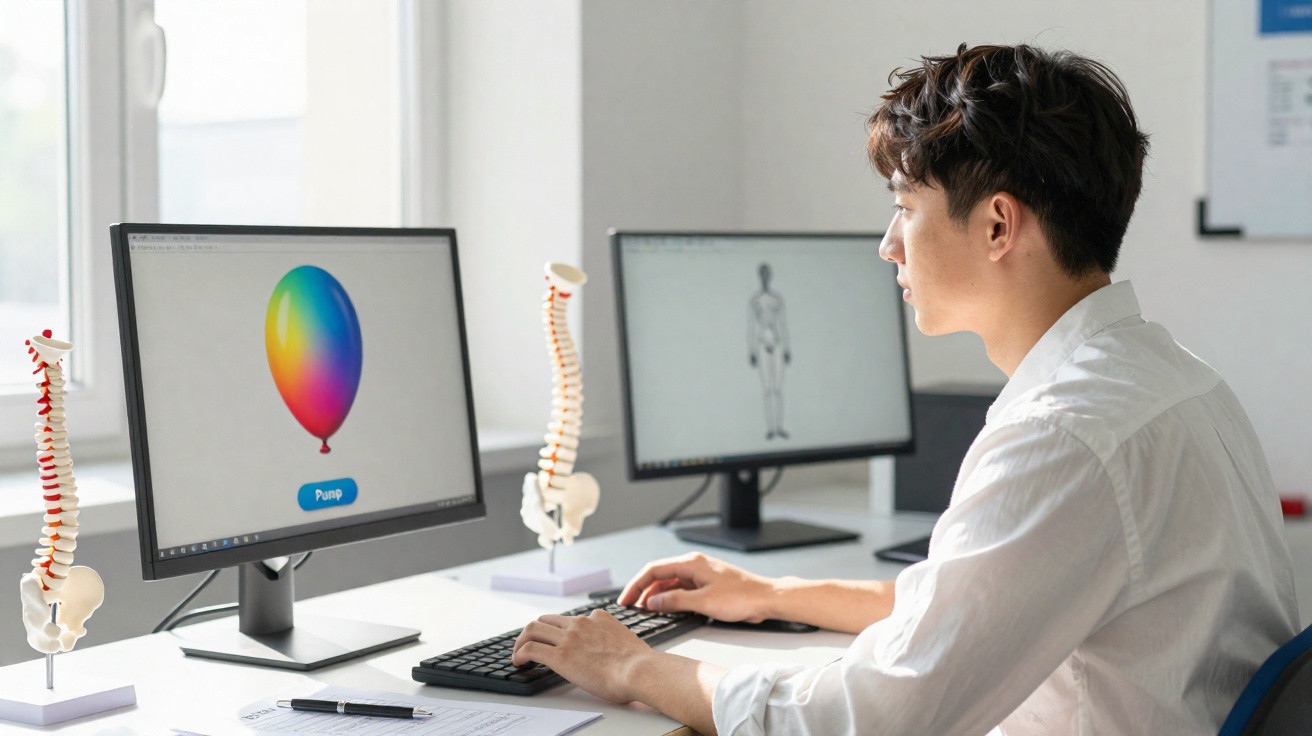
Your posture may be shaping your mood and the choices you make far more than you’d expect, and it can happen without you noticing.
A new study found that people who were seated upright did better on a risk-taking task.
Those participants also said they felt more positive than people who either slouched or sat in a typical position, despite the fact that none of them realised the room set-up had been used to steer their posture.
The work was led by Jorge Armony, a professor at McGill University, together with graduate student Soren Wainio-Theberge, who first proposed the project.
The results draw on data from nearly 200 participants, with an average age of about 20.
A cover story influencing body position
Armony and Wainio-Theberge recruited close to 200 people from the McGill community.
Participants first completed some preliminary tests on a computer screen. They were then asked to do what they were told was a new task on a tablet, presented as part of a supposed evaluation of a mobile app.
What actually mattered was where the tablet was placed. In one condition, the device sat on a stand on a raised, adjustable table, meaning participants had to sit up straight to keep the display at eye level.
In the other condition, the table was lowered and the tablet was set flat on the tabletop, encouraging participants to lean forward and hunch to see it properly.
No-one received instructions to sit in any particular way. Instead, the room arrangement did the work, and later video analysis confirmed the manipulation functioned as intended.
Participants in the upright condition maintained noticeably straighter neck angles during the task than those in the hunched condition. Even so, both groups reported that the posture felt similarly comfortable and required about the same effort to maintain.
The balloon analogue risk task
After being positioned, participants completed a widely used risk-taking measure known as the balloon analogue risk task. In this test, players earn small rewards by inflating a virtual balloon one pump at a time, but they lose everything if the balloon bursts.
Across the task, those seated upright consistently accepted greater risk and, on average, finished with larger rewards.
“This suggests they were not acting more impulsively but rather were engaging in more effective risk-taking,” Armony explained.
A comparison with a separate group who carried out the task at a standard desk indicated that the main driver was the upright posture itself, rather than slouching simply dragging performance down.
People in the upright condition also reported significantly stronger feelings of pride afterwards-an emotion associated with a positive mood-although the study did not find an equally clear change in arousal.
Solving a problem in posture research
The notion that posture can influence the mind is not new, and it has been argued about for years-particularly in work on so-called “power poses.”
However, that research has faced a recurring objection: if participants are instructed to adopt a specific pose, they may unconsciously produce the response they believe researchers want, which can cloud the findings.
The McGill team avoided that pitfall by never drawing attention to posture. Rather than giving directions, they relied on the physical set-up to nudge participants into a position without their awareness.
In post-experiment interviews, most participants said they had not noticed any attempt to alter how they were sitting.
The researchers also used video-tracking software to quantify each person’s neck angle throughout the task, providing a more precise indicator of actual posture than many earlier studies in this area had used.
Small effects, real implications
Adjusting the way you sit is not going to overhaul your life.
Even so, the findings highlight something worth noticing: everyday environmental details-such as desk height or the tilt and placement of a screen-may quietly influence mood and decision-making without people realising it, including in workplace ergonomics.
The researchers also point to limits on how widely the results can be applied.
Most participants were young women from a university community, so the findings may not automatically extend to older adults, different cultures, or samples that are more evenly balanced by gender.
That imbalance has an upside, however. Some accounts linking posture to dominance suggest the effects are largely a male phenomenon, and these results do not support that assumption.
If posture can shift behaviour even when people are unaware of it, then subtle features of everyday spaces may shape our psychology more than we think.
Standing desks, chair height, and where a screen sits relative to eye level may all matter. What remains unanswered is just how far that influence actually goes.



Comments
No comments yet. Be the first to comment!
Leave a Comment