
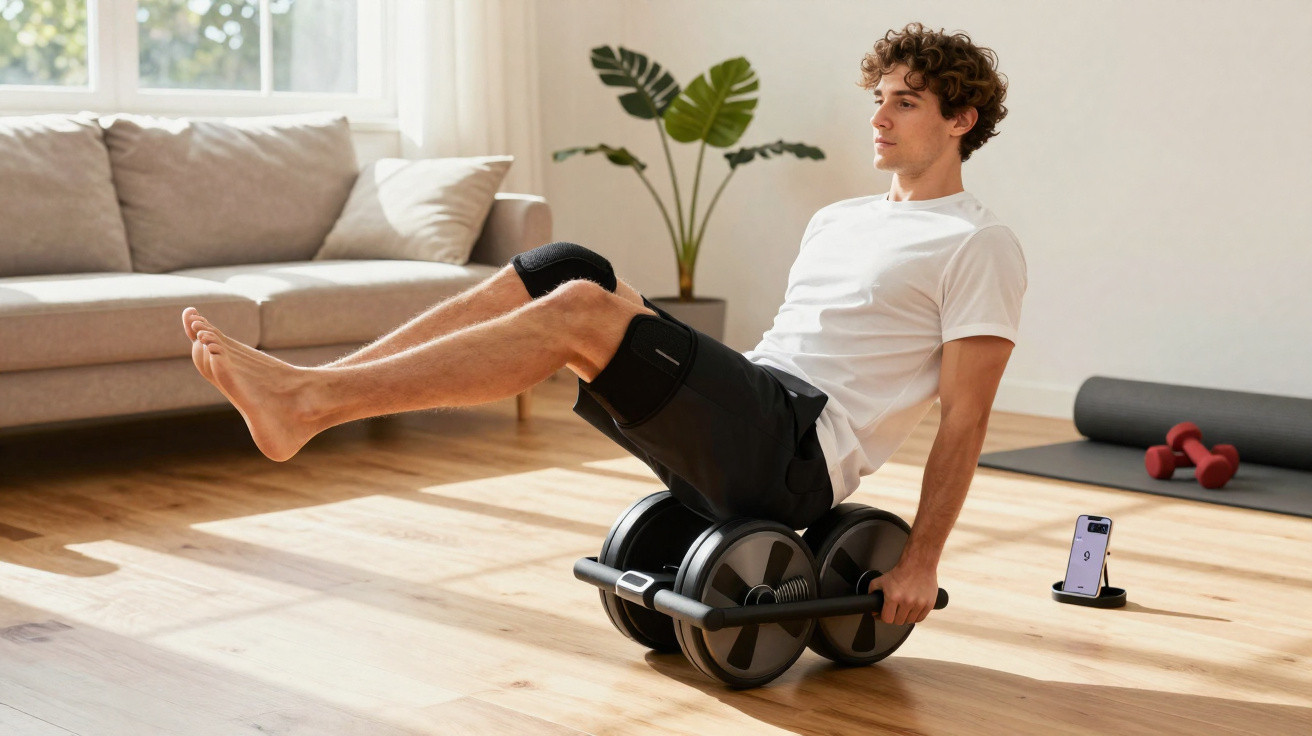
If you want to do something for your midsection after work, you often fall back on the old staples: sit-ups, planks, crunches on the living-room carpet. After a few days, your neck, shoulders or lower back start to complain - and your motivation disappears with them. A Decathlon training device costing around €60 claims to tackle exactly that problem: more effective ab exercises, fewer aches and pains, and a bit more enjoyment. It sounds like a marketing line, so it’s worth looking at what’s actually behind it.
What’s behind the new Decathlon ab trainer
At first glance it resembles a classic ab wheel, but the design has clearly been taken further. Instead of a single roller, it uses a compact frame with four wheels, and you support yourself on your forearms. Unlike the wobbly one-wheel models that can quickly turn into a slip-and-slide, the priority here is stability.
"The core of the concept: challenge the abdominal muscles as much as possible without putting unnecessary strain on the wrists, neck or lumbar spine."
It also comes with padded elbow rests. That shifts the pressure away from the wrists - a common drawback of many traditional ab wheels. And for anyone who spends most of the day at a desk or on their phone and already has sensitive wrists, that design choice is a real advantage.
Four wide wheels instead of a wobble-fest
Each of the four wheels is around 9 cm wide and finished with rubber strips. That brings several benefits at once:
- more grip on smooth floors such as laminate or parquet,
- less chance of slipping out from under you,
- kinder contact with the flooring,
- a steadier, more controlled roll forwards and back.
Because the wheels are wider, your weight is spread more evenly. Anyone who has ever tipped unexpectedly on a narrow ab wheel knows how unpleasant that can be - especially for the shoulder joints and lower back. This Decathlon device removes some of the intimidation from a home-fitness classic.
Spring mechanism: help with the hardest part of the move
The interesting part is inside: there’s a built-in spring mechanism that assists the motion. As you roll forwards, your muscles work normally against gravity. When you roll back, the spring provides a gentle boost to help you return.
The return phase is often the sticking point with this exercise. If you overestimate your strength or roll too far forwards, it’s easy to yank yourself back using the lower back rather than the core. Over time, that can lead to tightness or even injury. The spring is designed to reduce that risk - without turning the exercise into a soft option.
"The spring takes some of the load, but leaves enough resistance so the abs and core still have to work hard."
How strong the effect feels also depends on how far you roll. Beginners can keep the movement closer in; more experienced users can travel much further forwards until the abdominal muscles really start to burn.
Designed for beginners and fitness pros alike
Decathlon is clearly positioning the device for a wide range of people. If you’re new to training, you can start cautiously thanks to the stable platform and the spring assistance. The movement is more guided, and the chance of collapsing into an exaggerated arch in the lower back drops noticeably.
At the same time, trained athletes still have plenty of room to push themselves. They can increase the range of motion, hold the end position longer, or simply add more repetitions. The pattern stays the same; you control intensity through reach and tempo.
More than just “ab exercises”
One detail many people underestimate: rolling movements like this don’t only work the visible “six-pack”. They also recruit:
- the deep abdominal muscles,
- the obliques,
- muscles around the lumbar spine,
- the shoulder girdle and chest muscles.
Sports medicine tends to talk about the “core”. A strong core supports the spine, reduces strain on the back, and can improve posture. So if you sit a lot or regularly deal with back discomfort, the benefits of this type of training can go beyond appearance.
Electronics on board: counter, battery and smartphone holder
To make workouts easier to track, Decathlon has added a small LCD counter. It shows, among other things:
- number of repetitions,
- elapsed training time,
- estimated calories.
It’s not revolutionary tech, but it can make a difference day to day by keeping you organised. Seeing progress in black and white makes it easier to stick with it. The built-in battery charges via a USB‑C cable, which is included. That suits anyone already charging everything through the same connector - phone, headphones, tablet.
There’s also a practical phone holder. You can position your mobile so you can follow workout videos, online programmes, or simply play a playlist, without leaving your device lying loose on the floor. For people who like guided sessions, it’s a helpful touch.
Comfort details: knee pad and living-room suitability
A soft knee pad is included, and on hard surfaces it makes a noticeable difference. Anyone who trains on tiles or a thin carpet will recognise the issue: after ten minutes, your knees can hurt more than your abs. With an extra pad, that excuse is neatly removed.
On top of that, the rubber on the wheels makes it quieter and gentler to use in the living room. After a long day, nobody wants loud rolling noises disturbing the neighbours - or scratches carved into a parquet floor.
Is this device enough to lose belly fat?
As appealing as it sounds, a single piece of kit won’t make belly fat vanish. Professional bodies repeatedly point out that visible fat loss around the midsection mainly comes down to three things:
- regular movement that includes both strength and endurance,
- a calorie-aware diet based mostly on fresh foods,
- enough sleep and as little chronic stress as possible.
Your body also decides for itself which fat stores it reduces first. Targeting “just the belly” doesn’t work biologically. What the Decathlon device can do is make it easier to start core strength work, make progress measurable, and reduce stress on sensitive areas such as the neck and wrists.
"Anyone who uses the device consistently builds muscle, improves posture and increases energy expenditure - which supports any form of weight loss."
Who it’s worth buying for - and who should pass
The device is particularly appealing for people who:
- want a straightforward way to train at home,
- get neck or back pain from classic crunches,
- struggle with loading the wrists,
- like seeing their progress as numbers.
It’s less suitable for anyone with acute back issues, slipped discs, or shoulder injuries. In those situations, any new training stimulus should be discussed first with a doctor or physiotherapist.
How to integrate the training sensibly
A realistic beginner set-up could look like this:
- 2–3 sessions per week,
- 3 sets of 8–10 controlled repetitions,
- 60–90 seconds rest between sets,
- over the weeks, gradually increase repetitions or range of motion.
If you pair that with simple moves such as squats, lunges and press-ups, you end up with a small full-body routine at home that doesn’t rely on lots of gym equipment.
If you’ve been training for a while, you could add the Decathlon device at the end of your session as a “finisher” to target the core one last time. In that case, longer holds in the far-forward rolled position can work especially well - it really hits the deep muscles.
Ultimately, the €60 device won’t replace personal effort or healthy habits, but it can be the missing piece that makes at-home training easier to stick with. In particular, anyone who previously gave up due to pain or insecurity with the movement gets a tool that reduces many common stumbling blocks - and that can be what determines whether a good intention fades after three days or finally becomes a routine.

Comments
No comments yet. Be the first to comment!
Leave a Comment