
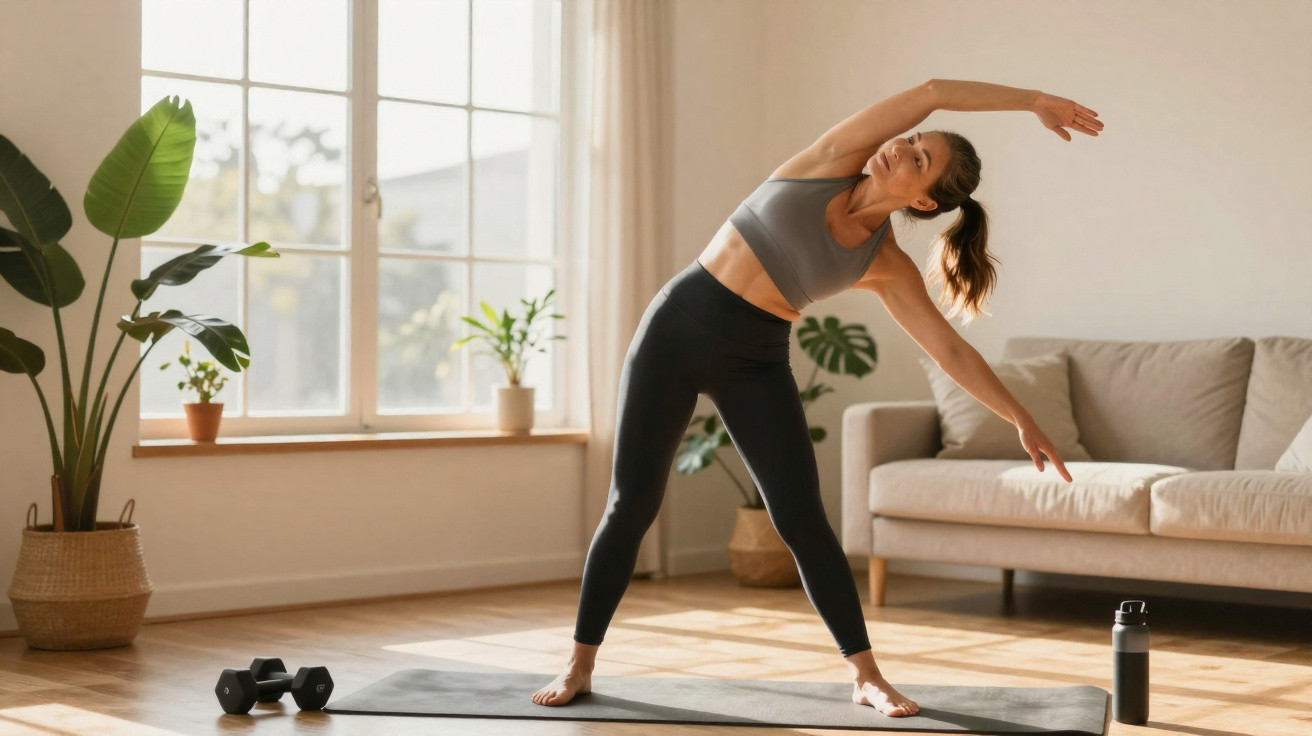
Keeping your abdomen strong after 50 is one of the biggest contributors to mobility, balance, and overall quality of life. While many people link abdominal training purely to appearance, the truth is that simple, consistent exercises can deliver clear benefits for posture, body stability, and independence in everyday tasks. Among the most approachable options, the standing twist stands out as a practical and effective way to work the abdominal area.
Why strengthen the abdomen after 50?
As we get older, there is a natural decline in muscle mass, which can reduce stability and raise the risk of falls. That is why building strength through the body’s central area becomes an important way to maintain function and wellbeing.
Beyond helping you look more toned, the abdominal muscles play a direct role in supporting the spine, maintaining good posture, and enabling day-to-day movements. A stronger abdomen can make a wide range of activities feel safer and more comfortable.
How to perform the standing twist correctly
The standing twist is straightforward, but it requires careful attention to posture so the movement is done effectively. Correct form helps engage the abdominal muscles and limits unnecessary compensation.
Before you begin, brace your abdomen, set your feet hip-width apart (roughly shoulder-width), and keep your gaze forwards. To do the exercise safely, follow these steps:
- Stand with your feet spaced shoulder-width apart.
- Reach your arms straight out in front of your body.
- Keep your abdomen engaged for the entire set.
- Rotate your arms quickly to the left and to the right.
- Keep your torso steady and your eyes looking straight ahead.
- Complete 25 repetitions for three sets.
How often should the workout be done?
Consistency is one of the key factors in achieving lasting results. Doing a hard session now and then is not enough; progress comes when the exercise becomes a regular part of your routine.
International recommendations point to combining aerobic activity with muscle-strengthening exercise. Walking, swimming, cycling, and targeted strength work can all complement abdominal training very well.
Which habits maximise results?
Abdominal strengthening depends on more than one factor. Exercise matters, but the benefits tend to be far more noticeable when it is paired with healthy, sustainable habits.
To understand in depth how to balance physical effort with how your body functions, it is worth checking the guidance from trainer @leandrotwin. In the video below, he challenges myths about age and explains how to align training, diet, and metabolism to achieve solid, long-lasting results.
What benefits can be noticed with continued practice?
When practised regularly, the standing twist can help increase abdominal muscle activation, supporting muscle definition and trunk stability. Improvements usually appear gradually, at a pace that suits each individual.
Alongside any aesthetic changes, many women notice better posture, smoother coordination, and more energy for daily tasks. With perseverance, discipline, and a balanced routine, this simple exercise can become a strong ally for health and quality of life after 50.
Comments
No comments yet. Be the first to comment!
Leave a Comment