
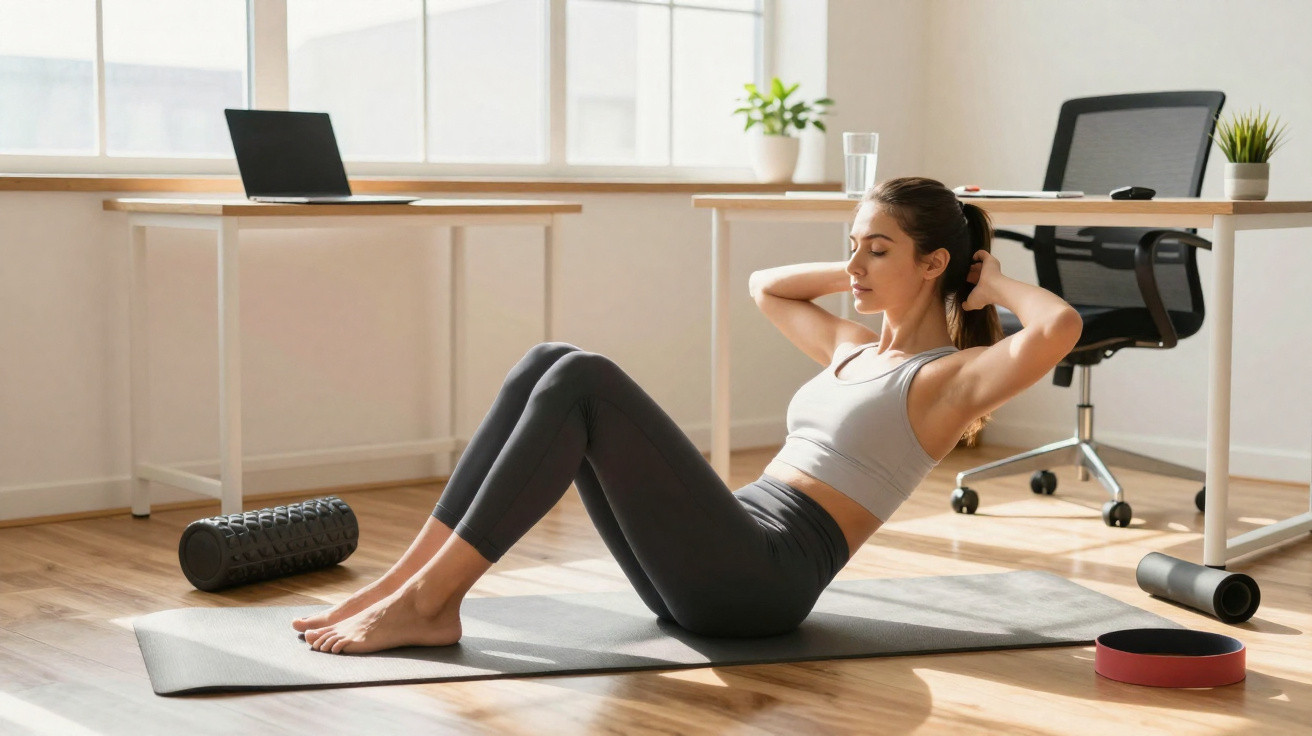
Spending long stretches seated in front of a computer has become everyday life for a large share of people. In that context, building a stronger core-the area spanning the abdominals, lower back, hips and pelvis-has increasingly been used as a practical way to ease aches, support better posture and feel more energised throughout the working day.
What is the core and why does it matter so much for people who work sitting down?
The core is made up of muscles around the middle of the body, including the rectus abdominis, obliques, transversus abdominis, lumbar paraspinals, glutes and part of the hip musculature. Together, they stabilise the spine and pelvis, providing a firm base so the arms and legs can move with greater control-particularly important if you spend hours at a desk.
When this region is underactive, rounded shoulders, a forward head position and increased neck tension often appear. Over time, that pattern is commonly linked to back pain, stiffness and feeling tired sooner. A straightforward core-focused routine can improve spinal alignment, help distribute load more evenly while sitting, and make the workday feel more comfortable.
Watch a video on the Treino em Foco YouTube channel about abdominal activation exercises and core strengthening that can help improve posture and avoid back pain:
https://www.youtube.com/watch?v=G3w7B8n9M_U
What are the five essential exercises to strengthen the core in day-to-day life?
Among the many movements you could choose, a few stand out for training the deeper trunk muscles with minimal equipment and very little space. Below are effective options for anyone who remains seated for much of the day, with an emphasis on spinal stability and postural control.
- Isometric floor plank: builds strength in the abdominals, lower back, shoulders and glutes by keeping the body aligned like a “plank”.
- Side plank: targets the obliques and improves lateral spinal stability-useful for reaching across your desk.
- Dead bug: pairs arm and leg movement while the lower back stays supported, developing control of the pelvis and lumbar area.
- Glute bridge: switches on the glutes and hamstrings, helping stabilise the pelvis and reduce stress on the lower back.
- Seated knee raises: done on a chair, works the abdominals and hip flexors-ideal for quick breaks at the office.
How to perform each exercise safely and with good posture?
How well you move matters more than how long each set lasts, especially if you already notice spinal discomfort. Keeping your breathing steady (without holding your breath) and setting your neck in line with your torso are simple adjustments that improve effectiveness and lower the chance of aggravating anything.
Isometric plank
- Place your forearms and toes on the floor, stacking shoulders over elbows.
- Keep a straight line through the body-don’t lift the hips too high or let them sag.
- Brace the abdominals and squeeze the glutes, breathing calmly.
- Hold for 15 to 30 seconds and repeat 2 to 3 times.
Side plank
- Lie on your side, support yourself on your forearm, and lift your hips until shoulder, hip and ankle form one line.
- Keep the core firm and the neck aligned with the spine.
- Hold for 15 to 30 seconds on each side.
Dead bug
- Lie on your back with hips and knees at 90 degrees and arms reaching up towards the ceiling.
- Press the lower back gently into the floor.
- Extend one leg and the opposite arm towards the floor at the same time, without losing lower-back contact.
- Alternate sides for 8 to 10 repetitions.
Glute bridge
- Lie on your back, bend your knees, and place your feet flat on the floor hip-width apart.
- Lift the hips until you form a line from shoulders to knees.
- At the top, tighten glutes and abdominals while keeping the lower back neutral.
- Hold for 2 seconds, then lower slowly, repeating 10 to 12 times.
Seated knee raises
- Sit on a chair with an upright spine and feet planted.
- Lightly hold the sides of the seat for stability.
- Lift one or both knees towards the chest without excessively rounding the shoulders.
- Return slowly and repeat 10 to 15 times.
How to fit core exercises into a work routine in a practical way?
If you sit for extended periods, consistency matters more than long sessions. A simple approach totals 10 to 15 minutes, 2 or 3 days per week, rotating through the five exercises and adding shorter “active break” versions during the workday.
One workable order is: isometric plank, dead bug, glute bridge, side plank and seated knee raises, with brief rests between sets. Support from a fitness professional or physiotherapist can help tailor the effort, respect limitations, and turn core care into a sustainable habit that protects the spine over the long term.


Comments
No comments yet. Be the first to comment!
Leave a Comment